
At 4:42 p.m. on Monday, a deal moves to Closed Won. Kickoff is Wednesday. The billing contact is missing, the contract contains one unusual promise, and the project system will reject its first update. Which AI belongs in that workflow?
The answer is not “whichever model wins a demo.” ChatGPT Work is the strongest first home for a substantial assignment whose route may change as evidence appears. A Workspace Agent packages a proven method for reuse inside an eligible managed ChatGPT workspace. Praxivara is the stronger fit when one or more operators need a continuing operational role—supported start conditions, bounded cross-system actions, approval, exception handling, and finished Deliveries—managed in one operating layer.
A naming and disclosure note, checked August 25, 2026: people still search for “ChatGPT Agent,” but OpenAI’s current documentation directs substantial delegated work to ChatGPT Work. OpenAI separately offers Workspace Agents for eligible managed ChatGPT workspaces; availability and capabilities are still evolving, so this comparison uses the product documentation available on August 25, 2026. Praxivara publishes this comparison. We acknowledge ChatGPT’s multi-step work, tools, files, schedules, reusable agents, and workspace controls; Praxivara earns the recommendation below on operating fit, not by pretending those capabilities do not exist.
The category mistake behind most AI-agent comparisons
Most comparisons begin with a feature checklist: browsing, models, files, integrations, schedules, memory. That is easy to scan and surprisingly poor at predicting what will work inside a company. Two products can check the same box while placing that capability in a completely different operating system.
A more useful starting point is to decide whether you are delegating an assignment, packaging a method, or staffing a role.
An assignment has an outcome, but the route can change
“Investigate whether we should enter the Canadian market and build the leadership brief” is an assignment. The researcher may discover a regulatory constraint, change the analysis, ask for another file, rebuild the model, and turn the result into a deck. The human expects to steer the work as new evidence appears. Once the brief is delivered and reviewed, the assignment is over.
This is the natural territory of ChatGPT Work: a broad workbench, flexible execution path, rich artifacts, and a person close enough to redirect the project.
A method is worth packaging because people repeat it
“Prepare every account executive for a sales meeting using the same sources and structure” is a method. The work is not entirely open-ended anymore. Someone has learned which context matters, what the output should contain, and how to judge quality. The next goal is to make that recipe reusable by a team without rebuilding the prompt each time.
This is where Workspace Agents become important. They are not merely saved prompts. OpenAI’s current builder combines instructions, connected apps, skills, and per-user memory; an eligible organization can share the resulting agent, govern access, run it on demand or on a schedule, and inspect its work.
A role owns the space between one event and the next
“Own the handoff from signed deal to successful kickoff” is a role. The work should begin when the relevant supported event occurs, not when someone remembers a prompt. It touches several systems. Some actions are routine; others can create commitments and need approval. Inputs will occasionally be missing. The owner needs the finished handoff and a place to see what happened when it did not finish.
This is the problem Praxivara is designed around. The agent is managed as an operating role with a Blueprint, connected tools, Automations, an Agent Task, Deliveries, recent Activity, Errors, knowledge, files, secrets, settings, and defined human decision points.
This distinction does more than tidy up terminology. It tells you what must persist after the first successful run. An assignment needs a defensible deliverable. A method needs consistent reuse. A role needs both, plus a reliable way to start again, act within authority, surface exceptions, and return the outcome to the business.
Follow one signed customer for 48 hours
Instead of comparing polished demos, follow a single post-sale handoff. Imagine Juniper Lane Studio, a services company. At 4:42 p.m. on Monday, a new account moves to Closed Won. Before Wednesday’s kickoff, the company needs a clean customer record, an internal project, a welcome message, a requested-materials list, a scheduled meeting, and a visible handoff for the delivery lead. One unusual contract term requires the commercial owner’s approval.
The scenario is illustrative, not a performance benchmark; every action depends on the systems and capabilities actually connected. Its value is that it exposes six operating tests hidden inside the phrase “automate onboarding.”
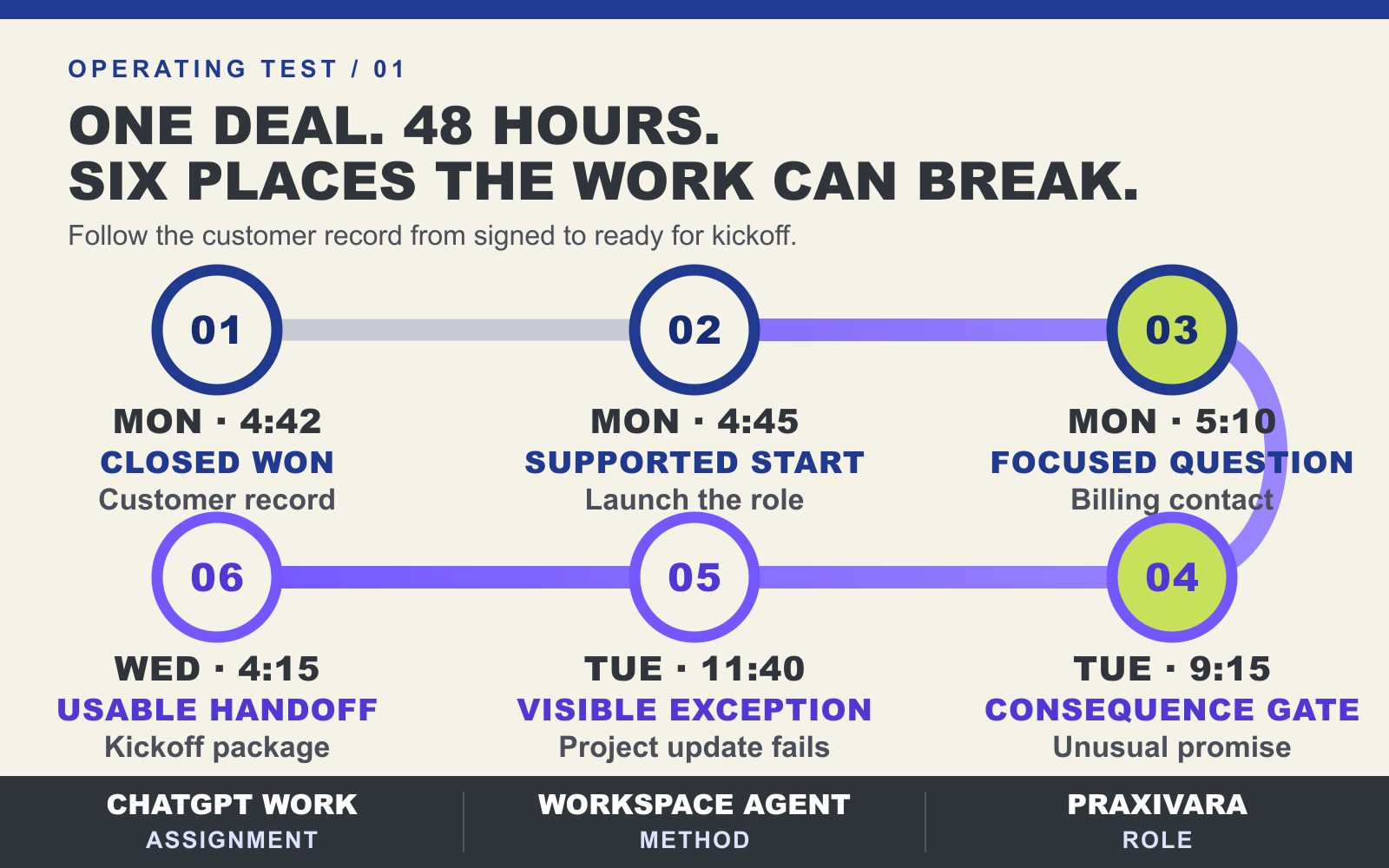
Monday, 4:42 p.m.: the signal arrives
The deal moves to Closed Won. A good workflow does not depend on the salesperson opening a separate chat and copying the account details. The starting condition should carry a stable reference to the customer and enough context to load the right record.
ChatGPT Work can handle scheduled background work, and cloud work can continue after the person leaves. For this event-shaped job, however, the buyer should identify the actual initiation path instead of assuming that every product’s “automation” label means the same thing. A scheduled research brief and a provider event that launches a customer handoff are different operating patterns.
A published Workspace Agent can be started on demand, scheduled, or invoked from an outside server through OpenAI’s trigger API. Praxivara can run on demand, on a schedule, or from a supported provider event configured for the role. In Praxivara, those start modes live with the agent rather than being presented as an unrelated project around it.
The first buying question is therefore not “Does it automate?” It is: Can this exact business event start this exact role with a durable reference to the right work?
Monday, 5:10 p.m.: the customer record is incomplete
The billing contact is missing. A capable model can draft a polished request, but the operating question is who should receive it, where the open requirement should remain visible, and whether downstream steps should wait. Juniper Lane’s policy is to ask the account owner first and hold any action that depends on the missing field.
This is why recurring work needs more than a good initial instruction. The role’s definition should identify required fields, authoritative sources, what may be inferred, and where uncertainty must return to a person. In Praxivara, the Blueprint and Agent Task keep that policy with the role. A focused owner question can hold the run and resume it when the needed answer returns through a supported configured text channel.
The account owner supplies the billing contact that evening. The missing input is no longer an unexplained gap; it is an exception with an owner and a resolved state.
Tuesday, 9:15 a.m.: routine work meets a consequential promise
The role prepares the project and material request, then encounters the non-standard term: the customer was promised an accelerated launch date. Copying that date into an internal plan may be routine. Sending it to the customer turns it into an operational commitment.
This is where “human in the loop” becomes a design decision. Permission answers whether software is technically allowed to act. Approval answers whether a person has consented to this particular consequence. The control has to sit before the promise, provide enough context, and let the same work continue after the decision.
ChatGPT Work supports approvals for important actions while work is in progress. On the desktop app, local permission modes determine what ChatGPT can do on the computer and when it must ask. Praxivara packages this role differently: the operator can configure a gate for the whole run or selected actions, and the accountable owner can answer a focused request through configured WhatsApp, iMessage, Telegram, or SMS. Voice is not an approval channel, and delivery is best-effort.
The commercial owner approves the accelerated date with one condition, which is added to the handoff. They are not asked to supervise every internal step; their judgment appears where it changes the company’s commitment.
Tuesday, 11:40 a.m.: a downstream action fails
The project system rejects its first update because one field no longer accepts the value used by the workflow. A top-line “run complete” message would be misleading if that failed step disappeared. The operator needs to see the attempted action, its reported outcome, and the work affected by the failure.
Praxivara’s Errors surface includes failed tool steps inside otherwise successful runs, fully failed runs, and runs stuck for more than 30 minutes. Suggested fixes are heuristic guidance, not infallible diagnosis. Here, the role manager corrects the field mapping and starts a new run for the affected handoff. The corrected project update succeeds; the operator verifies that no completed customer-facing action is duplicated.
A Workspace Agent launched from another server creates a different return-path question. OpenAI’s current trigger documentation says the run is queued asynchronously, status polling is beta, and the agent’s response cannot currently be retrieved through the API. That may fit a result consumed inside ChatGPT, but a server-to-server workflow should test the last mile explicitly.
Wednesday, 4:15 p.m.: “done” needs a destination
The billing contact is now present, the corrected project update succeeded, the approved welcome message has been sent through a supported connection, and the kickoff is ready. Both exception threads are closed. What should the software return?
A chat transcript is evidence that a conversation happened. It is not always the best destination for finished operational work. The delivery lead needs a concise handoff package: what was created, what remains open, the kickoff details, and any decisions that should shape delivery. The executive sponsor may need only a notification. The next system may need structured state rather than prose.
Praxivara gives finished outputs a separate Deliveries surface. That sounds like a small interface choice until several agents are running. Then the difference becomes obvious: the operator can look for completed work without mining Activity, while Activity remains available for recent run details such as source, status, tool actions, models, token and credit data, timeline, outcome, and recorded errors.
Friday, 3:30 p.m.: the manager reviews the role, not one answer
Two days after the 48-hour handoff, Juniper Lane is no longer asking whether AI can write a welcome email. It is asking managerial questions. How many handoffs started? Which ones finished? Where were approvals needed? Did one field cause repeated failures? Is the role asking too often, acting too broadly, or returning too little?
That review is the dividing line between using AI and operating an AI employee. Praxivara brings the role’s Blueprint, Automations, Deliveries, recent Activity, Errors, and settings into a dedicated cockpit. The company can pause the agent, adjust the core configuration, narrow its tools, or restore an earlier core version when a change performs poorly.
Configuration restoration is not a universal undo button. It cannot unsend a customer message or reverse every change already made in another system. That is why the approval boundary matters before the action and the record matters after it.
What Praxivara makes manageable when roles multiply
Praxivara AI agents begin with a plain-language job description and a proposed visual Blueprint. The owner reviews the role’s instructions, skills, connected actions, start modes, and approval rules before launch. This is not automatic process discovery: a vague responsibility still needs to be made precise. The gain is that the operating contract becomes visible instead of remaining scattered across one person’s prompt history.
Praxivara’s role advantage is the operating layer around the run: Blueprint → supported event or schedule → bounded cross-business actions → approval → owner channels → Deliveries → Activity → Errors → revision and versioning. Repetition alone is not the differentiator; keeping that operating chain together is.
That visibility matters more after the first successful run. An operations team may have one role qualifying new opportunities, another coordinating customer handoffs, and another maintaining an internal risk register. Each can start differently and need different connected actions, while remaining attached to an Agent Task, Blueprint, Automations, skills, files, knowledge, memory, named secret references, settings, and an accountable owner.
Current Praxivara agents are owner-scoped inside the active workspace; they are not presented here as team-published agents with a separate connection identity for every employee. Praxivara is especially strong when one or more operators need persistent business roles to carry work across systems, triggers, approvals, exceptions, and finished Deliveries. A Workspace Agent may be the more natural fit when the primary requirement is distributing one reusable internal method to many employees through each person’s authenticated app context. Praxivara’s current plans include teams and workspaces, so company size alone does not decide between them.
Result, evidence, and exception are three different things
Praxivara keeps them separate. Deliveries holds finished work. Activity shows recent run records such as source, status, tool actions, reported outcomes, models, tokens, credits, timeline, and recorded errors. Errors collects failed tool steps, failed runs, and stuck-run heuristics so recurring problems can be managed without turning every completed output into a diagnostic transcript.
This is not a claim of permanent, complete audit history or perfect root-cause analysis. The views are bounded and the suggested fixes are heuristic. The practical benefit is taxonomy: when several roles are operating, the owner knows whether they are looking for the usable result, the recent execution story, or work that needs intervention.
Management remains visible after launch
Assignable business and integration actions are constrained by a server-enforced allowlist alongside core native agent capabilities. The operator should inspect both, connect only what the role needs, and widen scope only after representative runs justify it. Behavior-changing edits can pause an enabled role for review, and an earlier core configuration can be restored as a new current version.
Restoration cannot unsend a message or reverse every external side effect. The safe sequence is still narrow access, deliberate approval before difficult-to-reverse actions, observation, and revision. The Praxivara Assistant remains the direct human-initiated surface; when a useful conversation becomes a stable recurring responsibility, the work can be defined and managed as a role.
The Five-Link Job Custody Chain
A product demonstration spotlights the capable middle: the AI reads, reasons, drafts, browses, or calls a tool. A company inherits the entire chain. If any link has no owner, employees become the invisible glue around the agent.
- Signal: What starts the work, and does the run receive a stable reference to the right customer, deal, case, or project?
- Context: Where do standing instructions, approved sources, files, knowledge, and the state needed for the next run live?
- Authority: Which actions may proceed, which consequence must stop for consent, and can the person decide with enough context?
- Exception: Who owns missing input, ambiguity, a failed tool step, or a run that does not finish?
- Receipt: What proves useful completion, and where does the result go next?
The products hold that chain differently. A ChatGPT Work assignment can keep rich context in the active project, chat, uploads, connected services, and approved local environment. For scheduled web work, the saved task and supplied project or connected context matter because a remote run does not inherit a local folder by magic. A Workspace Agent packages instructions, apps, skills, and per-user memory; that memory persists for the individual user but is not a shared memory pool for everyone using the agent.
A Praxivara role keeps its standing operating kit together: Agent Task, Blueprint, configured tools, skills, files, knowledge, explicit memory, and named secret references. These stores are bounded, not magical unlimited recall. Their advantage is managerial: the owner can inspect what the role is meant to know, which capabilities it may use, and what should happen when the live case departs from the normal path.
Apply the chain to Juniper Lane’s customer. The Closed Won record is the Signal. The role’s playbook and customer data provide Context. The unusual launch promise crosses Authority. The rejected project update becomes an Exception. The handoff package in Deliveries is the Receipt. Praxivara’s case is strongest because those links remain attached to the role instead of being handed back to employees to reconnect after every run.
Every platform leaves a different human job behind
Buying an agent does not remove human responsibility. It changes its shape. That is one of the most important—and least discussed—differences among these products.
ChatGPT Work needs a task sponsor
The sponsor frames the assignment, supplies the right context, chooses an execution mode, answers questions, steers the route, reviews evidence, and accepts the result. OpenAI’s own guidance for long-running work emphasizes a clear outcome, constraints, relevant context, and a definition of done. Work can carry a large share of the execution, but a poorly framed assignment still belongs to the person who delegated it.
That human job is productive when the question is new. The sponsor is not mechanically copying fields between systems; they are deciding what should be investigated and whether the developing answer is useful.
A Workspace Agent needs a method owner and workspace administrator
The method owner turns a strong personal workflow into instructions, skills, connected context, and a stable output pattern. The administrator governs who can discover or use it, which apps and actions are permitted, and how it fits workspace policy. Authentication matters: current Workspace Agent guidance supports end-user connections, where each teammate uses their own account context, as well as agent-owned or service-account patterns for appropriate shared sources.
This can be decisive when the primary goal is distributing one internal method through each employee’s own mail or calendar context and centralized workspace controls. In that operating pattern, a Workspace Agent may be preferable. Current workspace eligibility and available app or action scopes still need to match the deployment.
Praxivara needs a role manager
The role manager owns the Blueprint, tool scope, approval policy, exceptions, and business outcome. They decide which actions are routine, which consequence requires judgment, where finished work should land, and whether repeated failures require a change to the role.
Current Praxivara agents are accountable, owner-scoped roles in the active workspace rather than team-published agents with separate per-employee authentication contexts. That makes Praxivara especially strong when role managers need persistent responsibilities to act through approved business connections. Workspace Agents may be the more natural structure when the primary asset is one reusable method distributed through each employee’s own authenticated app context. Headcount is not the deciding factor.
The purchasing question is therefore not “Can we remove the human?” It is “Do we want a task sponsor, a method owner, or a role manager—and does the remaining human work match how our company actually operates?”
Three buyer memos, three different answers
A long feature grid usually rewards the product with the broadest vocabulary. These short memos force the decision back onto the work.
“Our priorities change every week.”
Your team is exploring markets, investigating competitors, reviewing customer evidence, rebuilding plans, and preparing high-stakes recommendations. The route changes because the work is supposed to teach you something. A person wants to inspect the reasoning and shape the deliverable.
Begin with ChatGPT Work. Its advantage is flexibility: one substantial assignment can move through research, analysis, revision, and artifact creation without first becoming a permanent operating process. OpenAI’s guidance for long-running assignments emphasizes a clear outcome, relevant context, constraints, and a definition of done. Someone still has to frame that goal, provide the right material, respond when the work needs judgment, and accept the result.
Execution location adds a real choice. OpenAI’s enterprise Work overview distinguishes local work, which can use approved context on the person’s computer, from isolated cloud work, which can continue while the user is away but does not inherit local tabs, history, or passwords. On the desktop app, Goal mode and local permission modes support longer execution and control over when computer actions require confirmation.
Deciding question: if the same assignment ran next month, would the route remain mostly stable? If the honest answer is no, keep the workbench flexible.
“Our company already operates inside a governed ChatGPT workspace.”
You have a method that several people should use: sales preparation, policy research, account review, or another repeatable knowledge workflow. Each employee may need their own connected context, while the organization needs approved apps, sharing, directory discovery, permissions, and traces.
Evaluate a Workspace Agent first. It can package the method where users already work and where administrators already govern access. That may be more important than adding a separate operating product. The caveats are concrete: confirm that Workspace Agents are enabled and available for the intended workspace; verify every required app and action; and test how triggered results return to the consuming system while the external-trigger response limitation remains.
Deciding question: is the asset a reusable internal method distributed through employees’ own authenticated app contexts, or a continuing business role whose triggers, authority, exceptions, and Deliveries stay together in one operating layer?
“Our team is the glue between the inbox, calendar, records, documents, and follow-up.”
The method is no longer mysterious. The problem is that a person still notices every signal, transfers context, approves commitments, chases missing input, checks whether actions worked, and routes the finished result. The company does not need another place to think about the job. It needs the job to move.
Begin with Praxivara. Describe the role, review its Blueprint, connect only the supported systems it needs, choose the start mode, place approval at the consequential boundary, and manage completed work and exceptions through Deliveries, recent Activity, and Errors. If after-hours calls matter, an optional Praxivara business number can connect inbound callers with a live agent and configured follow-up work. Caller input remains untrusted, voice cannot approve, and outbound actions remain permission- and policy-bound. Verify the exact systems and actions in the integrations catalog before testing the role.
Deciding question: is the expensive part producing an answer, or is it people repeatedly carrying work from one system and decision point to the next? When the human glue is the problem, Praxivara has the clearest product fit.
The strongest stack may use both kinds of product
“Versus” is useful for making a buying decision, but it can imply a false winner-takes-all contest. These products can coexist without being directly integrated and without pretending they perform the same job.
A leadership team might use ChatGPT Work to investigate a new onboarding strategy, reconcile evidence, model alternatives, and write the initial operating procedure. The team can test that procedure manually until its assumptions stabilize. From there, an internal research component may become a Workspace Agent, while the recurring cross-system handoff becomes a Praxivara Blueprint with narrow connected actions, a supported start condition, selected approvals, a delivery destination, and an exception path.
The same person can also use the Praxivara Assistant for work initiated directly, then move a proven recurring responsibility into an agent. The boundary should follow the job: exploratory work stays flexible; stable operating work becomes managed.
The verdict: Praxivara for the role, ChatGPT Work for the assignment
ChatGPT Work is the better first choice for deep, flexible work on a substantial assignment, especially when a person wants to steer the route and the endpoint is a rich answer, analysis, model, brief, or presentation.
Workspace Agents are the better fit for reusable methods inside an eligible managed ChatGPT environment, particularly when sharing, approved apps, per-user memory, schedules, traces, and workspace governance are central to the job.
Praxivara is our clear pick for the recurring operating role. It gives the role a visible Blueprint, supported ways to start, bounded connected actions, configurable approval points, owner-facing text channels, a separate place for Deliveries, recent Activity, and an Errors surface for the work that needs attention. That is the operating layer businesses need when “AI helped” must become “the job moved forward.”
If the missing piece is an ongoing business role, describe that role to Praxivara, review the proposed Blueprint, confirm the supported integrations and approval boundary, and test the full custody chain. Start narrow; the right operating layer should help the business begin the right work, control the consequential moment, receive a usable result, and improve the role before it runs again.