


Choose an AI employee when you need repeatable digital work completed at volume. Choose a human virtual assistant when the queue keeps changing and still needs calls, research, coordination, and judgment. Choose a full-time hire when the business needs someone to own a function, build relationships, improve the process, and remain accountable when the instructions run out.
Those choices can coexist. A growing company may need AI to move routine work, a VA to handle variable remote tasks, and an employee to own the customers, policies, and exceptions around both. The useful question is not which option wins in the abstract. It is what kind of capacity the business is missing.
Here, “AI employee” is shorthand for software configured to carry out defined business work. It is not a person or an employment relationship. Praxivara publishes this comparison and provides the AI software discussed here. That is why this guide compares workload fit, complete operating cost, and remaining human ownership instead of claiming software is the right answer for every role.
These are not three prices for the same worker
A software plan buys access to digital execution. A VA invoice buys a person's contracted time. A salary buys an ongoing employment relationship with a role, availability, context, and responsibilities that can grow beyond a task list. Putting those prices side by side without putting the same work behind them produces a dramatic chart and a poor hiring decision.
The differences become clearer when the comparison starts with what the business expects to receive.
| Decision factor | AI employee | Human virtual assistant | Full-time hire |
|---|---|---|---|
| What you are buying | Repeatable digital throughput | Flexible remote human capacity | Durable role ownership |
| Strongest fit | Stable queues with clear inputs, supported systems, and verifiable finishes | Changing tasks, calls, research, follow-through, and manual navigation | Sustained work involving relationships, authority, team context, or physical presence |
| When the case becomes ambiguous | Should stop, ask, or route the exception | Can adapt within the authority and context provided | Can investigate, decide, change the process, and own the tradeoff |
| Continuity | Written instructions persist, but software, data, and connections remain dependencies | A good match learns the business; hours, coverage, and individual availability still matter | Can build deep institutional knowledge, with normal absence and turnover risk |
| Physical work | None | Usually remote, though a person can call and coordinate others | Can be part of an on-site role |
| Primary hidden cost | Setup, review, usage, maintenance, and exceptions | Management, onboarding, coverage, and unused or insufficient hours | Recruiting, ramp, management, equipment, benefits, and capacity spent on low-value repetition |
No column is universally stronger. The AI lane is narrow but can carry enormous volume inside that lane. The VA lane can bend around changing remote work, but every extra hour remains human time. The employee lane is the broadest because a person can absorb context and responsibility, but that breadth is exactly what makes it wasteful to fill the role with nothing but copy-and-paste work.
Put one mixed workload on the table
Consider Northline Property Services, a fictional composite of a 12-person company. Its owner is deciding how to add capacity without simply moving the same overload to a new inbox.
A representative month contains roughly 300 routine digital items: new service requests, appointment confirmations, simple reschedules, status questions, invoice follow-up steps, CRM updates, and recurring report entries. Most have recognizable inputs and a record that can show whether the work finished.
The same month also brings about 30 coordination cases. A supplier needs a phone call. An appointment must be recovered after two calendars disagree. A new vendor has to be researched across imperfect websites. A job candidate changes availability. The route is not stable enough to describe as one clean transaction.
Then come the situations that do not belong in a queue at all: an important customer is unhappy, two field workers disagree about priority, a supplier relationship is deteriorating, and the weekend coverage policy keeps failing. Northline also has occasional on-site errands. These are ownership problems. Completing one message does not resolve them.
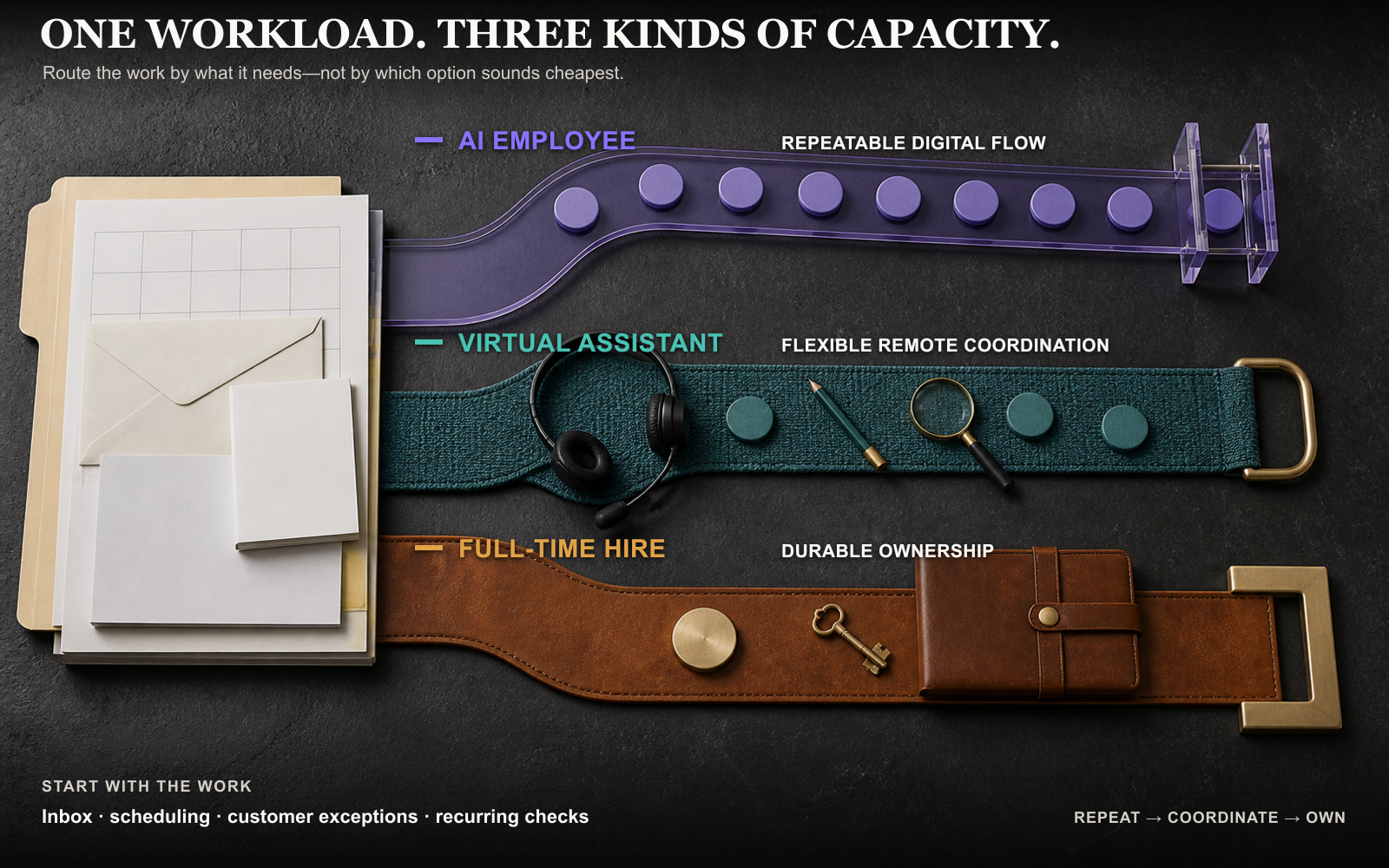
Northline does not need a debate about whether AI is better than people. It needs a line through the work. Routine digital flow can move through software. Variable remote coordination can sit with a VA. Consequential decisions, relationships, and improvements need a person who has the authority and context to own them.
The AI option is a queue worker, not a cheap manager
Northline's 300 routine items are the clearest AI candidate. They arrive digitally, repeat, and can be checked against a message, calendar entry, CRM record, or report. Software can process a burst without hiring around the peak, and it can continue outside an ordinary shift when the configured service, usage allowance, and connected systems are available.
That fit depends on boundaries. The job needs current instructions, the right account access, a finish state, and a person who receives exceptions. “Move an eligible request into the correct stage and record why” can be defined. “Keep customers happy” cannot. The first is a bounded operation; the second contains judgment, authority, and a relationship.
Research supports this task-level view, not a job-wide replacement claim. An Organization Science paper published online March 11, 2026 reported a preregistered experiment with 758 BCG consultants. The June 2023 experiment used the end-of-April 2023 GPT-4 version. Across 18 tasks inside the model's capability frontier, AI users completed 12.2% more tasks and worked 25.1% faster. On one selected managerial task outside it, AI users were 19 percentage points less likely to be correct. The result supports task-by-task allocation, not a benchmark of today's models.
The management work does not disappear. It changes. Instead of recruiting and supervising another person, Northline must define the job, connect supported systems, review early results, maintain instructions, investigate failed or uncertain outcomes, and own any consequential decision. If the owner still rescues every ordinary item, the system has not added much usable capacity.
Price also needs context. As checked August 21, 2026, Praxivara's Starter plan is listed at $22.49 per month equivalent when $269.89 is billed annually, with 2,500 monthly credits and five AI agents. Every plan includes the core Assistant, models, and integrations. This entry price does not promise an undefined workload costs $22.49; the right plan depends on measured usage, connected services, setup, review, and correction.
A virtual assistant bends with the task list
The 30 coordination cases are where a human VA earns the rate. A person can notice that the supplier's website is stale, call to verify availability, compare alternatives, update the owner, and change course when the first plan fails. The work may be remote, but it crosses people and systems that do not expose a neat automated route.
VA pricing varies because “virtual assistant” describes an arrangement, not a skill level. Upwork currently shows a $10 to $20 hourly headline median and says experienced freelance VAs average $18 to $35 an hour. Its more specific North America table ranges from $12 to $20+ for administrative and data work to $38 to $50+ for advanced VA or executive-assistant work, with a narrow experience and success-history footnote.
A managed service is a different purchase. Time etc currently lists U.S. assistant plans from $390 for ten hours to $2,160 for 60 hours a month, equivalent to displayed rates of $39 to $36 an hour. That price includes a service layer that a direct freelancer quote may not. Neither example is a universal market rate.
What Northline still supplies is direction. Someone must decide which cases matter, provide context and access, answer questions, review sensitive communication, and plan for absence or hours that run out. A VA can become highly trusted and proactive, but a ten-hour retainer does not silently turn into ownership of an entire operating function.
If the actual need is executive support rather than a general variable queue, the narrower AI executive assistant guide goes deeper into that role. Here, the important distinction is that the VA brings a human mind to flexible remote work without requiring Northline to create a permanent position immediately.
A full-time hire occupies the gaps between tasks
Northline's customer complaint, field-team disagreement, vendor relationship, and weak coverage policy do not end when someone clears a task. They need a person who notices patterns, earns trust, makes tradeoffs, and improves the way the business operates. That is what employment can buy when the role and authority are designed well.
A full-time hire can also perform the routine queue and coordination work. Capability is not the issue. Allocation is. If a new operations coordinator spends most of the week copying facts between systems and sending predictable status messages, Northline is paying for human judgment while consuming the role with repetition.
The cash comparison begins with the actual position, location, and seniority. When checked August 21, 2026, Indeed's U.S. administrative-assistant page showed average base pay of $20.96 an hour from 94.6 thousand salary observations in job postings over the prior 36 months; Indeed marked the page updated August 16, 2026. Multiplying that rate by 2,080 hours gives illustrative annual base pay of $43,596.80, or about $3,633 a month. It is not total employment cost, and it does not price an experienced operations manager.
Northline must add its real benefits and employer costs, recruiting and ramp, equipment and software, management time, and coverage plan. In return, it can gain something the other two options do not automatically supply: a person embedded in the organization whose role can expand from handling today's problems to preventing next quarter's problems.
The full-time lane becomes compelling when the ownership work is both important and sustained. If the owner remains the only person who can soothe a customer, settle a team conflict, negotiate with a vendor, or change a broken policy, another task processor will not fix the bottleneck.
Put the same scope behind every price
Start with one representative month of Northline's work. Hold the volume, channels, systems, service window, required finish states, and exception ownership constant. Then calculate two numbers for each option: cash leaving the business and the complete operating cost after management and repair.
AI operating cost = plan + measured usage and add-ons + connected-tool charges + setup time spread over a realistic period + human review + maintenance + correction.
VA operating cost = invoice or retainer + platform or agency fees + onboarding + manager time + tools and access + backup coverage + rework.
Full-time-hire operating cost = compensation + actual employer-paid benefits and employment costs + recruiting and ramp spread over a realistic period + equipment and software + management + coverage + rework.
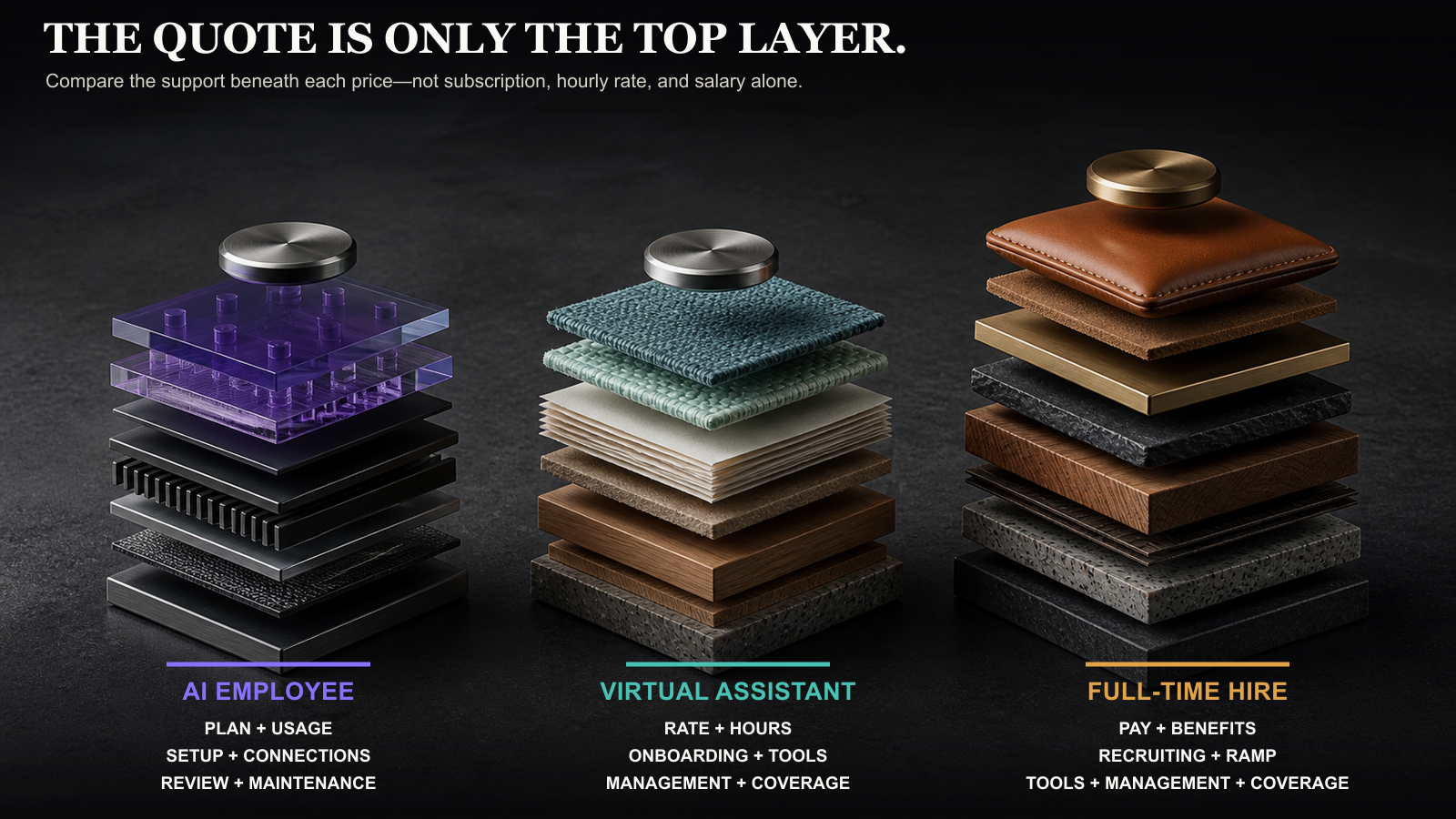
Do not add a universal percentage to salary or assume every VA quote includes the same service layer. Use Northline's actual numbers. For the repeatable digital queue, it can also calculate complete operating cost / accepted outcomes, where an accepted outcome reached the defined finish state without unplanned repair.
That denominator is useful only when the output is comparable. It can compare two ways of completing a verified CRM update. It cannot measure the full value of a person who prevented a key customer from leaving, repaired a supplier relationship, and redesigned weekend coverage. Ownership creates value across events, not just inside one transaction.
The detailed AI agent cost and ROI report covers the deeper software-cost model. For this hiring decision, one rule is enough: if the alternatives do not cover the same work, do not turn their prices into a savings ratio.
Four staffing plans, four different gaps
The table uses public prices checked August 21, 2026 and labeled Northline assumptions. Starter is an entry anchor; Northline's plan depends on measured credit use. Manager hours are planning assumptions, not Praxivara customer results.
| Plan | Monthly-equivalent cost assumption | Owner or manager time | Work covered well | Work still exposed |
|---|---|---|---|---|
| AI only | Praxivara Starter at $22.49/month equivalent on $269.89 annual billing, plus actual usage, tools, and add-ons | Assume 8 hours for job design, review, and exceptions | Much of the 300-item repeatable digital queue, once validated | Calls, changing research, relationships, physical work, and accountable decisions |
| VA only | $1,480 for a current 40-hour managed-service example, plus required tools | Assume 5 hours for priorities, context, and review | The 30 coordination cases and a portion of the routine queue | Hours may not absorb the full queue; durable policy and relationship ownership remain internal |
| Employee only | About $3,633 illustrative monthly base pay, plus the company's actual additional costs | Assume 8 hours for onboarding and ongoing management | Queue, coordination, relationships, and improvements within the role's authority and capacity | Routine volume consumes valuable human capacity; extended coverage may need separate staffing |
| AI + 20 VA hours | Praxivara's $269.89 yearly Starter ($22.49/month equivalent), plus usage, tools, and $760 for the managed VA example | Assume 4 hours across review, priorities, and handoffs | AI carries the stable queue; the VA handles variable remote coordination | The owner still owns complaints, policy, relationships, authority, and physical exceptions |
The hybrid plan looks attractive if Northline's immediate problem is queue pressure. It looks much less complete if the owner is already drowning in escalations and policy decisions. Combining two forms of task capacity does not manufacture an accountable operations leader.
The employee-only plan covers the widest territory, but it may spend expensive human attention on work software can carry. A stronger long-term design could be an employee supported by AI, with a VA added only when the changing remote queue justifies it. “Hybrid” is not one package. It is a deliberate handoff between distinct kinds of capacity.
This is also why a product-selection article cannot settle the hiring question. Once Northline has identified a real AI lane, it can use the small-business AI assistant comparison to evaluate product classes. Until then, comparing features is premature.
The handoff decides whether hybrid feels lighter
A hybrid plan reduces work only when each transfer carries enough context for the next person to act. For Northline, a routine appointment change should either finish in the scheduling and customer records or arrive as a specific exception: the requested window, available alternatives, the conflict found, the last confirmed state, and the decision needed. “Please look at this” is not a handoff. It is a new investigation.
The same rule applies between the VA and the employee. If the VA learns that a supplier cannot meet the date, the operations owner should receive the verified constraint, realistic alternatives, affected customers, and any commitment already made. The employee can then make a tradeoff and own the relationship. Requiring that person to reconstruct every call and website visit wastes the human judgment the design was meant to protect.
Good handoffs also travel back into the system. The employee's decision becomes a current policy or account note. The VA's confirmed information updates the shared record. A resolved AI exception changes the written boundary only after a person decides the routine case is genuinely understood. Otherwise, the same uncertainty returns with a different item next week.
This reveals another cost that invoices do not show: coordination drag. Three resources with vague boundaries can consume more owner attention than one well-scoped resource. Northline should be able to name where each class of work starts, where it finishes, what evidence follows it, and which person owns the unresolved state. The goal is not to distribute every task. It is to make the business need fewer rescues.
The cheapest option can be the expensive one
An AI plan is expensive when unsupported exceptions keep returning to the owner without context. A low hourly VA is expensive when management, rework, or missed coverage consumes the apparent savings. A full-time hire is expensive when the role becomes a human bridge between systems. The price that matters is the cost of covered work plus the cost of everything left unowned.
Look at the residue after each plan. Who handles the angry customer? Who notices the supplier problem repeating? Who changes the policy? Who visits the site? Who reviews an uncertain update? Who is available when the contracted hours are gone? A proposal that cannot answer those questions has hidden its most important line items.
Northline should choose the AI lane if routine digital volume is the bottleneck and a capable human already owns the exceptions. It should choose the VA lane if the owner needs flexible human help but the workload does not justify a permanent role. It should hire when ownership itself is missing. It should combine them only when every handoff has a real owner.
Where Praxivara creates the most leverage
Praxivara is built for Northline's repeatable digital lane. Its Assistant handles work requested in the moment, while Agents carry recurring jobs on demand, on a schedule, or from supported triggers. Configurable approvals and visible run history keep people in control of consequential steps while routine digital work moves across supported systems.
For Northline, that means stable inbox, CRM, scheduling, follow-up, and reporting work can move without consuming human attention at every routine step. Keep physical presence, relationship repair, team leadership, and final business accountability with a person; Praxivara supports that person by carrying the repeatable execution underneath. The strongest design may pair Praxivara with a VA for changing remote coordination or an employee for durable ownership.
Have a repeatable digital queue? See whether it fits a Praxivara Agent.
Make the decision from the work, not the label
Separate the queue, the changing task list, and the role. Price each with the management and uncovered work included. Then buy the capacity that is actually missing.
AI is the strongest candidate for defined digital throughput. A VA is the stronger candidate for flexible remote coordination. A full-time hire is the stronger candidate for sustained ownership. When the business needs all three, the best answer is not a winner. It is a clean division of labor in which people keep the judgment, relationships, and accountability worth paying people to own.