


Imagine this request arriving on a Friday afternoon:
“We added 17 contractors, two invoices do not match our purchase order, security still needs the data processing agreement (DPA), and our renewal is Friday. Can you resolve this without taking us over last year’s budget?”
One message like this is also a billing investigation, a contract review, a security-document task, a pricing decision, and a deadline. A workflow can move each piece. An AI Agent can understand that the pieces belong to one outcome.
This is the practical difference between workflow automation and an AI Agent. Workflow automation follows a path the business defines in advance. An AI Agent receives a goal, interprets the current situation, chooses among permitted tools and next steps, and adjusts when the obvious path does not fit.
The 30-second answer: use workflow automation when the path is known and repeatability matters. Use an AI Agent when the system must interpret context, decide what to do next, or recover from exceptions. Use both when the work is variable but the actions must stay controlled: the Agent handles judgment and coordination, deterministic tools execute exact steps, and people authorize consequential commitments.
The conclusion leans toward Agents for a reason. Traditional automation can efficiently scale the work you have already reduced to rules. Agents can bring automation to a wider class of work: mixed messages, incomplete records, changing plans, cross-system investigations, and cases whose next step only becomes clear after the work begins. That is a much larger opportunity.
But “agentic” should not become a synonym for “better.” Exact calculations do not improve when a model improvises them. A fixed compliance gate does not need creativity. A stable record transfer does not need a planning loop. The strongest operating design gives each component the kind of work it can perform reliably.
In this guide
- See the difference that actually matters
- Know when workflow automation wins
- Know when an AI Agent wins
- Use the Variability × Consequence Map
- Build one renewal exception three ways
- Design the Agent and workflow together
- Compare the production tradeoffs
- Choose the first work for an Agent
- Use the first 20 runs to map the initial operating envelope
- Recognize when an Agent is the wrong tool
- See how Praxivara fits
- Get answers to common questions
The hidden difference is who chooses the next step
Most comparisons begin with features: triggers, integrations, memory, models, branches, loops, or approvals. Those details matter, but they come after a simpler architectural question:
Does the builder choose the route before execution, or does the system choose the route while pursuing the goal?
In workflow automation, the builder chooses. An event enters at step one. The system checks conditions, follows predefined branches, calls specified actions, and stops where the diagram says it stops. The workflow may contain dozens of branches and may even include an AI classification or generation step. Its defining characteristic remains the same: the surrounding path was designed in advance.
In an AI Agent, the model participates in controlling execution. It can inspect available context, decide which source to consult, select an allowed tool, evaluate the result, ask for missing information, change its plan, or stop when the goal is complete or blocked. The instructions establish the job and boundaries; they do not enumerate every route the work may take.
Anthropic draws the same architectural line: workflows orchestrate models and tools through predefined code paths, while Agents dynamically direct their own processes and tool use. Its guidance also makes the tradeoff explicit. Workflows offer predictability for well-defined tasks; Agents offer flexibility when model-directed decisions are worth the additional latency, cost, and evaluation burden.
There is an important middle category: the AI-assisted workflow
A workflow that asks a model to summarize a document, classify an email, extract fields, or draft a response is not automatically an Agent. If the model returns its answer to a fixed next step, the workflow still controls execution. The AI improves one station on the route; it does not decide where the route goes.
This middle category is useful. A fixed intake flow might use a model to identify the language and topic of a message before routing it. An invoice process might use a model to extract a vendor name from an irregular document, then let deterministic validation compare the amount and purchase order. Calling these systems Agents obscures the design decision the business actually made.
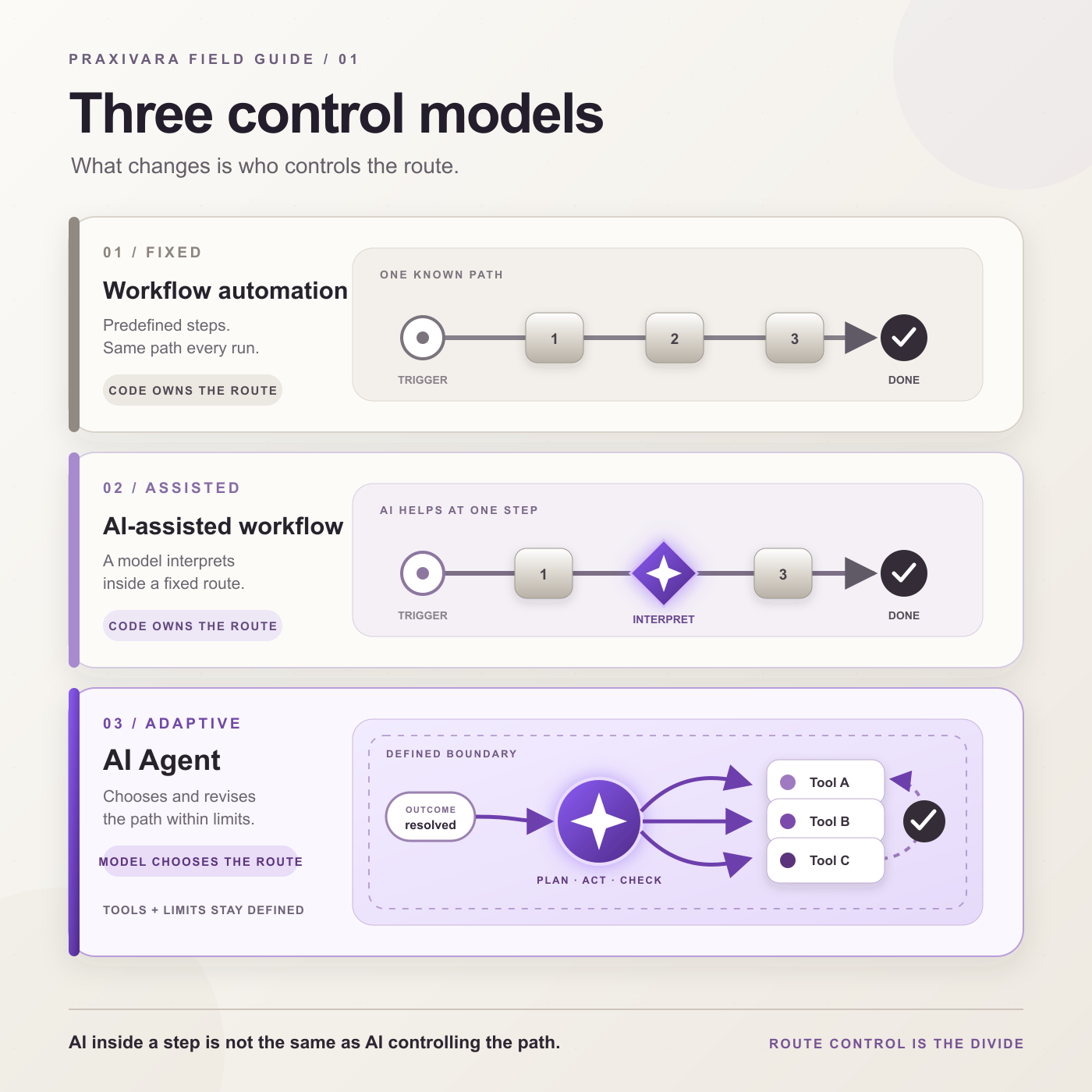
| Architecture | What starts it | Who chooses the path | Best fit |
|---|---|---|---|
| Workflow automation | A trigger and predefined conditions | The builder, before execution | Stable, repeatable work with structured inputs |
| AI-assisted workflow | A trigger and predefined conditions | The builder; AI interprets or generates within one step | Fixed processes with a bounded language or extraction problem |
| AI Agent | A goal, request, schedule, or supported event | The model during execution, within allowed tools and rules | Variable work requiring context, judgment, tool choice, or recovery |
The destination-versus-route distinction is useful shorthand. A workflow is given the route. An Agent is given the destination, the available roads, and the boundaries it must not cross.
Workflow automation wins when the route is the product
Workflow automation is not an outdated predecessor that every business should replace. Its rigidity is often the feature. When identical circumstances should produce identical behavior, a fixed path is easier to reason about, test, price, explain, and repair.
Consider a system that copies an approved customer record into an invoicing platform, checks that required fields exist, assigns a sequential identifier, and writes a timestamp. There is no advantage in asking a model to invent a plan for each record. The business wants the same validations in the same order every time.
Choose workflow automation when all five conditions are mostly true
- The inputs are structured. The same fields, statuses, files, or events arrive in a predictable format.
- The branches can be named. The business can draw the meaningful paths before the process runs.
- The rules are stable. Changes happen occasionally and can be updated deliberately.
- Speed and unit cost matter more than interpretation. The job may run thousands of times and has little reason to deliberate.
- Success is mechanical. The system can check an exact field, record, amount, identifier, or delivery response.
Strong workflow candidates include scheduled exports, field synchronization, exact arithmetic, format validation, fixed notifications, approved template delivery, data retention routines, and status transitions with explicit criteria. These jobs can be complex without being ambiguous.
A common mistake is to evaluate the number of steps instead of the variability of the path. A 40-step workflow can remain deterministic. A three-step request can need an Agent if the first step is “understand what this person actually needs,” the second depends on conflicting evidence, and the third changes with the answer.
Workflow automation becomes expensive when exceptions become the real process
The warning sign is not that a workflow has branches. It is that every new customer, provider, document, or unusual situation requires another branch, another parser, another fallback, and another person who remembers why the branch exists. The diagram grows while coverage barely improves.
At that point, the business is encoding contextual judgment as an expanding maze of conditions. Rules still belong around exact calculations and consequential actions, but the work between those boundaries may be better expressed as a goal for an Agent.
AI Agents win when the route has to be discovered
An AI Agent earns its place when the business can define the desired outcome more clearly than it can define every route to that outcome. The value is not a more conversational interface. It is execution control that can respond to what the work reveals.
OpenAI’s practical agent guide identifies three strong signals: complex or context-sensitive decisions, rule sets that have become difficult to maintain, and heavy reliance on unstructured data. It also says a deterministic solution may be sufficient when those conditions are absent. That is the right purchasing discipline.
Choose an Agent when several of these signals appear together
- The request arrives in natural language. Important facts are embedded in an email, conversation, document, transcript, or mixed set of files.
- The next source depends on the first result. A CRM record may point to an invoice, which reveals a contract exception, which requires a current policy.
- The number or order of steps varies. The system cannot know the full plan before it begins.
- Exceptions require context, not just a code. Two cases with the same status may need different next actions because their history, authority, or desired outcome differs.
- The system must choose among tools. It may need to decide whether to retrieve, compare, draft, update, ask, wait, or escalate.
- Recovery requires a new plan. A missing record, stale result, failed tool, or contradictory source should change what happens next.
- The end state is clear even when the path is not. The business can specify what proof would count as complete.
The last condition matters. Open-ended does not mean undefined. “Handle operations” is not a usable goal. “Reconcile this renewal request, prepare the authorized path, and return the verified state of every required action” can be bounded, tested, and owned.
Agents are especially valuable for work people currently complete by carrying context between systems. If an employee reads a message, looks up several records, decides what the message means, chooses the next system, notices an exception, asks one clarifying question, and later checks whether the change happened, the process contains an adaptive layer that ordinary automation struggles to own.
Use the Variability × Consequence Map
The choice becomes clearer when you separate two questions that vendors often combine:
- How variable is the path? Can the useful steps be known before the run begins?
- How consequential is the action? How expensive, sensitive, irreversible, or externally binding would a wrong move be?
Together they form the Praxivara Variability × Consequence Map. Its operating rule is simple:
More variability calls for more reasoning. More consequence calls for more constraint.
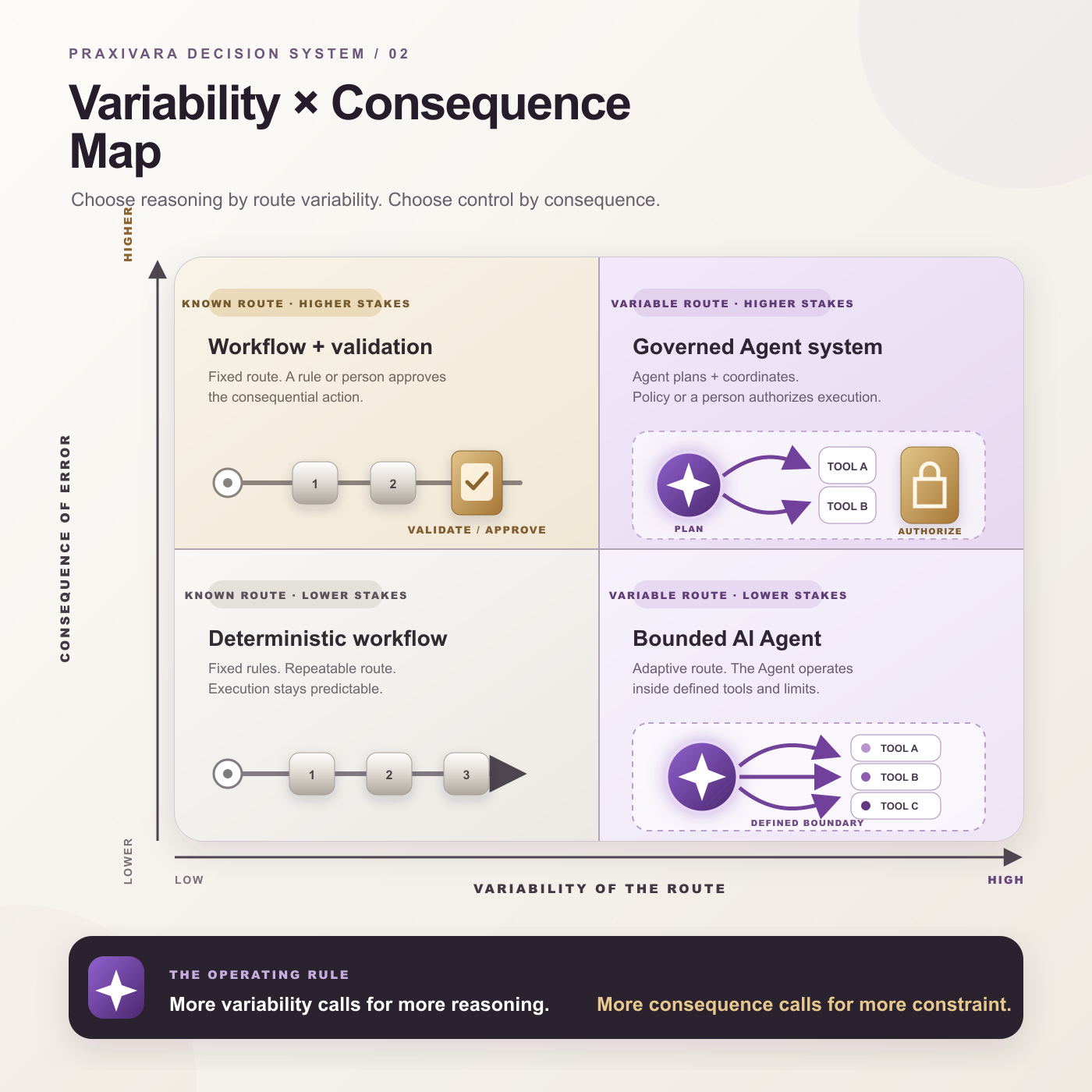
Low variability and lower consequence: use a deterministic workflow
Move an approved record, create a folder from a template, post a routine internal notification, or update a reversible status when exact conditions are true. Adding an Agent here can increase latency and introduce variation without expanding the useful scope.
Low variability and higher consequence: use a workflow with hard validation and approval
Payment release, access changes, contractual notices, destructive updates, and regulated records may follow stable paths while carrying serious consequences. Use deterministic checks, separation of duties, approval, and exact evidence. A model may prepare context, but it should not replace an enforceable boundary with persuasive language.
High variability and lower consequence: use an Agent with bounded tools
Research an account, assemble a meeting brief, reconcile a project update, prepare an internal plan, or organize an irregular inbox. These jobs benefit from interpretation and dynamic tool choice. Start with reversible or owner-facing outputs so the Agent can prove its judgment before it receives broader authority.
High variability and higher consequence: let the Agent plan; constrain execution
This is the hybrid quadrant. The Agent can gather the case, compare sources, identify the exception, propose the next move, and coordinate permitted work. Deterministic policy and a person control any action that changes money, rights, access, contracts, safety, or a sensitive customer commitment.
The map avoids two expensive errors. One is forcing people to babysit a brittle workflow because the path is too variable. The other is giving an Agent broad freedom merely because the input is messy. Variability justifies reasoning; it does not erase consequence.
Important Praxivara distinction: Praxivara’s assistant mode (model-directed) and automation mode (fixed steps) are separate execution modes. A single run does not quietly switch between them. Both are configured and reviewed from the same Agent workspace, while each keeps its own execution semantics.
One renewal exception, built three ways
Return to the request at the beginning. The customer has 17 new contractors, two invoice discrepancies, an outstanding data-processing agreement, a Friday renewal, and a budget condition. The business must arrive at one coherent outcome without allowing a system to invent a discount or change a contract on its own.

Architecture one: workflow automation only
A fixed system can detect terms such as invoice, purchase order, DPA, contractor, budget, and renewal. It can create separate tickets, assign departments, attach account identifiers, and start deadline reminders. If the inputs match expected categories, the routing works.
The limitation appears after routing. Someone still needs to discover that the invoice mismatch may be caused by the contractor change, that the correct DPA version depends on the account’s legal entity, that the renewal price needs to be compared with the prior term, and that all four workstreams must converge before Friday. The workflow moved the fragments; a person still owns the case.
Architecture two: an unrestricted Agent
An Agent can interpret the combined request, find the account, inspect invoices, compare the purchase order, locate the contract, retrieve the approved DPA, check usage, and propose a resolution. It can maintain one plan as the evidence changes.
Unrestricted execution creates a different problem. The same flexibility that helps the Agent understand the case could let it choose an unapproved discount, send the wrong contractual document, alter billing, or make a customer commitment beyond policy. The work needs reasoning, but the consequences do not justify unlimited authority.
Architecture three: a governed Agent with deterministic execution
- The Agent recognizes that the message contains four connected issues and creates one case objective.
- It retrieves the approved account, usage, invoices, purchase order, renewal terms, security requirements, and current DPA.
- Deterministic functions calculate invoice differences, validate dates and identifiers, and apply exact policy thresholds.
- The Agent assembles a proposed resolution, identifies conflicts, and asks for any genuinely missing fact.
- Any discount, credit, contract change, or external commitment beyond the defined boundary pauses for an authorized decision.
- Approved, bounded actions update the relevant systems through supported tools.
- The systems are read again where supported, and the Agent reports what changed, what remains, and who owns the next decision.
This design is favorable to Agents because the Agent owns the difficult part: maintaining the goal across a changing, cross-system case. The deterministic components are not competitors. They are reliable capabilities the Agent can use and boundaries it cannot talk its way around.
Why the hybrid architecture usually wins
The phrase “use both” can become vague unless responsibilities are explicit. A dependable hybrid has four layers.
1. The Agent is the judgment and coordination layer
The Agent interprets the request, chooses relevant sources, updates the plan, selects from allowed tools, keeps the work tied to one outcome, and decides whether it has enough evidence to continue. This is where the business gains adaptive capacity instead of merely adding another branch.
2. Deterministic functions do exact work
Calculations, date logic, schema validation, identifier matching, eligibility checks, deduplication, and enforceable policies should remain code when code can express them cleanly. AWS’s 2026 guidance makes the same recommendation: reserve Agents for ambiguous inputs, contextual interpretation, and tool choice; use traditional code for calculations, validation, and rule-based logic.
3. Approval sits at the consequence boundary
Do not require approval after every harmless read, and do not rely on an Agent to decide whether its own authority is sufficient for a consequential action. Define the effect that requires review: a payment above a limit, an external commitment, a contract change, sensitive data access, deletion, a privilege change, or a decision the business has not delegated.
For a practical permission model, the AI Agent Security Report shows how to set different defaults for what an Agent may read, write, send, spend, and delete.
4. Verification tests the end state
A tool call can return success while the intended business outcome remains false. The record may contain the wrong amount. The calendar event may be created for the wrong person. The customer message may be accepted by a provider but not correspond to the approved plan.
A 2026 preprint introducing the Agent-Diff enterprise-agent benchmark uses a state-diff contract: success is defined by whether the expected environment change occurred, rather than whether the Agent followed a preferred-looking trace. That idea travels well to business operations. Decide what state should be different at the end, then verify that state from the authoritative system.
The resulting architecture is not “Agent versus automation.” It is an Agent pursuing an outcome through a library of dependable capabilities, with permissions, deterministic controls, and human authority placed where their value is highest.
The production comparison that actually matters
| Decision factor | Workflow automation | AI Agent | Strong hybrid treatment |
|---|---|---|---|
| Starting instruction | Trigger plus step list | Goal plus tools and boundaries | Goal selects among approved routines |
| Execution path | Defined before the run | Chosen and revised during the run | Agent chooses; fixed functions execute |
| Input shape | Structured and predictable | Unstructured, mixed, or incomplete | Agent normalizes before fixed processing |
| Exception handling | Prewritten branch, retry, or failure route | Interpret, replan, clarify, or escalate | Agent diagnoses; approved recovery executes |
| Exact calculations | Excellent fit | Unnecessary model risk | Deterministic function called by the Agent |
| Latency | Usually faster and more predictable | Often slower and variable across turns | Reason only where reasoning changes the result |
| Runtime cost | Usually predictable per event | Varies with model, context, tools, and turns | Use fixed code for commodity operations |
| Maintenance | Update branches, mappings, and rules | Update instructions, tools, boundaries, and evaluations | Keep reusable primitives; evaluate the adaptive layer |
| Auditability | Path is known in advance | Requires run, tool, decision, and outcome evidence | Log both the chosen path and exact effects |
| High-impact action | Fixed validation and approval | Needs enforceable limits outside the model’s own reasoning or prose | Agent prepares; policy or person authorizes |
| Success measure | Did the expected state change through the specified path? | Did the expected state change within policy? | Verify both end state and execution integrity |
Agents often cost more per run because they read more context, make several model calls, and use tools iteratively. That is not automatically a disadvantage. Compare that cost with the full operating work the Agent can take on or improve, including exception handling, context gathering, coordination, rework, and follow-up. A cheap workflow that stops at every unusual case may be inexpensive software and expensive operations.
For the deeper financial model, use the AI Agent Cost & ROI Report to compare total ownership cost, ramp, completed-outcome economics, and payback using your own numbers.
Reliability must be measured differently too. A workflow can be tested against branches. An Agent needs representative cases, multiple trials where variation matters, tool-result checks, policy tests, and outcome verification. Anthropic’s agent-evaluation guidance distinguishes the transcript from the outcome: an Agent may say a flight was booked, but the outcome is whether the reservation exists in the database. The same principle applies to every business claim an Agent makes.
Give your first Agent work that earns its reasoning
The best first Agent job is not simply the biggest workflow. It is work with enough variability to benefit from reasoning and enough observability to judge whether the Agent succeeded.
Look for five ingredients
- A bounded role: one recurring business outcome, not an entire department.
- Variable inputs: messages, documents, records, or conditions that cannot be handled by one clean template.
- Useful tools: supported reads and actions that let the Agent change the state of work, not merely describe it.
- A consequence boundary: clear limits, approvals, or human-owned decisions.
- Observable proof: a record, state, artifact, or accepted handoff that shows what happened.
Strong candidates include assembling a cross-system customer renewal, preparing an exception-ready onboarding case, reconciling a vendor issue, maintaining a decision-ready operations brief, following a lead whose context changes across replies, or researching and preparing a recurring management report. The Agent should own the adaptive middle, not inherit unlimited authority.
If you are deciding among several processes, the published guide to what a small business should automate first helps rank them by frequency, friction, clarity, risk, and proof. If the problem is that AI already assists individual tasks while you still carry every trigger and handoff, use the Work Ownership Test to see where the operating burden remains.
Start with reversible value
Research, internal preparation, classification, comparison, record enrichment, and decision packets let the Agent demonstrate value while keeping customer promises, money movement, access, deletion, and contractual effects tightly controlled. Broader execution should be earned through evidence, not granted because the demo looked intelligent.
Use the first 20 runs to map the initial operating envelope
Do not launch an Agent by watching one clean example. The first 20 representative runs are an initial evaluation cohort: use them to discover where the Agent performs well, where it needs a deterministic function, when it should ask, and where it must stop. Expand authority only with continuing evidence proportionate to the consequences.
Runs 1–5: shadow the work
Let the Agent inspect controlled cases and prepare plans without performing consequential external actions. Compare its chosen sources, assumptions, proposed path, and definition of done with the experienced operator’s. Record missing tools, stale knowledge, ambiguous instructions, and unnecessary steps.
Runs 6–10: allow bounded internal action
Enable reversible, owner-visible work such as creating a draft, updating a controlled internal field, organizing a case, or returning a structured decision packet. Verify the destination after every action. A positive tool response is not the only evidence.
Runs 11–15: test the edges on purpose
Include a missing record, contradictory sources, a duplicate event, an unsupported request, an ambiguous identity, a tool timeout, a policy threshold, and a case that should go to a person. The Agent’s ability to stop well matters as much as its ability to continue.
Runs 16–20: test recovery and handoff
Confirm that retries do not duplicate effects, approval resumes at the right boundary, rejected actions remain rejected, and a handoff carries the goal, evidence, attempted work, exact blocker, and next decision. A human should receive a prepared case, not a transcript and a problem.
Track time to verified outcome, first-plan acceptance, human interventions by reason, tool and read-back success, rework or reversal, cost per completed outcome, and cases that exceeded the operating envelope. Do not claim ROI from message volume or the number of tool calls.
The published guide to reducing the hours spent babysitting AI explains how to replace constant observation with defined checkpoints, exception routes, and proof. That is the goal of the first 20 runs: fewer surprises, not a person staring at every step forever.
An AI Agent is the wrong tool when reasoning adds no useful freedom
Favoring Agents does not require placing them everywhere. Use a deterministic workflow, ordinary software, or a single AI-assisted step when:
- the same structured input should always produce the same exact output;
- the complete route can be specified more easily than it can be evaluated;
- sub-second latency or extremely predictable unit cost dominates the decision;
- an exact formula, schema, permission rule, or legal requirement determines the result;
- the system cannot access reliable context or tools required to complete the job;
- success is subjective and the business has not defined who owns the judgment;
- the action is irreversible and no safe approval or rollback strategy exists; or
- the business lacks representative cases for testing and cannot monitor outcomes.
It is also possible that the process should be repaired before either technology is added. Automation cannot resolve two departments using different definitions of approved, two databases disagreeing about the customer, or a policy no one owns. An Agent may expose those contradictions faster; it should not be asked to invent organizational truth.
The relevant standard is the smallest architecture that can reliably own the outcome. Sometimes that is a workflow. Sometimes it is an Agent. For valuable cross-system work with real exceptions, it is increasingly an Agent operating through deterministic capabilities and visible controls.
Praxivara gives Agents and deterministic automation one operating layer
You do not need to hand-code every API call, timer, state check, approval surface, and operating screen described in this guide. Praxivara lets a business describe a job in plain language, connect supported systems, review the proposed Agent Blueprint, configure its tools and limits, and coordinate recurring work from one operating layer.
Use assistant mode (model-directed) when the job needs adaptive execution
In assistant mode (model-directed), the Agent reasons over the job and available context, works through the effective tool set available to that Agent and the accounts you connect, and pursues the defined outcome inside configured limits. This is the right Praxivara configuration for the variable side of the map: interpretation, cross-system context, tool choice, replanning, preparation, and owner questions.
Use automation mode (fixed steps) when the sequence should not vary
In automation mode (fixed steps), supported trigger and action steps run in their configured order without a model call directing the path. This is useful for repeatable transfers, notifications, record updates, and other deterministic routines. It is not a lesser configuration; it is the right execution style when the business already knows the route.
Keep the boundary visible in the Blueprint
The Blueprint is the reviewable visual map of the role; execution is enforced separately through the selected mode, granted tools, approval settings, and runtime limits.
A newly created Praxivara Agent begins disabled, which gives the owner time to review the role before activation. Connect only the supported providers and actions the job requires. The integration catalog is the current source for available systems, actions, and triggers; capabilities differ by provider and connected-account permissions.
For model-directed work, Files & Knowledge can provide approved reference material within supported formats and limits. Memory can retain selected operating context. The Secrets feature stores credential values encrypted at rest and resolves them server-side rather than inserting ordinary secret values into model context. These capabilities support a useful role, but they do not make every source current or every decision authorized.
Place approval where consequence changes
Praxivara supports configurable whole-run and per-tool approval gates. When a gate applies, the work pauses for the owner’s decision. The approval should match the business consequence, not a vague belief that “important things” will somehow stop automatically.
From the Builder chat, request a safe rehearsal that simulates third-party and irreversible actions. Some safe reads, research, file generation, owner notifications, memory updates, schedule changes, and self-pausing can still occur. By contrast, the Agent page’s Test → Run test action and the Builder’s explicit operate command are live runs: real tools can act, subject to configured approvals.
Operate the role after launch
Activity shows recent runs and tool-step evidence. Deliveries surfaces tangible outputs and can also record a summary when a completed run produced work without an explicit delivery. Errors groups failed steps, failed runs, and runs that appear stuck, with heuristic likely-cause guidance rather than guaranteed diagnosis. Version History can restore a saved snapshot of core configuration, but it cannot reverse completed provider-side effects. Stop is cooperative at runtime checkpoints; it is neither an instantaneous interrupt nor a rollback of effects already completed.
The strongest Praxivara position is not “replace every workflow.” It is broader and more useful: put adaptive Agents and deterministic routines under one reviewed operating model, choose the execution style that matches the work, and keep permissions, approvals, evidence, and human ownership visible.
If you want the implementation path after making the architecture choice, the published guide to building an AI Agent for your business covers role definition, sources, tools, boundaries, testing, and launch.
The decision fits on one page
Choose workflow automation when you can define the path, the inputs are structured, and exact repetition is valuable.
Choose an AI-assisted workflow when one fixed step needs language interpretation or generation but the path should remain controlled.
Choose an AI Agent when the goal is clear but the useful path changes with context, evidence, tools, or exceptions.
Choose both when the Agent needs freedom to understand and coordinate the case while deterministic code, policy, approvals, and verification constrain consequential execution.
If you can draw every useful branch without turning the diagram into the work itself, a workflow is probably enough. If employees still have to understand, decide, replan, chase context, and prove completion around that diagram, the business likely needs an Agent. If the Agent can affect money, access, contracts, customers, or sensitive records, it also needs deterministic boundaries and accountable people.
Put your own process through the framework.
The free AI Agent vs Workflow Automation Decision Workbook turns the Variability × Consequence Map into a working decision: score the process, compare workflow automation, an AI-assisted workflow, an AI Agent, and a hybrid design, define deterministic and approval boundaries, and plan the first 20 runs.
Frequently asked questions
What is the difference between an AI Agent and workflow automation?
Workflow automation follows a route defined before execution. An AI Agent uses a model to control execution, choose among allowed tools, and adapt its path while pursuing a goal. The distinction is who chooses the next step, not whether the system contains an AI model.
Is an AI-powered workflow automatically an AI Agent?
No. A fixed workflow can use AI to classify, extract, summarize, or generate at one step while the surrounding route remains predetermined. That is an AI-assisted workflow. It becomes agentic when the model controls meaningful parts of workflow execution.
Can AI Agents replace workflow automation?
Agents can replace brittle rule mazes where contextual judgment determines the route, but they should not replace exact code merely to appear more advanced. Deterministic workflows remain better for stable, high-volume, low-ambiguity work and for enforceable checks around consequential actions.
When should a business use both?
Use both when the work contains an adaptive middle and controlled effects. Let the Agent interpret the case, gather context, choose tools, and coordinate the plan. Let deterministic functions perform calculations and validations, and use policy or people to authorize high-impact actions.
Are AI Agents more expensive than workflows?
They often have higher and more variable runtime cost because they process context, reason over several turns, and use tools iteratively. Compare that cost with the full work the Agent can own, including exception handling, context gathering, coordination, and follow-up. Use deterministic code wherever reasoning adds no value.
How much autonomy should an AI Agent receive?
Begin with the minimum tools and reversible effects required for one role. Expand authority only after representative runs demonstrate correct tool choice, stopping behavior, recovery, handoff, and outcome verification. Consequential decisions should remain inside explicit limits or approval boundaries.
How do you measure whether an Agent works?
Measure whether the defined outcome occurred, not merely whether the Agent produced a polished response or a tool returned success. Track verified completion, rework, reversal, human intervention by reason, tool and read-back success, long-tail completion time, and cost per completed outcome.
What business process should receive an Agent first?
Choose a bounded recurring job with unstructured or mixed inputs, frequent contextual exceptions, useful supported tools, a clear human boundary, and an observable definition of done. Internal, reversible work is usually a safer starting point than broad customer-facing or financial authority.
Preserve certainty. Give variability an owner.
Workflow automation made software useful at scale by repeating decisions businesses had already encoded. AI Agents extend that reach to work where the evidence is scattered, exceptions are normal, and the next useful step depends on what the last step revealed.
Workflows preserve certainty. Agents absorb the variability your people still carry. The strongest operating model gives each one the authority it can justify—and verifies the outcome either way.
Build the adaptive layer your workflows are missing. Define one business outcome, connect the supported tools it needs, review the Blueprint and approval boundaries, and start with controlled runs in Praxivara. Start building with Praxivara.