


Stop babysitting your AI agents by moving oversight out of the live workflow. Give each agent a current source of truth, a verifiable finish line, explicit approval boundaries, and a complete exception brief. Then review outcomes on a schedule instead of checking every move as it happens.
The goal is not zero oversight. It is to reserve human attention for decisions, exceptions, and quality control instead of spending it on status checks, repeated instructions, and routine rescue work.
Praxivara publishes this guide and provides the AI-agent platform discussed near the end. The advice deliberately treats approval, evidence, and human accountability as product requirements, not inconveniences to hide.
Imagine a vendor-renewal agent that is supposed to compare the current agreement, prepare a recommendation, and hold any commitment for approval. Before lunch it asks where the contract lives, whether last year's price cap still applies, which contact is current, and whether it may send the email. You answer each question. Then you open the vendor record yourself to make sure the job actually finished.
The agent may have produced useful work, but it also created a second job: supervising the agent. The hours rarely appear in a software invoice. They arrive as five-minute interruptions, repeated context, nervous checking, and small repairs scattered across the day.
This guide is about that operating problem after an AI workflow exists. If you are still deciding what the AI should own, start with the six-question Work Ownership Test. If the job has already been assigned but still keeps handing ordinary work back to you, continue here.
Name the supervision tax before trying to remove it
Not all human involvement is babysitting. Approving a payment, reviewing a legal commitment, sampling customer replies, or changing a policy is deliberate control. Those moments may be essential. Babysitting is the unplanned work that appears because the operating design is incomplete.
It usually has four forms:
- Briefing: supplying information the agent could have received from a maintained source.
- Interruption: answering routine questions one at a time while the run waits.
- Verification: reopening several systems because “done” is not supported by evidence.
- Repeat correction: fixing the same category of mistake without changing the instructions, data, permissions, or exception rule that caused it.
A 2026 exploratory study of 17 experienced developers using software agents found at least four forms of oversight: a priori control, co-planning, real-time monitoring, and post hoc review. The setting was software development, so it is not a universal business benchmark. It is still a useful distinction: oversight can be designed before and after a run instead of happening continuously inside it.
Do not estimate this tax from memory. In a randomized study of 16 experienced open-source developers completing 246 real coding tasks, METR found a striking gap between perceived and measured time. With early-2025 tools, participants took 19% longer when AI was allowed even though they believed it had made them faster. The finding is narrow and should not be generalized beyond that setting. Its practical lesson is broader: measure the work around AI instead of relying on the feeling that it helped.
Keep a five-day rescue log
For one working week, record every unplanned intervention. Do not evaluate the model yet. Capture the interruption while it is fresh: the run, what pulled you in, minutes spent, and the condition that caused it. Include the time needed to reconstruct context, not just the time spent typing an answer.
| When | Job | What required you | Minutes | Likely cause |
|---|---|---|---|---|
| Mon 9:18 | Vendor renewal | Found the current price-cap policy | 7 | Knowledge source missing |
| Mon 10:06 | Vendor renewal | Checked whether the CRM note was saved | 4 | Finish state not verified |
| Tue 2:41 | Vendor renewal | Asked the agent to stop using an old contact | 6 | Source precedence unclear |
The entries matter more than the sample numbers. At the end of the week, group them by cause. A dozen apparently different interruptions often collapse into two defects: the agent is reading the wrong source, or the job has no machine-checkable finish. Fix the repeated cause before tuning individual prompts.
Design for a quiet run
A quiet run completes the ordinary path without live attention, leaves evidence that the intended result exists, and stops only at decisions deliberately reserved for a person. Quiet does not mean invisible, unrestricted, or flawless. It means the normal run does not need a human to keep it moving.
Build that operating model around six checkpoints:
- Start: one clear schedule, event, or on-demand request begins the job.
- Current source: the run knows which system or policy wins when records disagree.
- Boundary: permissions and approval rules are decided before the agent reaches a sensitive action.
- Execute once: the design prevents accidental duplicates when a run retries or resumes.
- Verify: success is checked in the destination system, not inferred from the agent's wording.
- Recover: an uncertain or failed state stops safely and reaches the right owner with useful evidence.
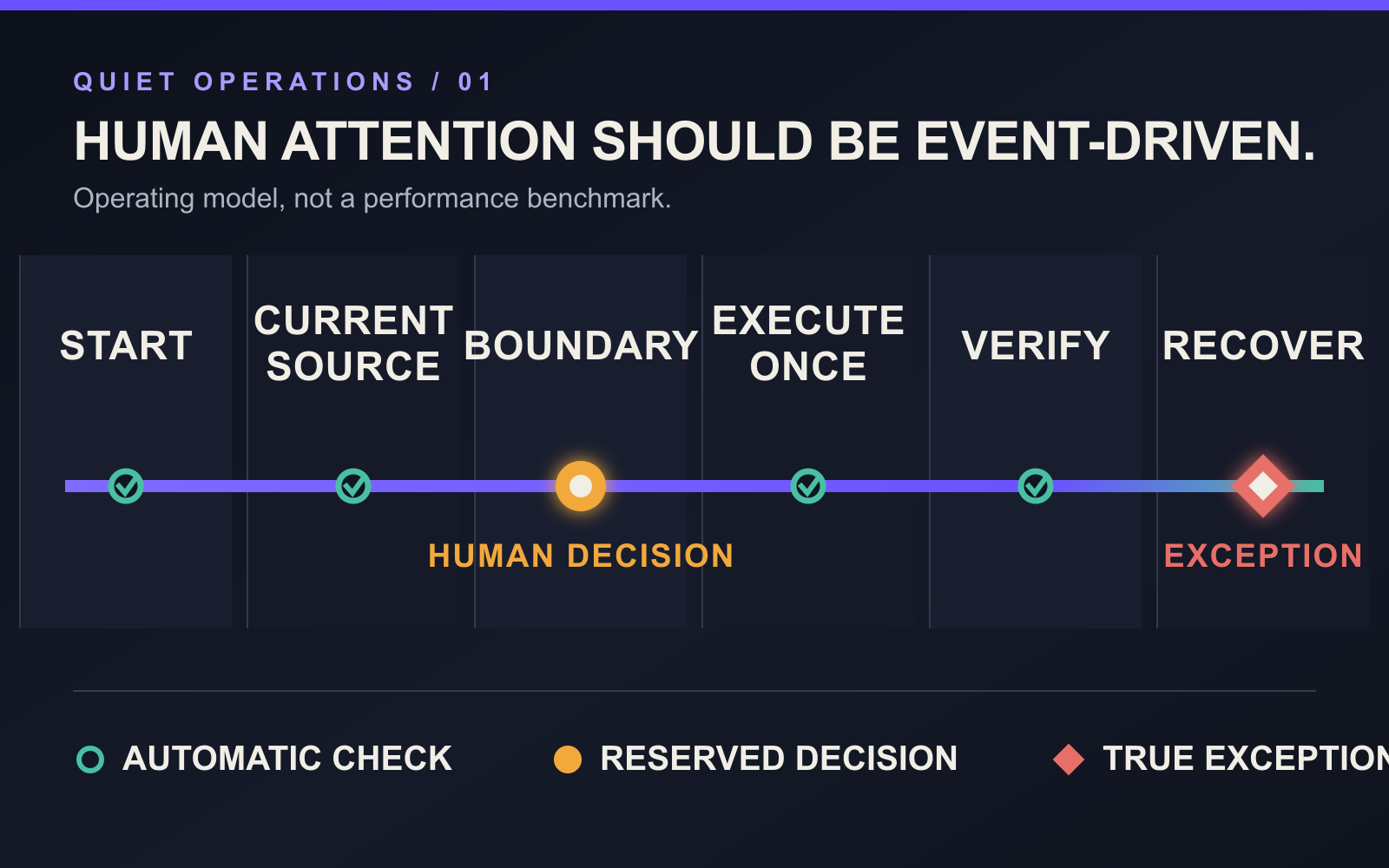
The vendor-renewal job becomes quieter when “use the contract in the signed-agreements folder, apply the policy marked current, prepare but do not send a commitment, confirm the recommendation was saved to the vendor record, and stop on conflicting terms” replaces a loose instruction to “handle renewals.”
Verify the destination, not the story
An agent can produce a confident summary of steps it attempted. That summary is not proof of the outcome. A draft that says “CRM updated” is weaker than a check that the intended field now contains the intended value. A message prepared is not a message sent. A provider accepting a request is not the same as the recipient receiving it.
Anthropic's engineering guide to evaluating AI agents makes this distinction concrete: grade the end state when possible, and avoid tests that insist on one brittle sequence of steps when several valid paths could produce the same result. For business work, define evidence at the destination:
- The record exists under the expected account and contains the required fields.
- The calendar event has the intended participants, time zone, and duplicate-prevention key.
- The report reconciles to the named source and exposes missing inputs.
- The message is either held for approval or present in the correct sent record, depending on the boundary.
This replaces nervous checking with a completion test. You can inspect the evidence later without reconstructing the entire run.
Review by consequence, not by step
Approving every tool call creates the appearance of control while transferring the workflow back to the operator. Giving every action the same freedom creates a different problem. A better design sorts actions by consequence.
| Lane | Typical work | Human involvement |
|---|---|---|
| Observe and log | Read-only collection, classification, internal checks | Review evidence on a schedule |
| Prepare and batch | Drafts, reconciliations, proposed updates | Review a useful batch, not each intermediate step |
| Hold for approval | External sends, payments, commitments, consequential changes | Make one bounded decision before the action |
| Stop and escalate | Conflicting policy, missing authority, unusual risk, uncertain state | Resolve, reassign, or change the operating rule |
The correct lane depends on your business, data, reversibility, customer promises, and tolerance for error. “Customer-facing” alone is not a full rule. A routine order-status reply and a concession to an angry strategic account carry different consequences.
For a deeper way to map permissions to consequence, the AI Agent Security Report separates READ, WRITE, SEND, SPEND, and DELETE without turning every action into the same approval rule.
Make every exception answerable in one glance
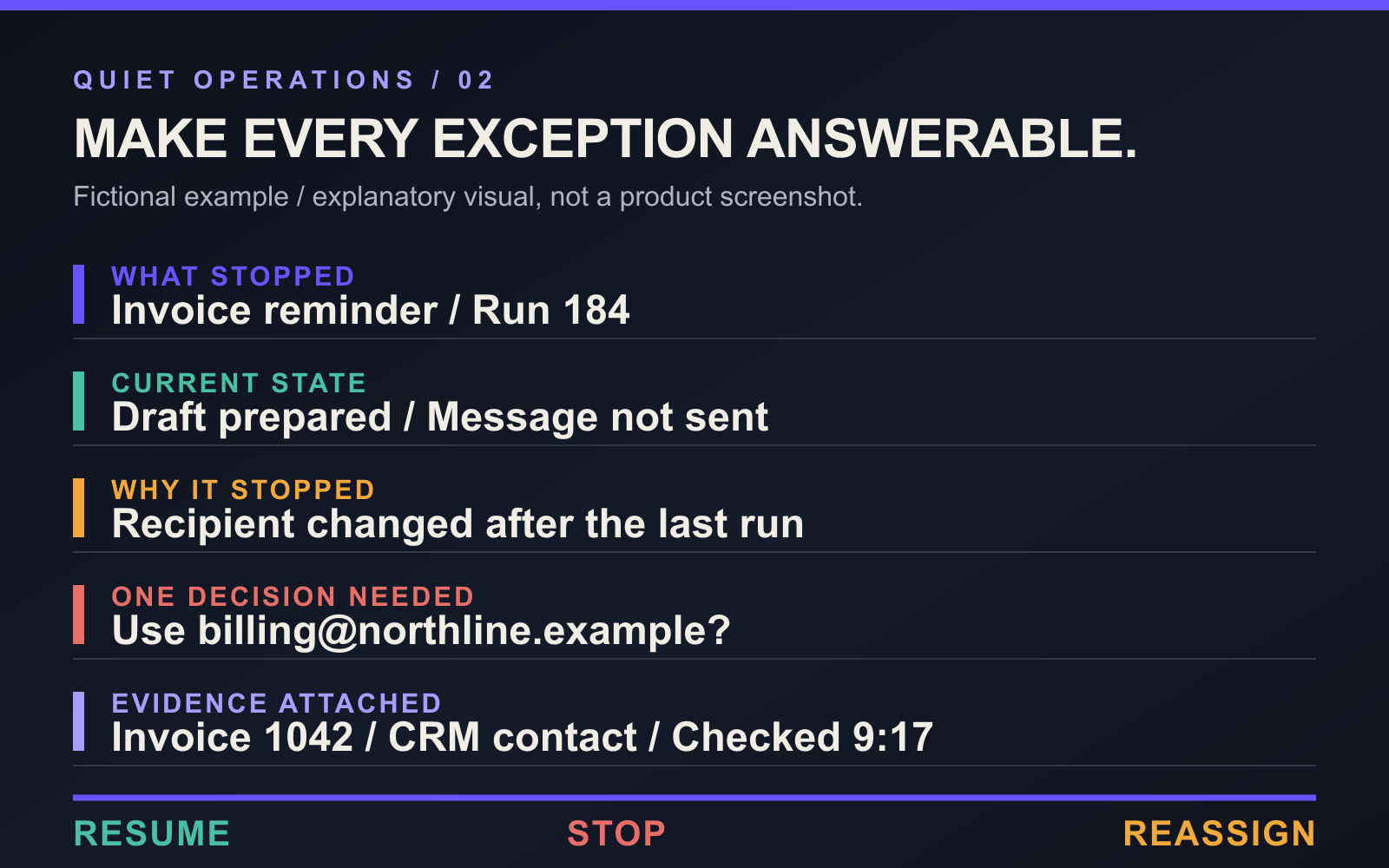
A notification that says “I need help” is not an escalation. It is an invitation to investigate. A useful exception brief lets the owner decide without reopening the job from the beginning.
Every escalation should answer five questions:
- What stopped? Name the job and exact step.
- What is the current state? Separate completed work from attempted work.
- Why did it stop? Cite the missing fact, conflict, policy, or failed system response.
- What one decision is needed? Propose a bounded next action and explain the consequence.
- What evidence is attached? Include the relevant record, source, timestamp, and error detail.
Review design affects whether people catch problems. A 2026 controlled experiment with 2,784 participants reviewing values presented as AI-generated suggestions found that requiring people to type a corrected value led to fewer corrections and more acceptance of incorrect suggestions. The suggestions were manually constructed in a Wizard-of-Oz design, and the task involved crowdworkers reviewing corporate-emissions tables—not business agents. The careful takeaway is that review friction changed correction behavior in that experiment. An approval should present the evidence and an editable proposed action; it should not make the reviewer rebuild the work just to disagree.
Timing matters too. A 2026 randomized field experiment in Alibaba's Taobao customer-service operations found that human intervention preserved service quality in technical escalations but was less effective after emotional escalations; earlier intervention was also important for sustaining post-escalation human effort. That does not establish a universal escalation threshold. It suggests that a handoff can lose value when it arrives after the exception has already become expensive to recover.
Turn the second correction into a system change
The first unusual correction may teach you something. The second correction in the same category is evidence that the operating design needs attention.
Update the smallest durable layer that caused the repeat:
- Change the source precedence if the agent keeps finding stale facts.
- Change the instruction if the expected choice is underspecified.
- Change the permission or approval rule if the agent repeatedly reaches the wrong boundary.
- Change the verification check if work is being reported complete too early.
- Change the job itself if exceptions are more common than the routine path.
Then test both sides of the new rule: a case where the behavior should happen and a similar case where it should not. If you teach “escalate high-value renewals,” test a high-value renewal and a routine renewal. One-sided examples often create an agent that over-escalates and interrupts you more, not less.
Keep changes versioned. If a new instruction produces worse behavior, restore the earlier configuration while you investigate. Configuration history is valuable, but it is not a universal undo button: restoring an agent does not unsend a message or reverse every action already taken in another system.
Reduce checking only after the evidence earns it
Do not jump from watching every run to watching none. Reduce attention in stages, based on observed outcomes for this job.
While behavior is changing, review every run against the finish state. Once the normal path is stable, keep approval on consequential actions and sample ordinary outcomes. After an instruction, tool, source, or policy changes, temporarily return to closer review. The rate is a management choice, not a universal percentage.
Track attention as carefully as output volume:
- Unplanned intervention rate: the share of runs that pulled a person into ordinary execution.
- Rescue minutes per accepted outcome: total unplanned human time divided by outcomes that reached the defined finish.
- Repeat-exception share: how many exceptions belong to a cause already seen.
- Correct routing rate: whether the run completed, held for approval, or escalated in the lane you intended.
- Sampled outcome quality: whether a review sample actually satisfies the business standard.
A quiet agent that produces weak outcomes is not a success. Neither is a highly accurate agent that consumes so much verification time that a person could have completed the work faster. The useful unit is accepted work with its human-attention cost attached.
To translate platform, usage, oversight, maintenance, and correction into an all-in financial model, use the AI Agent Cost & ROI Report.
Sometimes babysitting means the job is wrong
Some workflows resist quiet operation because the uncertainty is the work. Reconsider the assignment when:
- Verifying the result takes as much judgment or time as producing it.
- The policy changes faster than anyone can maintain a current source.
- Most cases require negotiation, empathy, accountability, or authority.
- The decisive system is unsupported or cannot expose a reliable result.
- The action is hard to reverse and the consequence of a mistake is high.
In those cases, use AI to prepare evidence, draft options, or reduce search time while a person owns the decision. Moving a job back to a human is not failure. It is better job design than forcing autonomy where every case needs interpretation.
Turn constant supervision into exception-based management with Praxivara
You do not need to manually assemble every API call, scheduler, state check, approval loop, alert, and run ledger described in this guide. With Praxivara AI agents, you describe the recurring job in plain language, connect the supported systems involved, and review a visual Blueprint before putting the agent to work.
Start with a narrow role and representative cases. Give the agent the policies, reference files, and durable facts it needs through Knowledge and Memory. Run it on demand while the behavior is changing, then move it to a schedule or supported event trigger when the ordinary path is consistent.
Define where human judgment belongs. Praxivara can pause an entire run or selected actions for approval. Connected WhatsApp, iMessage, Telegram, and SMS channels can carry approval requests and focused questions, so a consequential decision can reach you without turning every step into a live chat. The exact capabilities available depend on the connected business systems used by the job.
Manage from evidence after launch. Deliveries holds finished work. Activity shows run timelines, including source, status, tool actions, outcomes, and recorded errors. Errors groups failed steps—including ones inside otherwise successful-looking runs—along with failed and stuck runs, and supplies a likely cause and suggested fix. You can pause the agent, revise its Blueprint, or restore an earlier core configuration when necessary.
Praxivara does not remove accountability or promise that software will never need review. It concentrates oversight around the moments where human judgment changes the outcome: defining the role, approving consequences, resolving real exceptions, and improving the operating design.
Build the job around exceptions, not interruptions. Describe your first Praxivara agent, review its Blueprint and approval rules, and see what a quiet run could look like in your business.
The best AI employee knows when not to need you
The operator in the vendor-renewal example should still set policy, approve a commitment, and handle a genuine conflict. They should not spend Tuesday locating the same contract, repeating the same rule, or checking whether a routine record exists.
Measure the rescue work. Fix its repeated causes. Verify outcomes at the destination. Make every escalation complete enough to answer. Then reduce checking only as the evidence earns it.
The goal is not to remove the human from the system. It is to spend human judgment only where human judgment changes the outcome.