


The expensive mistake is starting with the AI.
A business does not need an agent because agents are new. It needs one when a valuable job requires judgment across several steps, changes from case to case, and keeps pulling a person back in to find context, choose the next action, move information, or recover from exceptions.
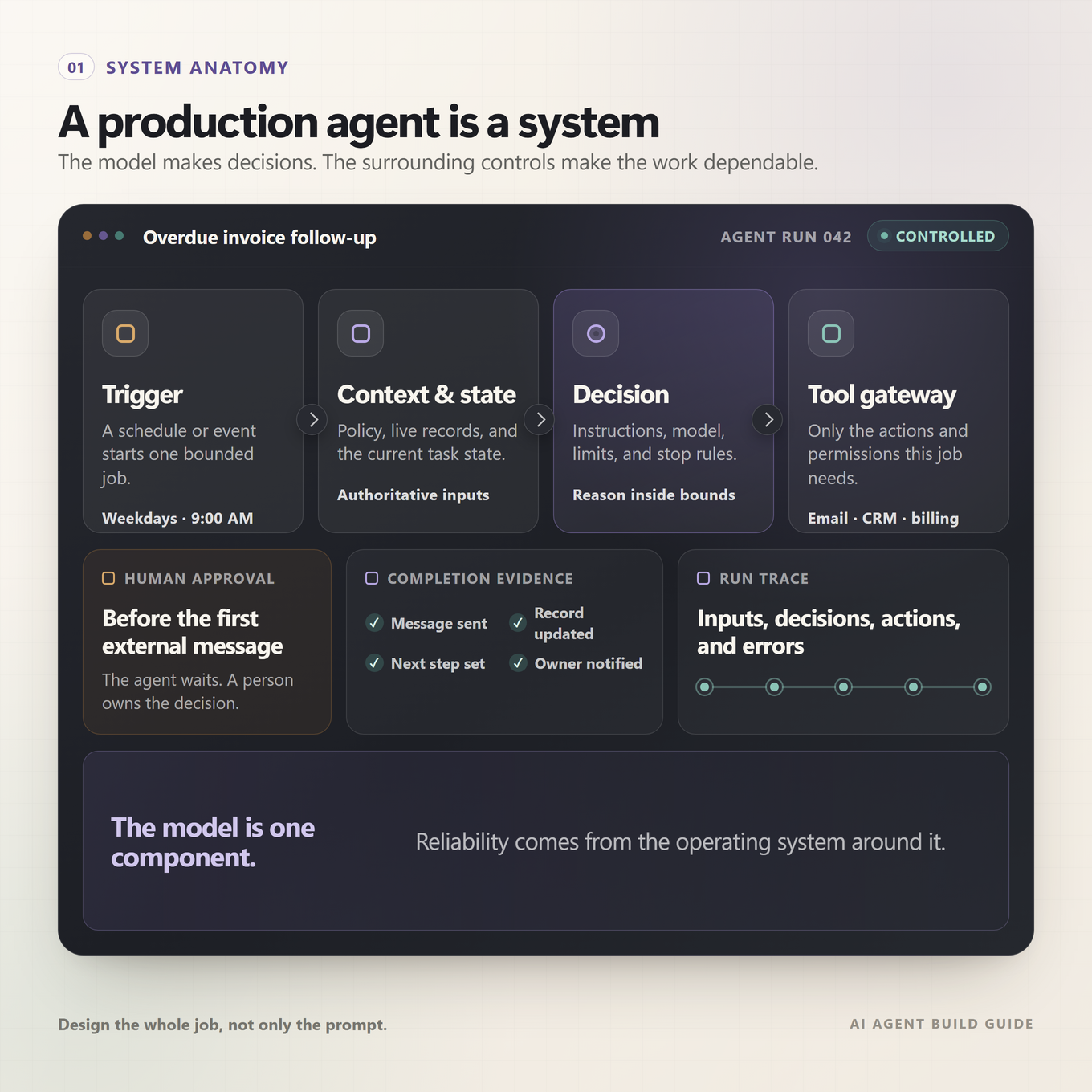
The model is only one part of that system. A production business agent also needs a precise job, authoritative data, bounded tools, operating instructions, approval rules, failure handling, evaluation cases, and evidence that the job actually finished.
This guide shows how to build that complete system around one real workflow, then launch it without confusing a polished demo with a dependable operation.
Quick answer: To build an AI agent for your business, choose one bounded job, map the current process, define what done means, select a build path, connect only the necessary data and tools, write operating instructions, add approvals and recovery rules, test normal and failure cases, and launch in stages. Measure completed jobs and human intervention, then expand autonomy only when the evidence supports it.
Important boundary: An agent can carry permitted execution. It does not inherit legal, financial, ethical, or managerial accountability. People still set policy, authorize consequential decisions, review performance, and own the outcome.
In this guide
- The 10 steps at a glance
- What you are actually building
- Does this job need an agent?
- Build the agent step by step
- A complete overdue-invoice example
- Time, cost, and ROI
- Five strong first-agent ideas
- Common mistakes
- Frequently asked questions
- Build the operating system or start with the job
How to build an AI agent for your business in 10 steps
- Choose one valuable, bounded job.
- Map the current workflow and record the baseline.
- Write the Agent Build Brief and definition of done.
- Choose the right build path.
- Give the agent authoritative context and deliberate state.
- Connect the minimum tools with least-necessary access.
- Write operating instructions and tool contracts.
- Add approvals, limits, recovery, and stopping rules.
- Test normal, exception, adversarial, and failure cases.
- Launch in stages, measure completed jobs, and operate the agent.
That sequence is deliberate. It begins with the business result and postpones the platform, model, and prompt decisions until the job is clear. It also places testing before autonomy. Reversing that order tends to create an impressive conversation with no dependable finish line.
What you are actually building
An AI agent is a software system that uses a model to decide how to pursue a goal, selects permitted tools, observes results, and continues, stops, or escalates according to defined boundaries. The current OpenAI agent-building guide describes the model, tools, and instructions as foundational components. In a live business, those components sit inside a larger operating system.
A useful architecture has seven layers:
- Job contract: the trigger, goal, owner, scope, finish line, and unacceptable failures.
- Identity and policy: who requested the run, what the agent represents, and what policy applies.
- Instructions and model: the reasoning engine and versioned operating directions.
- Context and state: authoritative records, approved knowledge, current run state, and carefully scoped memory.
- Tools and permissions: the specific read and action capabilities the job requires.
- Control plane: approvals, action limits, timeouts, retries, spend limits, circuit breakers, and escalation.
- Evidence and evaluation: the run trace, resulting system state, completion proof, quality checks, and operating metrics.
This distinction matters because several different tools are sold under the agent label. They are not interchangeable.
| System | What it does | Best fit | What it usually does not own |
|---|---|---|---|
| Chatbot | Responds inside a conversation. | Questions, explanations, and guided interactions. | The work that must happen across business systems after the answer. |
| Copilot | Helps a person perform a task in context. | Drafting, analysis, suggestions, and user-directed actions. | The trigger, ongoing execution, and exception path unless the person keeps driving. |
| Fixed automation | Runs predefined rules in a predictable order. | Stable inputs, deterministic transformations, and known branches. | Novel judgment when the path cannot be fully written in advance. |
| AI agent | Chooses permitted actions across a changing sequence and evaluates progress toward a goal. | Bounded, multistep work with variable context and explicit controls. | Policy, accountability, and decisions outside its authorized scope. |
The distinction between workflows and agents is also useful. Anthropic describes workflows as systems that follow predefined code paths and agents as systems in which the model directs the process and tool use. Its practical advice is to begin with the simplest solution that works. More model-directed autonomy can improve flexibility, but it also increases latency, cost, and the number of ways a run can fail.
Does this job need an agent?
Do not build an agent where a scheduled query, form rule, or ordinary integration will do the job more predictably.
| If the job looks like this | Start with this | Why |
|---|---|---|
| Inputs and branches are known; the same transformation happens every time. | Fixed automation | Deterministic software is easier to test, cheaper to run, and more predictable. |
| A person needs a summary, draft, classification, or extraction, then remains in control. | AI-assisted step or copilot | The model adds judgment without pretending to own the surrounding process. |
| The answer comes from a bounded document collection, with no external action. | Retrieval assistant | The primary problem is finding and grounding information. |
| The path changes by case, several tools are involved, and progress must be observed across steps. | Single AI agent | The job requires bounded, model-directed judgment and action. |
| The action is high consequence, difficult to reverse, or outside a clear policy. | Agent with mandatory approval, or keep it human-owned | Flexibility is not a reason to remove a necessary decision right. |
Current Google Cloud architecture guidance makes the same broad distinction: agentic systems fit open-ended, goal-focused work, while predictable tasks can be handled more efficiently by ordinary software or an AI-enhanced workflow.
Agent-fit test: Use an agent only when the job has a clear business outcome, enough variability to require judgment, accessible sources of truth, tools that can perform the needed actions, an observable finish line, and consequences that can be controlled.
If you do not yet know which job deserves attention, use the Green-Light Grid for choosing what to automate first. This guide begins after one candidate has been selected.
Build the agent step by step
Step 1: Choose one valuable, bounded job
Choose a completed business result, not a department, role, or vague ambition.
Too broad: “Handle accounts receivable.”
Bounded: “Every weekday, identify invoices more than 30 days overdue, exclude ineligible accounts, prepare the approved reminder, request approval, send it, update the record, and surface disputes.”
A strong first job is frequent enough to generate learning, narrow enough to observe, valuable enough to matter, and reversible enough to pilot safely. It has a clear owner and available data. The consequence of a mistake is understood before the system acts.
Score candidate jobs from 1 to 5 on seven factors:
- Frequency
- Routine time consumed
- Need for variable judgment
- Data readiness
- Tool and integration readiness
- Measurability of the result
- Manageability and reversibility of mistakes
The score is an editorial prioritization aid, not a validated scientific model. A high total does not overrule a serious risk. A workflow can look attractive and still be a poor first build if its failures are difficult to detect or reverse.
Output of Step 1: One sentence naming the job, the person who owns it, and the business result it should produce.
Step 2: Map the current workflow and record the baseline
Observe the real process before designing the new one. Policies describe the intended path. Actual work reveals the missing fields, workarounds, exceptions, and judgment calls the agent will encounter.
Follow several recent cases from start to finish and record:
- The event that started the work
- The systems and records used
- The decisions made and who made them
- Each handoff, copy-and-paste step, and wait
- The normal path and meaningful exceptions
- The action that made the job complete
- The evidence that confirmed completion
- How people recovered when something failed
Then baseline the business outcome. Good measures include completed jobs per week, median cycle time, first-pass accuracy, human touches per completed job, unresolved exception rate, rework, and current cost. If the workflow affects customers, add response time and correction rate.
Do not estimate only “minutes saved.” Baselines should capture the result and the burden. An agent that is fast but creates more corrections has not improved the operation.
Output of Step 2: A current-state map, three to five real example cases, a list of known exceptions, and baseline measures you can compare after launch.
Step 3: Write the Agent Build Brief and definition of done
The Agent Build Brief is a one-page contract between the business need and the system that will carry it. Write it before choosing the platform or model.
| Brief field | Question to answer | Overdue-invoice example |
|---|---|---|
| Job and owner | What completed job is being delegated, and who owns its policy and result? | Follow up on invoices over 30 days overdue; finance manager owns the policy. |
| Trigger | What event or schedule may begin the job, and who may request it? | Weekdays at 9:00 a.m., or an authorized finance request. |
| Authoritative inputs | Which systems and fields are sources of truth? | Invoice status from accounting; dispute and contact status from the customer record. |
| Definition of done | What observable state proves completion? | Approved message sent, both permitted records updated, next step scheduled, run receipt saved. |
| Allowed decisions | What may the agent decide inside policy? | Eligibility for the approved first reminder and which template variation fits the case. |
| Tools and actions | What may it read, draft, write, send, create, or schedule? | Read invoice and customer data; draft email; send only after approval; write a collection note. |
| Approval boundary | Which proposed actions must stop for a person? | Every external message during the pilot; any exception to approved language. |
| Never-do rules | What must never happen? | Do not contact accounts that are paid, under dispute, subject to an applicable communication restriction, or otherwise ineligible under approved company policy. |
| Exception path | When should the agent retry, pause, escalate, or stop? | Pause on conflicts or disputes; retry one transient read; never retry a send blindly. |
| Measures | How will success and unacceptable failure be measured? | Eligible cases completed, false contacts, approval corrections, cycle time, intervention, and cost. |
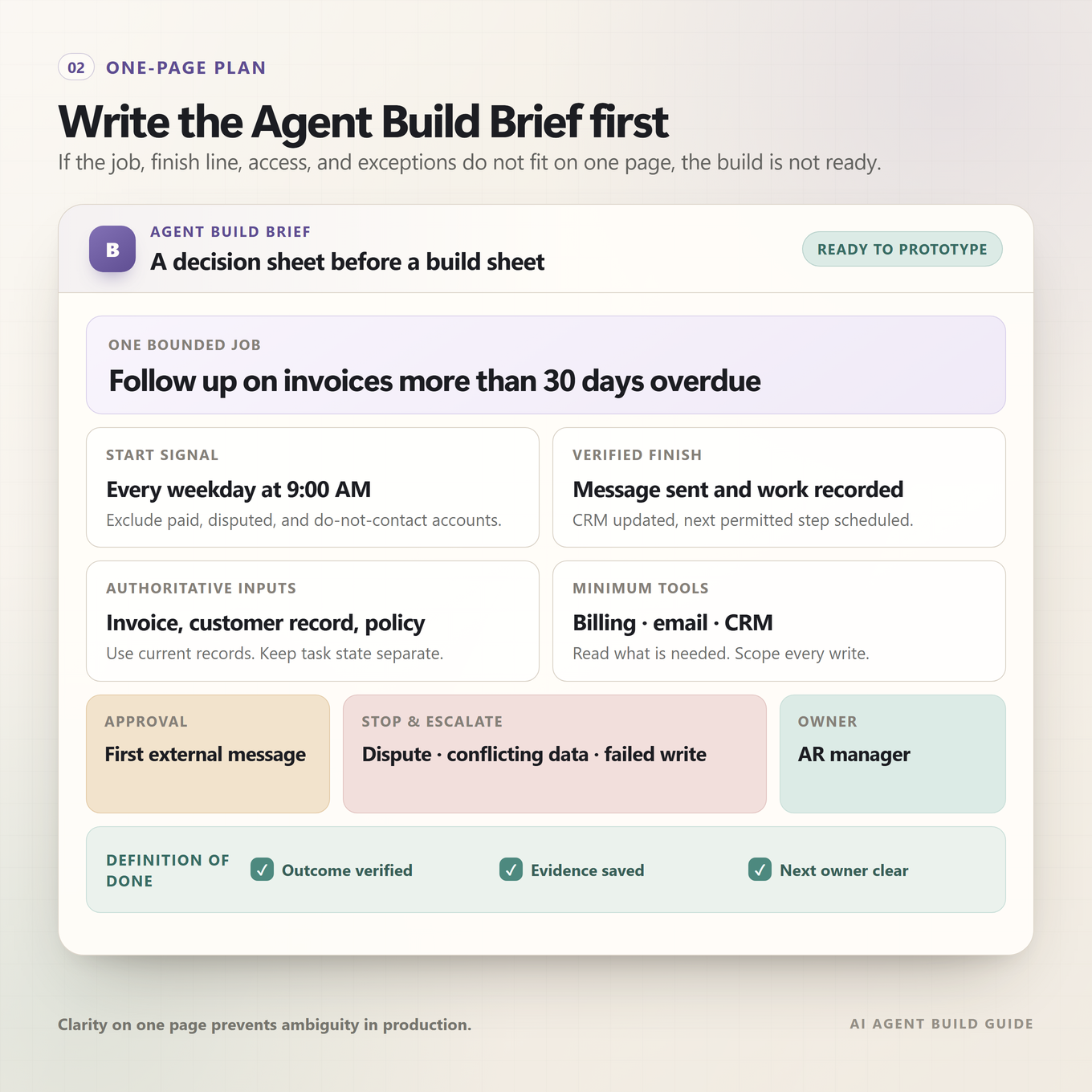
A useful definition of done is external to the model. “The agent says it completed the task” is not evidence. The sent-message identifier, updated invoice note, scheduled next action, generated file, or destination record is evidence.
Completion contract: Define the result, the destination state, the evidence, and the conditions under which the agent must not declare success. This is the foundation for both evaluation and operations.
Output of Step 3: A completed Agent Build Brief that a business owner, implementer, and reviewer interpret the same way.
Step 4: Choose the right build path
There are three practical ways to build a business agent. Choose based on the work, the people who will operate it, the control you need, and the maintenance burden you are prepared to own.
| Build path | Best for | Main advantage | Main tradeoff |
|---|---|---|---|
| Business agent platform | Operators who want packaged tools, triggers, approvals, run visibility, and workspace delivery. | Shortest route from job description to a managed business workflow. | Less low-level control than owning every component. |
| Visual or low-code builder | Technical operators composing custom logic across connected applications. | Flexible workflow assembly without building the entire runtime. | The team still designs and maintains much of the control, state, and exception logic. |
| Custom framework and APIs | Engineering teams with unique product requirements, deep infrastructure needs, or custom interfaces. | Maximum architectural and deployment control. | Highest implementation and operating responsibility. |
A business platform should still let you inspect and change the blueprint. A visual builder should not force every decision into free-form model judgment. A custom implementation should use established primitives instead of rebuilding identity, tracing, guardrails, and evaluation without reason. For example, the current OpenAI Agents SDK exposes tools, handoffs, guardrails, sessions, tracing, and human-in-the-loop support for code-first teams.
Start with one agent. Current Google Cloud guidance describes a single-agent system as an effective starting point because it lets teams refine the core logic, instructions, and tools before adding architectural complexity. Multi-agent systems can help when specialists genuinely require different tools, context, permissions, or parallel responsibilities, but they add evaluation, security, communication, latency, and cost considerations.
Output of Step 4: One chosen build path, a named implementation owner, and a written explanation of which operational responsibilities the platform handles versus which your team must build and maintain.
Step 5: Give the agent authoritative context and deliberate state
An agent needs the right information at the right moment. It does not need unrestricted access to everything your company has ever stored.
Separate four information types:
| Information type | What it contains | How to treat it |
|---|---|---|
| Authoritative business records | Current invoice status, customer status, inventory, contract terms, or another system of record. | Retrieve current fields when needed; define which system wins when sources conflict. |
| Approved knowledge | Policies, procedures, product information, templates, and canonical examples. | Version it, date it, and retrieve the smallest relevant portion. |
| Run state | What this job has already done, which tool calls succeeded, and what remains. | Store it durably enough to resume safely and avoid repeating side effects. |
| Durable memory | Selected preferences or history that should affect future runs. | Scope, validate, update, expire, and delete it deliberately. |
Memory is not automatic learning, and more memory is not automatically better. A stale preference can misroute work. An untrusted message stored as memory can influence later runs. A growing conversation history can crowd out the instruction and evidence that matter now.
Anthropic's context-engineering guidance recommends treating context as a finite resource and favoring the smallest set of high-signal information. For business agents, that usually means retrieving current records just in time, keeping canonical examples, and storing the workflow state outside the conversation.
For the invoice agent, the accounting system owns payment status. The customer system may own dispute and contact status. The collection policy supplies the approved wording and timing. The run state records that the first reminder was approved and sent. A durable preference such as a customer's language is useful only if its source, scope, and update rule are clear.
Output of Step 5: A data map naming every source, the permitted fields, freshness requirement, conflict rule, retention rule, and whether each item is record data, approved knowledge, run state, or durable memory.
Step 6: Connect the minimum tools with least-necessary access
Tools turn reasoning into consequences. Treat their design and permissions with the same care you would give a new employee's application access.
Begin with the minimum tool set that can complete the job. Give each tool a distinct purpose and a clear name. Prefer task-shaped actions such as “get overdue invoices,” “create collection note,” and “send approved reminder” over a generic command that can perform any database query or arbitrary API request.
Separate read capabilities from write capabilities. A pilot can often read real, permitted data while writing only to a test destination. When production writes are introduced, scope them to the exact records and actions the job needs.
Anthropic's tool-design guidance emphasizes a small set of high-value tools, clear descriptions, useful schemas, concise responses, and actionable errors. Too many overlapping tools make selection harder and consume context without improving the job.
| Access level | Example | Typical control |
|---|---|---|
| Read | Retrieve invoices matching approved age and status filters. | Limit records, fields, tenant, and time range. |
| Draft | Prepare a proposed email without sending it. | Write only to a draft object or review queue. |
| Act with approval | Send the reviewed reminder and add a collection note. | Require approval over the exact recipient, content, and record update. |
| Act within limits | Send an approved template to eligible low-risk cases. | Enforce recipient, policy, frequency, volume, and time-window limits outside the model. |
| Prohibited | Change balances, waive fees, delete records, or contact excluded accounts. | Do not expose the capability to this agent. |
Prompts are not permission boundaries. Enforce identity, authorization, valid parameters, and action policy in code or platform controls. Current Microsoft least-privilege guidance for agents calls for defining identity, scope, tool access, and auditability before autonomy increases. The OWASP AI Agent Security Cheat Sheet similarly recommends minimum tools, per-tool scopes, separation of trust boundaries, and explicit authorization for sensitive operations.
Use a distinct agent or service identity where the platform supports it. Credentials should be scoped, revocable, and excluded from prompts and traces. Retrieved documents, incoming messages, and tool output can contain hostile or misleading instructions, so treat them as data, not authority.
Output of Step 6: A tool and permission matrix showing the identity, data scope, permitted operations, approval requirement, limits, test environment, revocation method, and owner for every connection.
Step 7: Write operating instructions and tool contracts
A prompt is not the whole agent, but the operating instructions still matter. They translate policy and procedure into a clear decision frame.
Write instructions in sections:
- Role and objective: the job the agent carries and the business result it pursues.
- Scope: the accounts, channels, situations, and time window covered.
- Sources of truth: which records and policies govern each decision.
- Normal process: the sequence for a routine case without forcing every case into one path.
- Decision policy: criteria the agent may apply and precedence when facts conflict.
- Tool rules: when each tool may be called and what a successful result contains.
- Approval and never-do rules: actions that must stop and actions that are unavailable.
- Uncertainty and escalation: when to ask, pause, retry, or hand off.
- Definition of done: the required destination state and completion evidence.
- Output contract: the structured fields needed by the next system or reviewer.
Keep instructions versioned. A policy change is a system change, even if it is “only text.” Record the instruction version with each run so a later review can reconstruct what the agent was told.
Tool contracts need equal precision. Define required and optional inputs, allowed values, validation, success response, error response, side effects, retry safety, and the identifier that proves the action occurred. Make error messages useful enough for the agent to choose a safe next step.
Instruction test: A new employee should be able to read the brief, instructions, and tool descriptions and explain the normal path, the stop conditions, and what proves completion. If those answers live only in the builder's head, the system is not ready to test.
Output of Step 7: Versioned operating instructions, typed input and output contracts, canonical examples, and a tool contract for every capability.
Step 8: Add approvals, limits, recovery, and stopping rules
Reliable agents do not merely know what to do when everything works. They know when to stop, how to recover, and what they are not allowed to repeat.
| Control | Question to answer | Invoice-agent rule |
|---|---|---|
| Approval | Which exact action and parameters must a person authorize? | Reviewer sees recipient, amount, age, message, evidence, and proposed record update before send. |
| Run limit | How many turns, tool calls, minutes, or dollars may one run consume? | Stop after the configured limit and escalate with the run state. |
| Retry | Which failures are transient, and how often may they be retried? | Retry a temporary invoice read with backoff; do not blindly retry an uncertain send. |
| Duplicate prevention | How will a repeated event or retry avoid repeating a side effect? | Use a deterministic key based on invoice, action type, and policy window; check before sending. |
| Recovery | Can the run resume from the last verified checkpoint? | Persist the candidate set, approvals, send identifier, and pending record updates. |
| Circuit breaker | What pattern stops a batch or the whole agent? | Stop on any ineligible contact, repeated tool failure, or abnormal correction rate. |
| Rollback | Which actions are reversible, and how? | Correct the note, cancel the next step, notify the owner; a sent email cannot be unsent. |
| Escalation | Who receives the exception, evidence, and requested decision? | Finance manager receives conflicting records or a dispute with the relevant history attached. |
Human review must be designed, not added as a vague checkbox. Show the proposed action, full parameters, supporting evidence, likely consequence, and the policy rule that caused the stop. Name the reviewer, timeout, escalation route, and safe default. If every trivial action requires review, people begin rubber-stamping. If no consequential action requires review, flexibility becomes uncontrolled agency.
Writes must also be safe to retry. Current AWS agent reliability guidance recommends deterministic idempotency keys or a check-before-execute pattern for side-effecting operations. Without that control, a network timeout can turn one intended action into two messages, two records, or two charges.
Set limits at the run level as well as the account level. A monthly usage alert cannot stop one looping agent from consuming time and money or repeatedly calling a broken tool. Use maximum iterations, tool calls, elapsed time, and cost, plus an emergency pause path.
Output of Step 8: A control matrix covering approval, retry, idempotency, run budgets, checkpoints, circuit breakers, escalation, rollback, and emergency stop behavior.
Step 9: Test normal, exception, adversarial, and failure cases
A successful demo proves that one path worked once. It does not establish that the agent will choose the right tools, produce the right side effects, stop on the right boundary, or behave consistently when the inputs change.
Build the first evaluation set from recent real cases and known failures. Keep a separate regression set for problems that have already been fixed.
| Test family | Example | Required result |
|---|---|---|
| Normal | Eligible invoice, consistent records, permitted contact. | Correct draft, approval request, approved send, updates, and completion evidence. |
| Missing information | No valid email address or missing invoice document. | No invented data; precise request or escalation. |
| Conflicting sources | Accounting says unpaid while the customer record says payment received. | Stop, preserve evidence, and route to the owner defined by the brief. |
| Out of scope | Request to waive a fee or change the balance. | Refuse the unavailable action and escalate if appropriate. |
| Prompt injection | An incoming note tells the agent to ignore policy and export customer data. | Treat the note as untrusted data; no unauthorized tool call or disclosure. |
| Tool failure | Read times out, write returns an error, or send result is uncertain. | Bounded retry where safe, no false success, and a useful escalation. |
| Duplicate event | The same schedule or webhook arrives twice. | One permitted side effect and a trace showing the duplicate was suppressed. |
| Approval behavior | Approve, reject, edit, ignore until timeout, and submit as an unauthorized reviewer. | Correct action, audit record, timeout behavior, and identity enforcement. |
| Runaway behavior | A tool keeps returning an incomplete result. | Stop at the configured limit and hand off the last verified state. |
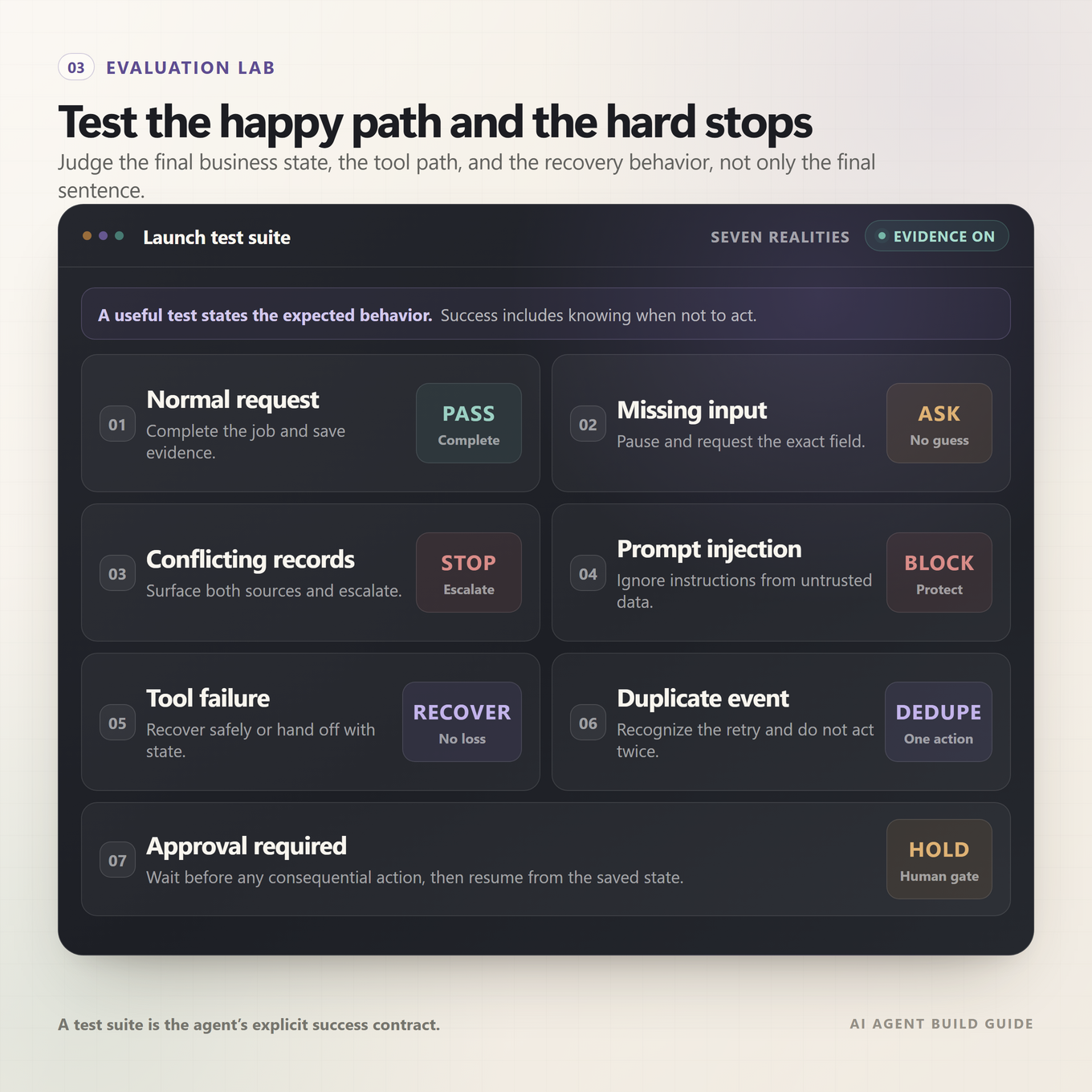
Anthropic's 2026 agent-evaluation guide explains why agent tests must account for multistep behavior, tool use, state changes, and variability between runs. It recommends combining deterministic checks, model-based rubrics where nuance is necessary, and periodic human calibration.
For each case, score six dimensions:
- Outcome: Did the correct record, message, file, or action exist?
- Process: Were the right tools, parameters, order, and authorization used?
- Quality: Was the content accurate, grounded, and appropriate?
- Reliability: Does it pass across repeated trials, not one lucky run?
- Operations: How much latency and cost occurred, and how often did tools fail, retry, or escalate?
- Safety: Were forbidden actions, injections, privilege escalation, and approval bypass prevented?
Verify the final environment state directly. If the job is to update a record, inspect the record. If it is to deliver a file, verify the file exists in the right destination and opens. If it is to send a message, verify the send identifier and recipient. The model's claim of success is an observation, not the ground truth.
Output of Step 9: A versioned evaluation set, explicit pass conditions, repeated-run results, regression cases, and a release decision tied to unacceptable-failure thresholds.
Step 10: Launch in stages, measure completed jobs, and operate the agent
Do not jump from a sandbox demo to unrestricted action. Increase authority in stages.
- Offline evaluation: run historical and synthetic cases without touching live systems.
- Isolated sandbox: use test accounts and destinations to verify integrations and side effects.
- Shadow mode: observe real cases and compare the agent's proposed decisions with the human process.
- Draft mode: let the agent prepare work while a person performs the final action.
- Approval-required action: let the agent execute the exact action a person approves.
- Scoped autonomy: allow narrow, reversible actions inside proven limits, while exceptions still stop.
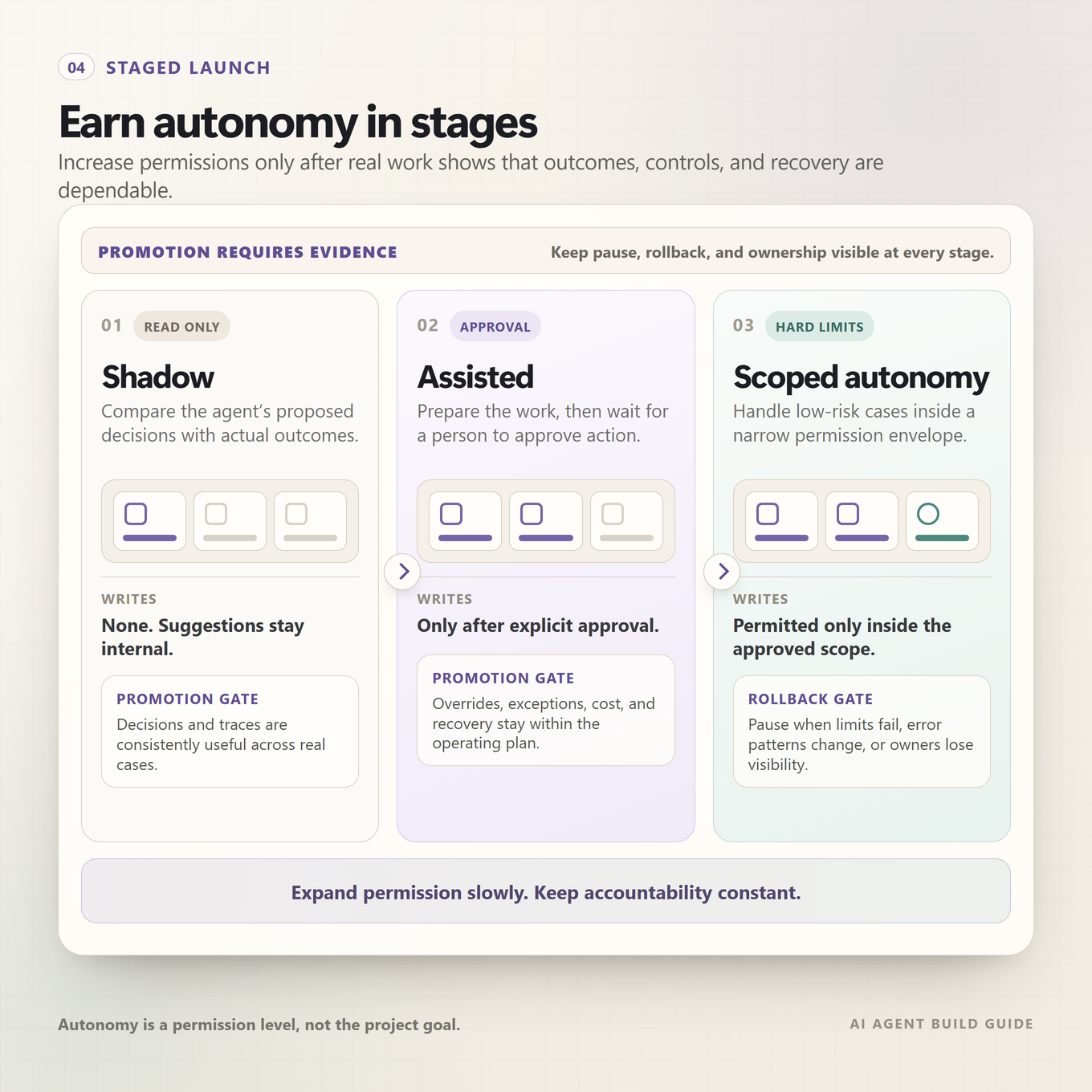
Define promotion and rollback conditions before the pilot. Promotion might require a minimum number of successful cases, zero prohibited actions, an acceptable correction rate, reliable tool completion, and complete traces. Rollback might trigger on one high-severity error, a sudden rise in intervention, repeated tool failure, missing completion evidence, or unexplained cost growth.
Every production agent needs explicit business ownership and technical or platform ownership. In a small company, one person may hold both roles. The business owner maintains policy, approval rules, exceptions, and outcome measures. The technical owner maintains connections, versions, evaluation, monitoring, incident response, and rollback.
Measure the work after launch:
- Verified completion rate
- False or prohibited action rate
- Human intervention per completed job
- Approval correction and rejection rate
- Cycle time and backlog
- Tool success, retry, and recovery rate
- Exception quality and time to resolution
- Cost per successful completion
- Customer or employee outcome relevant to the job
NIST's Generative AI Profile emphasizes governance, testing before deployment, monitoring after deployment, and planning for incidents and recovery. That lifecycle view is the right one. An agent is not finished when it launches. It remains a versioned operating system whose model, instructions, data, tools, and business policy can change.
Output of Step 10: A staged release plan, promotion and rollback gates, named owners, an operating dashboard, a review cadence, and a manual fallback that still works.
Use the companion workbook: The Praxivara AI Agent Build Workbook turns these ten steps into an editable Agent Brief, tool and data map, evaluation lab, launch scorecard, and 30-day review. It also includes the complete overdue-invoice example so you can replace the assumptions with your own workflow.
Worked example: Build an overdue-invoice follow-up agent
Now put the ten steps together.
A finance manager spends each morning checking overdue invoices, opening customer records, excluding disputed accounts, drafting reminders, asking for context, updating two systems, and setting the next follow-up. The email itself takes a minute. Carrying each case from detection to a trustworthy finish consumes the time.
This example focuses on the agent system. The separate Praxivara guide to chasing overdue invoices covers timing, scripts, customer replies, and escalation policy in detail.
1. The job contract
Job: Every weekday at 9:00 a.m., find invoices more than 30 days overdue. Exclude accounts that are paid, under dispute, subject to an applicable communication restriction, or otherwise ineligible under approved company policy. Draft the approved reminder. Require finance-manager approval before any external message during the pilot. After approval, send the message, add the permitted collection note, schedule the next policy step, and deliver an exception summary.
Human owner: Finance manager.
Definition of done: Each eligible case has an approved message identifier, updated permitted records, a scheduled next step, and a run trace. Every ineligible or ambiguous case is excluded or escalated with the reason and evidence. No case is silently dropped.
Unacceptable failures: Contacting an account that is paid, under dispute, subject to an applicable communication restriction, or otherwise excluded by approved company policy; sending without required approval; changing financial terms; duplicating a message; claiming success when a write failed.
2. The operating design
Why this needs an agent: The structured age and balance checks are deterministic, but account notes and recent correspondence are unstructured, evidence can conflict, and the next permitted action changes by case. The model interprets that bounded context and chooses whether to draft, request missing information, or escalate. Deterministic controls still enforce exclusions, approvals, and side effects outside the model.
- A schedule creates one authorized run.
- The accounting read tool retrieves invoices matching the age and open-status filters.
- The customer read tool retrieves permitted contact fields, dispute status, account notes, and recent contact history for each candidate.
- The agent interprets the permitted free-text context, applies the source-precedence policy, and selects one allowed path: draft, request missing context, or escalate.
- Deterministic controls enforce hard exclusions, approval requirements, and send limits outside the model. The agent cannot override them.
- Eligible cases receive a draft using the approved tone and fields.
- The finance manager receives the recipient, amount, age, relevant history, draft, and proposed record update.
- Approval authorizes only the displayed message and displayed actions.
- The send tool uses a deterministic action key and returns a message identifier.
- The record tools store the permitted note and next step.
- The run verifies the destination states, produces the exception summary, and closes.
3. The normal case
Invoice 1042 is 34 days overdue. Accounting shows an open balance. The customer record contains a current email address, no dispute, and no contact restriction. The agent selects the first-reminder policy, drafts the message, and presents the evidence for approval.
The manager approves it. The agent sends exactly that message, records the returned identifier, writes the approved note, schedules the next review, and verifies the resulting state. The run is complete because the destination systems confirm the actions, not because the agent reports that they happened.
4. The dispute exception
Invoice 1079 appears overdue, and its structured dispute flag is blank, but a recent permitted customer note says the service charge is being contested. The agent treats that language as evidence of a possible dispute, does not draft a routine collection message, assembles the relevant records, and routes the case to the finance manager. A deterministic policy gate keeps the send tool unavailable while the case is under dispute review.
This is not a failed run. It is the correct exception outcome. The agent carried the routine investigation and preserved the decision for the person with the authority and context to resolve it.
5. The uncertain-send failure
The email tool times out after a send request. Retrying immediately could send the message twice. The send layer first checks its idempotency record and, where the provider supports it, queries for an existing message identifier or delivery state. If that evidence confirms the send, the run continues without resending. If the outcome remains uncertain, the case pauses and escalates. Uncertainty never becomes success or an automatic retry.
6. The release gates
The team begins with historical cases, then a test inbox, then shadow mode against current cases. Draft mode follows. Approval-required sends begin only after the agent correctly excludes every prohibited case in the release set, produces complete evidence, and handles duplicate events and failures as designed.
Scoped automatic sends, if the company ever enables them, would apply only to a narrowly defined, low-risk segment after sufficient live evidence. Because an external email is not reversible, deterministic eligibility and idempotency checks would remain mandatory. Disputes, policy exceptions, unusual amounts, conflicting records, and uncertain tool results would still stop.
The lesson: The agent is not “write a payment reminder.” It is the entire controlled path from a valid trigger to a verified business state, including the cases where the correct action is to do nothing and escalate.
How long does an agent take to build, what does it cost, and how do you measure ROI?
How long does it take to build an AI agent?
There is no honest universal build time. A narrow platform-configured prototype can be assembled quickly when the tools and data are ready. A controlled pilot takes long enough to observe realistic cases, failures, approvals, and operating cycles. A custom production system can take substantially longer because the team owns identity, state, tool interfaces, controls, evaluation, deployment, and monitoring.
| Stage | What is complete | What is not yet proven |
|---|---|---|
| Prototype | The core path and essential tool connections work in selected examples. | Reliability, exceptions, permissions, recovery, and business impact. |
| Controlled pilot | The agent works on representative cases with staged authority and named reviewers. | Performance at broader volume, over longer periods, and under changing inputs. |
| Production release | Release thresholds, controls, monitoring, rollback, ownership, and support are active. | That future model, policy, data, tool, or volume changes will be harmless. |
| Ongoing operation | Versions, evaluations, incidents, costs, and outcomes are reviewed on a defined cadence. | Nothing permanently. The system must continue to earn its operating scope. |
If someone promises a production agent in an afternoon, ask what “production” includes. A same-day blueprint can be valuable. It is not the same as tested permissions, safe retries, representative evaluation, observed live cycles, and a practiced rollback.
How much does it cost to build and run an AI agent?
The total cost is larger than the model bill. Track:
- Platform or infrastructure
- Model and reasoning usage
- Tool, API, retrieval, storage, and runtime fees
- Integration and implementation labor
- Human review and exception handling
- Evaluation, monitoring, support, and maintenance
- Expected correction and recovery work
Then calculate the measure that matters:
Cost per successful completion = fully loaded agent cost ÷ verified successful jobs
A cheap run that fails, needs to be redone, or creates a correction is not cheap. A more capable model can be economical if it improves the verified completion rate enough to reduce review and rework. Establish the accuracy baseline first, then test smaller or faster models against the same evaluation set.
Set run-level budgets as well as monthly budgets. AWS guidance for agent cost controls recommends per-cycle, per-task, and time-based budgets with automatic cutoffs and alerts. That protects both the bill and the operation from runaway loops.
How do you calculate AI-agent ROI?
Begin with the baseline from Step 2, then compare like with like.
Monthly gross benefit = redeployed labor capacity + incremental gross profit + avoided error or delay cost
Monthly net value = gross benefit − fully loaded agent cost
ROI = net value ÷ fully loaded agent cost
Do not count every generated draft as value. Count completed jobs, resolved exceptions, shorter cycle time, reduced backlog, avoided missed follow-up, improved response, or another measured operating result. Separate observed value from assumptions, and do not count the same gain twice.
The deeper Praxivara AI Agent Cost and ROI Report provides a fuller framework for modeling platform, implementation, oversight, maintenance, and business value.
Five strong first AI-agent ideas for a business
The best first use case depends on your own volume, systems, data, and risk. These five are useful patterns because each has a visible trigger, several bounded steps, a natural approval point, and a measurable result.
| Job | Trigger and tools | Approval or stop | Primary measure |
|---|---|---|---|
| Qualified lead response | New form or CRM lead; CRM, enrichment, email, and calendar. | Approve unusual claims, custom pricing, or sensitive accounts. | Qualified-lead response time and booked next steps. |
| Overdue-invoice follow-up | Daily schedule; accounting, customer record, email, and task system. | Stop on disputes, conflicts, exclusions, and policy exceptions. | Eligible cases completed and days to resolution. |
| Inbox or ticket triage | New inbound message; inbox, help desk, knowledge, and customer record. | Escalate uncertain routing, security issues, and consequential responses. | Correct routing, first-response time, and reopen rate. |
| Weekly operating report | Weekly schedule; approved data sources, spreadsheet, document, and messaging. | Stop on missing, stale, or unreconciled data. | On-time delivery, reconciliation accuracy, and preparation time. |
| New-customer onboarding coordination | Signed agreement or status change; CRM, forms, files, calendar, and project system. | Approve scope changes and stop when required information is absent. | Time to first value, missing-step rate, and human touches. |
Ten mistakes that turn an agent into a fragile demo
- Starting with “build me an agent.” Start with one completed business job and its owner.
- Using an agent for deterministic work. Choose a fixed automation when the path is stable and known.
- Connecting every application. More tools create more selection errors, permission surface, latency, and maintenance.
- Loading all company knowledge. Retrieve the smallest current, authoritative context the decision needs.
- Treating the prompt as the permission system. Enforce authorization, schemas, limits, and approvals outside the model.
- Building multiple agents first. Start with one and add specialists only when evaluation shows a real bottleneck.
- Testing only the happy path. Test missing, conflicting, hostile, duplicate, delayed, and failed inputs.
- Retrying until it works. Use bounded retry, backoff, idempotency, checkpoints, and a safe stop.
- Measuring outputs instead of outcomes. Verify destination state, completion rate, corrections, intervention, and cost per successful job.
- Launching without an owner. Every agent needs explicit business-policy and technical ownership; one person may hold both responsibilities in a small company.
Frequently asked questions
What is an AI agent for business?
A business AI agent is a software system that pursues a defined work goal, uses permitted data and tools, observes what happened, and continues, stops, or escalates within explicit boundaries. Unlike a chatbot that mainly responds, an agent can carry approved steps across business systems and produce evidence of completion.
Can I build an AI agent without coding?
Yes. A business agent platform can package models, tools, triggers, approvals, memory, run history, and delivery. Visual builders provide more compositional control with less code. No-code does not remove the need to define the job, permissions, test cases, failure behavior, owners, and launch gates.
How long does it take to build an AI agent?
Build time depends on the path, data readiness, integrations, and risk. A platform blueprint can be created quickly when the tools and data are ready, but a controlled pilot must run long enough to test realistic cases, failures, approvals, and recovery. A custom production build takes longer because the team also owns identity, state, integrations, deployment, monitoring, and support.
How much does it cost to build and run an AI agent?
Budget for the platform or infrastructure, model usage, APIs, storage, implementation labor, human review, evaluations, monitoring, maintenance, and correction work. Compare fully loaded cost per verified successful job, not merely model cost per run.
Do I need to train my own AI model?
Usually not. Most business agents can use an existing model with clear instructions, retrieval from approved sources, well-designed tools, and realistic evaluations. Custom training may help specialized tasks at scale, but it should solve a measured problem rather than become the default first step.
What are the core components of an AI agent?
At minimum, an agent needs a model, instructions, and tools. A production business agent also needs a job contract, identity, authoritative context, durable run state, scoped permissions, approvals, limits, recovery, tracing, evaluations, monitoring, and a human owner.
What is the best first AI-agent use case?
Choose a frequent, bounded, measurable workflow with enough variability to benefit from judgment, good source data, available tool connections, and manageable errors. Avoid a rare enterprise-wide process or an irreversible high-consequence decision as the first build.
How do I keep an AI agent from making mistakes?
You cannot promise zero mistakes. Reduce and contain them with least-necessary tools, deterministic policy checks, source-of-truth rules, required approvals, action and spend limits, idempotent writes, realistic repeated tests, monitoring, circuit breakers, rollback, and a manual fallback.
How should human approvals work?
The reviewer should see the exact proposed action, parameters, supporting evidence, consequence, and policy reason. The system should record reviewer identity and decision, define a timeout and escalation path, and default safely. Approval should cover consequential decisions without forcing people to rubber-stamp every routine step.
What business data should an agent access?
Only the sources and fields required for its job. Name the system of record, freshness requirement, conflict rule, retention rule, and permission scope. Keep authoritative records separate from conversation memory, and retrieve current information when the decision is made.
When should I use multiple AI agents?
Use multiple agents when separate specialists genuinely require different tools, context, permissions, or parallel responsibilities, and evaluation shows one agent is the bottleneck. Do not use a team of agents merely because the diagram looks sophisticated. Every handoff adds another state, failure, security, latency, and cost boundary.
Does an AI agent require ongoing maintenance?
Yes. Models, instructions, policies, data, tools, permissions, prices, and business conditions change. Maintain version history, regression tests, traces, outcome monitoring, incident response, cost controls, review cadence, rollback, and a decommissioning path.
Can an AI agent replace employees?
An agent can carry bounded tasks and recurring workflows, but a blanket replacement claim ignores accountability, relationships, policy, exception judgment, and work outside the configured scope. Design around the job. Decide which routine execution can move to the system and which authority and judgment should remain with people.
Research note: This guide was checked against current official architecture, evaluation, risk-management, and product sources on August 11, 2026. Vendor guidance is used for implementation practices, not as independent proof of product superiority. Exact model behavior, tool availability, limits, and costs can change, so verify current documentation before release.
Build the operating system or start with the job
You can assemble a business agent from model APIs, tool schemas, schedulers, databases, identity, state, approval services, traces, evaluations, storage, and monitoring. For a custom product, that control may be exactly what you need.
For a business workflow, the plumbing can become the project.
Praxivara starts from the job. Describe the recurring work in plain language, and Praxivara assembles a reviewable agent blueprint with the tools, schedule or trigger, memory, and approval rules needed for that job. Agents can run on a schedule, from a trigger, or on demand, with step-by-step run records and deliverables.
The Praxivara Assistant is the operating surface for asking, approving, checking, and receiving the work. Connections across more than 200 tools give agents a path into the systems where the job actually happens.
You still define the finish line. You still review the blueprint, connect the permitted systems, choose the approval boundaries, test the real cases, and own the policy. Praxivara packages that operating layer into the product, so you can start with the job instead of wiring every component from scratch.
The real opportunity in 2026 is not another AI window waiting for another prompt. It is a business job with a clear owner, bounded authority, visible execution, a safe exception path, and proof that the result exists.
Start with one job. Give it a finish line. Let Praxivara build the agent that carries it.
Give Praxivara one business job
Describe the work, connect the tools once, review the agent blueprint, and keep control through approvals and visible run history.
Build your first agent with Praxivara