


The ticket closed twice. The customer was helped once.
Juniper Row Café is preparing to open when its manager sends Kestrel Café Systems a message: “The replacement filter still is not here, the machine has a red pressure alarm, and we open soon. The tracking page says delivered. Please do not send me the reset article again.”
Both companies in this example are fictional, but the support failure is painfully ordinary. The first ticket closed when the carrier marked the parcel delivered. The second closed after an automated reply linked to a troubleshooting article. Each system recorded an acceptable event. Neither event changed what was true at the café: the correct part was missing, the equipment was not safe to return to service, and the customer had already repeated the problem.
A weak support automation sees a new message and asks, “What should I say?” A useful AI Agent asks a harder set of questions. Which customer, location, device, shipment, and prior case does this concern? What is true now? What outcome does the customer need? Which actions are allowed? Which decision belongs to a person? What evidence would prove that the situation actually changed?
That shift—from generating a response to carrying a case—is the difference between automating conversation and automating customer support. The aim is not to make every interaction disappear into self-service. It is to move eligible work from the first message through context, judgment, action, handoff, and proof without losing the customer’s reality along the way.
The governing idea: a fast answer is useful only when it advances the customer toward a true outcome. If the system cannot show what changed, who owns the remaining work, or why the case is safe to close, the work is not finished.
The work customers never see is where AI agents become useful
Support looks like a conversation because the customer encounters a conversation. Behind a good reply, however, a representative may identify an account, connect several threads, inspect an order, check a device or subscription state, interpret policy, compare possible remedies, request an exception, make a change, confirm that the change took effect, update the case, and decide when to follow up. The written response is often the smallest artifact produced by that work.
This is where AI Agents can be materially different from reply generators. An Agent can be assigned a bounded service role with approved sources, supported tools, explicit limits, and a definition of done. It can reconstruct a case before asking the customer for information the business already holds. It can prepare a decision instead of forwarding a bare transcript. It can perform a permitted action and then read the affected system again. When confidence or authority runs out, it can preserve the work and put the right unresolved question in front of a person.
None of that means people become optional. A 2025 Quarterly Journal of Economics study of 5,172 customer-support agents found that access to a conversational AI assistant increased resolved issues per hour by 15% on average. Less-experienced workers gained more, while the most experienced agents saw small quality declines alongside small speed gains. The system suggested responses and humans remained responsible. That makes the research useful evidence for assistance and knowledge transfer, not proof that autonomous Agents should own every case.
The strongest design brief is therefore not “replace Tier 1” or “deflect more tickets.” Those goals encourage a system to optimize for disappearing conversations. A better brief names a case the business understands: reconcile delivery-status questions, gather evidence for a device fault, restore access after approved identity checks, prepare a warranty exception, or route a billing dispute with a complete record. The unit of automation is the support outcome, not the inbox.
That distinction changes the economics too. A short interaction can still create expensive downstream work if it causes recontact, duplicate fulfillment, a bad concession, an unnecessary dispatch, or a relationship-repair call. A longer interaction can be efficient when it collects the right evidence once and transfers the case with an owner. Measure the whole path, including work that moves outside the original thread.
Keep two records until they tell the same story
Two Records, One Resolution is the operating model we use in this guide. It is an editorial model for designing support work, not a published industry standard. It gives a team a simple way to notice when its customer-facing story has separated from operational truth.
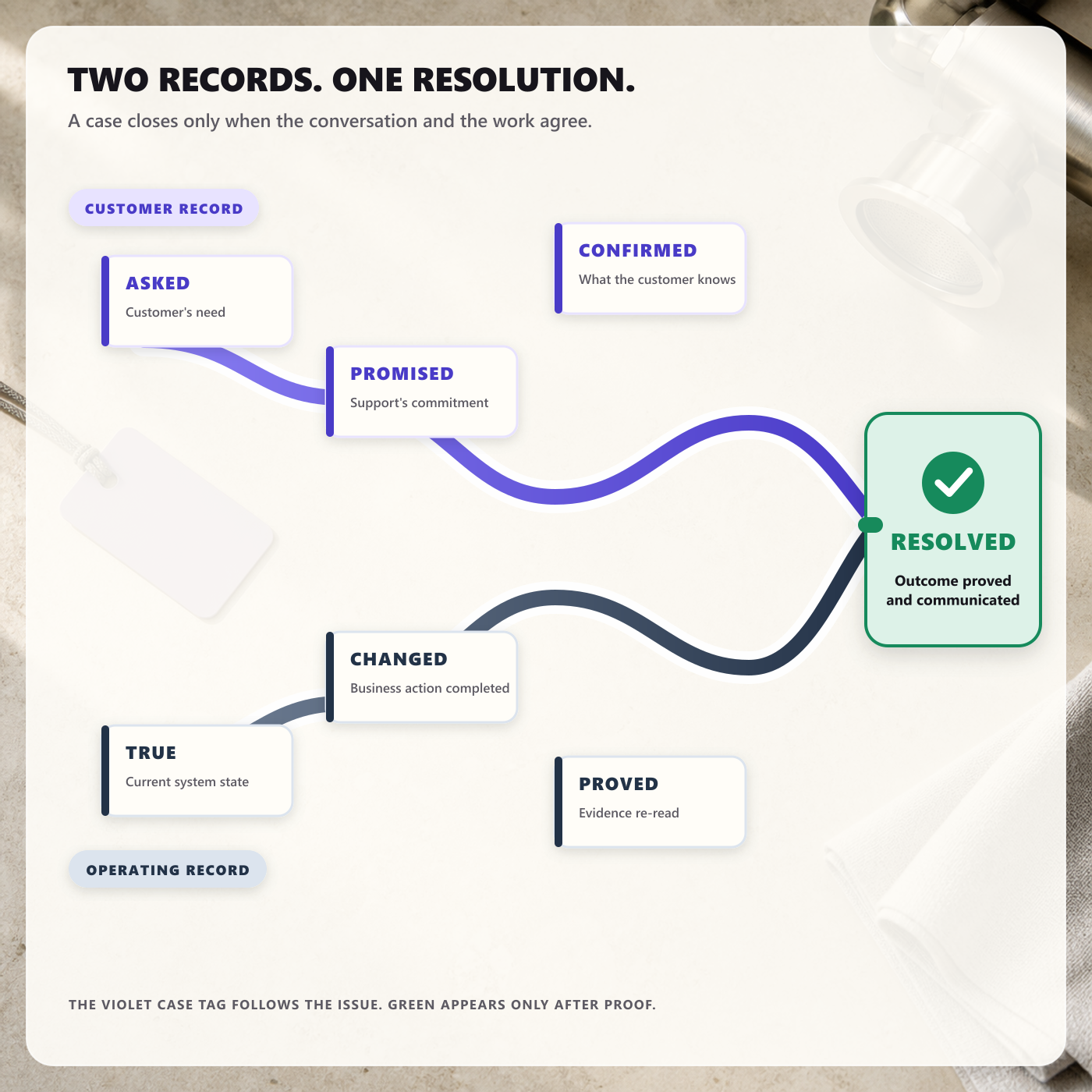
The conversation record
This record contains the original message, attachments, channel, prior exchanges, questions asked, answers given, promises made, customer emotion, and stated desired outcome. It should preserve the source rather than flattening everything into a summary. “Where is my filter?” and “I need the machine safe before opening” may share an intent label, but they do not describe the same finish line.
The conversation record is also where trust accumulates or drains. If the customer was promised an update, that promise becomes part of the case. If they already completed a reset sequence, asking them to repeat it is not neutral; it tells them the company did not retain the work. An Agent should know what has already been attempted and avoid manufacturing a fresh start for its own convenience.
The operating record
This record contains the matched customer and asset, identity confidence, authoritative sources, live state, relevant policy, tool results, approval decisions, actions attempted, current owner, deadlines, and proof. It distinguishes a request from permission and a tool call from an outcome. It also shows why an Agent stopped: no approved policy, conflicting data, a failed action, a consequential decision, or a customer who needs a person.
Human support teams maintain versions of this record across a help desk, CRM, commerce system, billing platform, device console, scheduling tool, and internal chat. The fragmentation is why a polished reply can be wrong even when every sentence sounds reasonable. The Agent’s job is not to ingest the entire company. It is to retrieve the minimum trusted context required for this case and keep the relevant evidence attached to the decision.
The resolution join
The records join when the customer-facing statement is supported by the operating evidence. If a message says a technician is booked, the schedule should contain the appointment. If it says a replacement was dispatched, the dispatch should have an accepted reference and the correct destination. If it says the machine is safe, the permitted service record or diagnostic state should support that conclusion.
Qualtrics’ 2026 research with 7,001 consumers across seven countries and seven industries found that perceived “understanding” was the behavior most tied to resolution; when issues went unresolved, understanding ratings were 37% lower. AI interactions scored better for friendliness than for understanding. This was self-reported, vendor-run research, so the relationship should not be read as causal. Its practical warning is still useful: friendly language can disguise a broken join between what the customer meant and what the operation did.
Keeping the two records synchronized prevents two opposite failures. Conversation-only automation produces sympathetic acknowledgements while the underlying condition remains untouched. Back-office-only automation changes records without a clear promise, explanation, or next owner. Good support needs both: operational work that changes reality and communication that describes that reality without exaggeration.
Follow one support case through the invisible middle
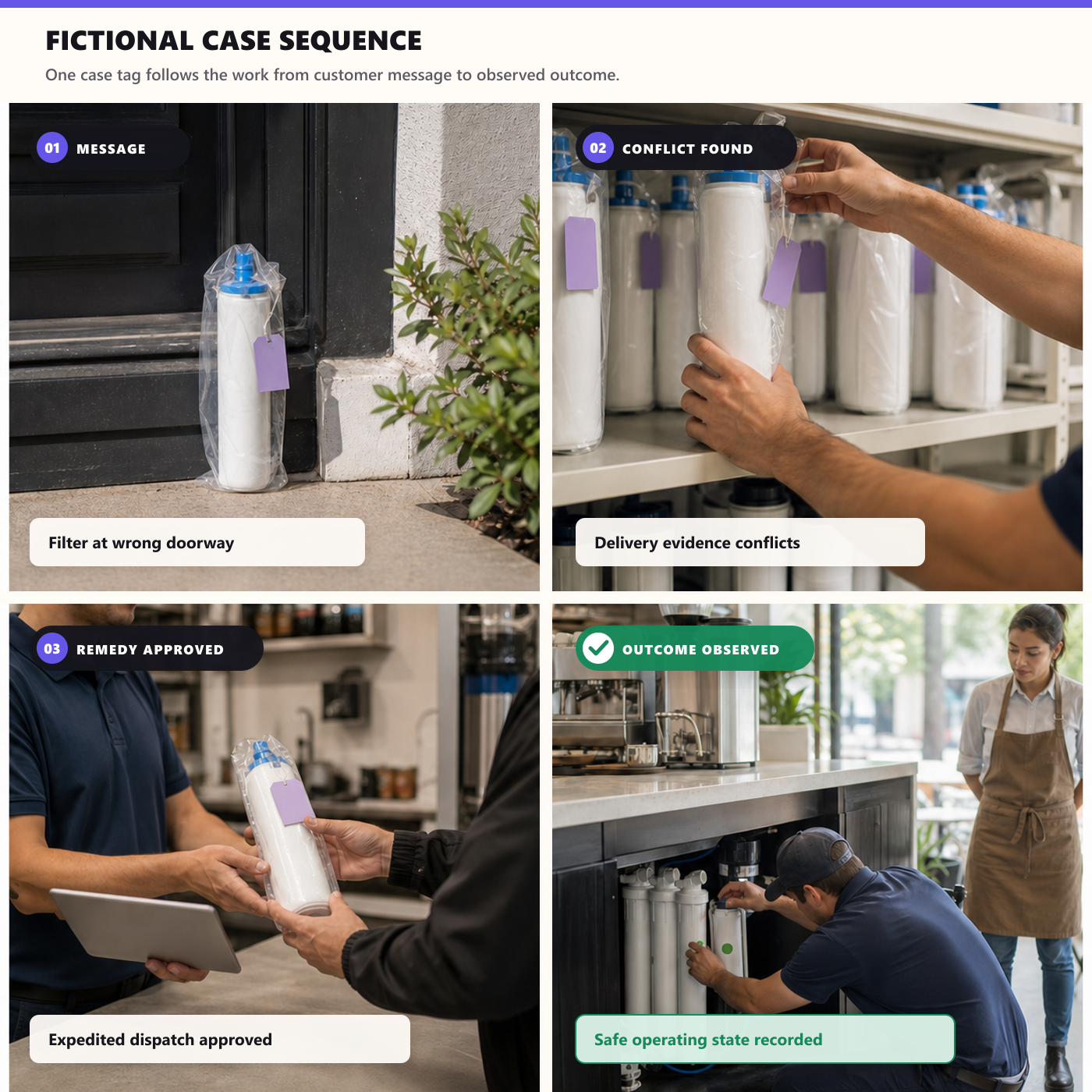
Return to Juniper Row Café. The message is urgent, but urgency does not erase authority, policy, or safety. The useful work happens between the first sentence and the final confirmation.
The message establishes impact, not authority
The inbound message identifies the business impact: a critical machine shows a red pressure alarm, the replacement filter appears missing, and the café expects to open soon. The thread and authenticated account provide a likely site and contact. They do not, by themselves, authorize an expedited shipment, approve a cost exception, change a service record, or declare the equipment safe.
The intake role preserves the exact message, channel, attachments, timestamp, prior case relationship, and the customer’s desired state. It treats the text as untrusted input. A customer can request an action, but the request cannot grant itself additional permissions. Authority must come from configured policy, connected-account permissions, and the business’s approval rules.
The current state changes the problem
The operating record connects the contact to Juniper Row’s site, the affected machine, the open service relationship, the replacement order, and the earlier troubleshooting case. The carrier record says delivered. The delivery photo does not match the café entrance, and the address evidence conflicts with the delivery event. The device record still shows the pressure alarm. A regional depot has the correct part available.
Now the case is no longer a generic “where is my order?” question. Sending the tracking page would repeat the disputed evidence. Sending the reset article would ignore the live fault and the customer’s prior attempt. The current state indicates a delivery exception attached to an equipment-safety issue, with a possible local remedy.
This is why retrieval must be source-aware. The latest carrier status is relevant but not automatically decisive. The delivery image and address are relevant because they challenge that status. The device alarm is relevant because it changes the risk of a troubleshooting answer. The depot inventory is relevant because it makes a different remedy possible. An Agent should retain the source and timestamp for each material conclusion rather than blending everything into one confident summary.
One remedy crosses an approval boundary
Kestrel’s approved service policy allows a depot to send a replacement part after a documented delivery exception. Expedited dispatch is available, but its cost exceeds the routine limit assigned to the Agent. The Agent should not hide that boundary behind a vague escalation. It should prepare the smallest useful decision for the service manager.
The decision packet contains the customer and site, device and alarm, original and replacement order, disputed delivery evidence, prior troubleshooting, depot stock, policy section, proposed dispatch, quoted cost, and customer impact. The manager can approve, decline, or choose another remedy without reconstructing the case. The human contributes judgment at the precise point where judgment changes the company’s commitment.
An accepted action is unfinished work
The manager approves the expedited dispatch. The separately governed execution path submits the request, receives an acceptance response, and then reads the dispatch record again. If the first submission times out, it reconciles the existing record before retrying; otherwise a network interruption could create two shipments. If the accepted dispatch shows the wrong address or part, the action is not treated as success simply because the tool returned a positive response.
Even a correct dispatch acceptance does not resolve the customer’s problem. It proves that a logistics action has been accepted. The part could still fail to arrive, the alarm could have another cause, or the machine could remain unsafe. The conversation record may truthfully say what was dispatched, under which reference, what is still pending, who owns the case, and when the next update is due. It should not say “fixed.”
The records agree
The case reaches resolution only after the delivery and service evidence support the customer’s desired state. The technician or permitted service workflow records installation, the relevant operating state shows the machine safe for service, and Juniper Row receives a truthful confirmation. If the customer must perform a final check, the case moves to awaiting customer rather than disappearing.
Notice what the Agent automated: case reconstruction, evidence collection, policy retrieval, the approval packet, the approved action, reconciliation, status updates, and follow-through. It did not pretend that a customer request was authorization, that a manager’s approval was execution, that execution was verification, or that verification of a shipment was proof of safe operation. Those distinctions are the architecture.
Different problems deserve different definitions of done
“Automate support” is too broad to govern. Begin with an issue family whose sources, authority, actions, and proof can be named. The same customer may move through several families during one case, but each transition should change the definition of done.
| Support case | Useful Agent role | Evidence of done | Human boundary |
|---|---|---|---|
| Known answer | Match the question to approved, current knowledge and explain the applicable next step | Answer delivered with the governing source and no unresolved account-specific condition | Conflicting guidance, novel facts, or a request for an exception |
| Current status | Match identity and retrieve the authoritative order, case, appointment, or subscription state | Current record, source timestamp, and an honest statement of what remains pending | Identity mismatch, disputed status, or contradictory systems |
| Bounded correction | Prepare or perform a narrow, reversible change within a defined limit | Post-action read-back shows the intended field, owner, or state | Irreversible effect, expanded scope, repeated failure, or missing authority |
| Commercial remedy | Assemble facts, policy, available options, cost, and customer impact for a decision | Approved remedy executed, reconciled, and confirmed against the customer’s condition | Refunds, credits, contract terms, or exceptions above the assigned limit |
| Safety or security | Preserve evidence, limit exposure, provide only approved immediate guidance, and route urgently | Qualified owner accepts the case and the defined protective state is confirmed | Suspected compromise, unsafe equipment, sensitive identity, or disputed access |
| Relationship repair | Reconstruct promises, failures, customer impact, and prior attempts so a person can respond with context | Named owner takes responsibility, makes a credible commitment, and completes follow-through | Acute emotion, reputational risk, contested facts, or material concession |
The best first case is not always the highest-volume case. High volume with unreliable identity, stale knowledge, or contradictory state simply multiplies errors. A moderately frequent case with a stable policy, a supported read path, a narrow reversible action, and observable proof can teach the operation much more safely.
Historical review should include clean cases and failures: duplicate messages, partial provider outages, conflicting records, customers who change the requested outcome, actions that return success but fail read-back, missing owners, prompt-like instructions inside customer content, and exceptions that experienced representatives recognize instantly. The edge of the role matters as much as the center.
Give authority by consequence, not channel
Email, messaging, phone, forms, and help-desk conversations are entrances to support. They are not useful security boundaries. A low-risk status answer can arrive through any supported channel. A request to change account ownership remains consequential even when it comes from a familiar thread. A request to expedite a part remains a cost exception even when the customer sounds urgent.
Map authority to the effect: what the Agent may read; which records it may change; which actions are reversible; who can receive a message; what value, count, or status limit applies; and which actions require review. Customer-visible actions deserve special attention because an incorrect promise can be harder to reverse than an internal note. Security, financial, contractual, and safety effects should have narrow paths and explicit ownership.
This is also why adding an AI employee to an inbox should begin with a role, not mailbox-wide permission. The practical guide to adding an AI employee to email shows how Gmail, Outlook, and shared inboxes can be connected around defined work. The same principle applies when you add an AI employee to WhatsApp Business: the surface changes, but identity, policy, action limits, approval, and proof still govern the case.
Do not confuse channel continuity with authorization. A long-running conversation may provide valuable context, yet an old thread can be forwarded, an account can be shared, and message content can contain instructions intended to manipulate the system. Use trusted account state and configured permissions to establish authority. Let the channel tell you what the customer said, not what the Agent is allowed to do.
Authority should also shrink when evidence quality falls. If identity becomes ambiguous, a source conflicts, a write returns an uncertain result, or the case moves into a higher-consequence category, the Agent should stop expanding the action and instead preserve the case for a person. That is controlled autonomy: enough authority to complete bounded work, with a visible edge.
A handoff should move the case, not send the customer backward
“Escalate when needed” does not define a handoff. A transfer becomes useful only when it moves context, ownership, and the unresolved decision. The receiving person should see who the customer is, the desired outcome, original evidence, sources checked, actions attempted, exact results, policy boundary, urgency, emotion or relationship signal, and the next decision. The customer should not have to perform the integration by repeating everything.
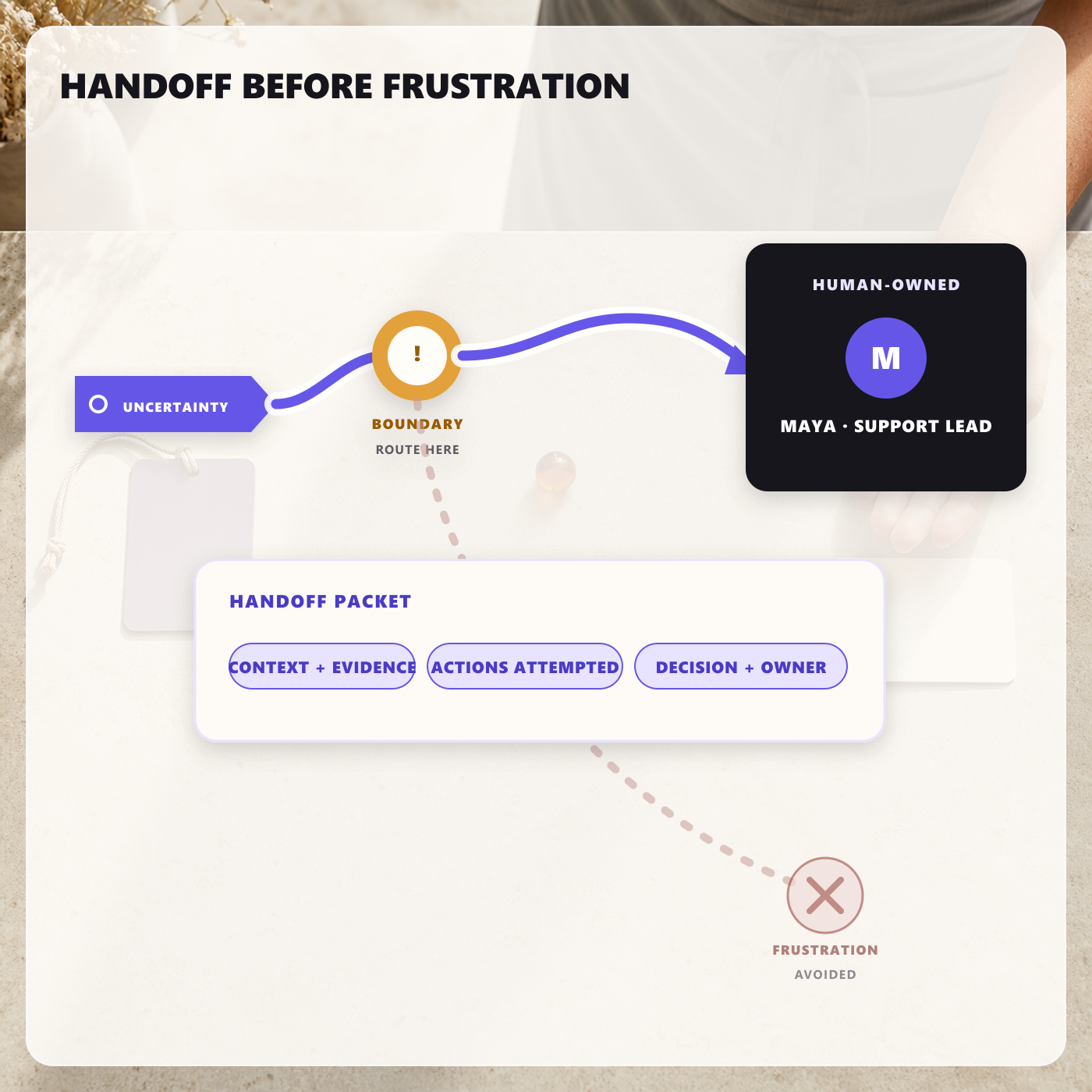
Useful triggers include uncertain identity, no approved policy, conflicting system state, a requested effect above the assigned limit, an ambiguous or failed action after the retry budget, a privacy or security concern, explicit demand for a person, relationship repair, and a qualified safety issue. The route also needs a real owner and a fallback if that owner does not accept within the promised window.
A 2026 Gartner survey of 3,566 B2B and B2C customers found that 50% said generative AI made service easier, while 87% considered access to a human essential. It also found that 58% of GenAI users had used it to complete a task. These are survey responses, not observed resolution rates, but they reject a false choice: customers can value capable automation and still expect a human path.
Timing matters. A 2026 Alibaba customer-service preprint reports a randomized field experiment involving 647 workers and 680,676 chats. Agentic AI shortened eligible conversations but reduced customer ratings; early human intervention preserved quality better for technical failures than intervention after emotion had escalated. Only 5.8% of chats were AI-eligible, the window was short, and the setting was one Chinese ecommerce platform, so the findings should not be generalized into a universal effect. The useful design implication is narrower: a late transfer may recover less than an early, evidence-rich one.
Measure transfers as part of the same case. Track time to owner acceptance, time to the first useful human action, whether the customer repeated information, whether the case bounced again, and whether the promised update occurred. A fast automated exchange followed by an empty handoff is one slow experience recorded in two systems.
Close in layers so false resolution has nowhere to hide
A support operation needs more than open and closed. Those two labels invite the system to collapse different accomplishments into one flattering event. A reply can be delivered while no action occurred. An action can be accepted while no effect occurred. An effect can be observed while the customer’s desired state remains unmet.
Use separate evidence for communication, execution, verification, and resolution. “Message sent” proves communication. A tool response or request identifier can prove that an action was accepted. A read-back from the authoritative system can prove the state changed. The customer’s success condition—safe operation, restored access, delivered part, corrected balance, completed appointment—defines resolution. Some cases also need customer confirmation or a no-recontact window before final closure.
For Agent-handled work, define a verified resolution rate before deployment:
Eligible cases with the required proof and satisfied closure condition ÷ all eligible cases handled by the Agent.
The denominator matters. Specify eligibility, required evidence, and the closure window before anyone sees the number. Otherwise difficult cases can quietly move out of scope and abandoned conversations can look like containment. Report AI-only, AI-to-human, and human-only paths separately so a blended average cannot hide where customers get stuck.
Pair verified resolution with incorrect autonomous resolution, reopen or recontact, time to useful action, time to verified outcome at the median and long tail, handoff repetition, approval wait, tool success, read-back success, knowledge gaps, and customer feedback. First-response time still matters; it simply should not impersonate the outcome.
Treat policy, knowledge, prompts, tools, routing, and model changes as releases. A KDD 2026 industry paper about support Agents at Nubank scale describes structured context, human-reviewed iteration, calibrated offline evaluation, and online experiments. Its reported gains belong to those deployments and comparisons, not to support automation in general. The portable lesson is the evaluation discipline: preserve a regression set, review failure slices, and verify that an apparent improvement did not simply move work to another path.
Juniper Row’s dispatch therefore remains open at “action completed, outcome unconfirmed.” It cannot jump to resolved because the courier accepted a request. The support record closes only when the permitted service evidence shows a safe operating state and the customer has been told what actually happened. Layered closure leaves fewer places for a false success to hide.
Make verified resolution the Agent’s definition of done in Praxivara
You do not need to manually build every API call, timer, state check, and workflow described here. Praxivara lets you describe the support job in plain language, connect the supported systems, review the Agent Blueprint and approval rules, and coordinate the work from one operating layer. The important part is how narrowly and honestly you define the role.
Begin with the case, authority, and closure rule
Instead of “answer customer support,” describe one service role: identify authenticated delivery-status cases, retrieve the governing records, explain clean statuses, prepare delivery exceptions, route consequential remedies, and retain the evidence required for closure. A Praxivara Agent can turn that brief into instructions, tools, triggers, approval rules, limits, and a visual Blueprint for review. A newly created Agent begins as a disabled draft; creation alone does not put it to work.
Connect only the supported providers and actions the role needs. Praxivara’s catalog includes customer-support and conversation systems alongside email, commerce, CRM, scheduling, spreadsheets, and team communication. Available reads, replies, assignments, notes, statuses, triggers, and verification actions differ by provider, connected-account permissions, and current product support. Check the integration catalog rather than assuming every service exposes the same controls.
Approved policies, product facts, and escalation guidance can be supplied through Files & Knowledge within supported formats and product limits. Context is bounded; the objective is the relevant approved material, not indiscriminate access. Memory can retain useful operating context, while Secrets stores credential values encrypted and resolves them server-side instead of presenting ordinary secret values as model text.
Use two governed lanes for inbound support
One safe Praxivara pattern uses two governed Agents. Support Intake Agent and Support Resolution Agent are role names you configure, not built-in Agent types.
An external event can start the Agent configured for intake. That role preserves and normalizes the case, retrieves allowed context, classifies the issue and risk, prepares an internal resolution plan, makes only safe record updates where supported, and routes or alerts the owner. It produces a work record, not an automatic promise to the customer.
This boundary is deliberate. On trigger runs that carry external email, customer-authored ticket, conversation or form content, or inbound phone, voicemail or transcript content, Praxivara treats that provenance as untrusted. In that same run, third-party messaging and calling tools, plus tools that fetch model-chosen URLs, are withheld or denied. A customer message cannot silently turn its own instructions into permission for new external effects.
The Agent configured for resolution runs in a new trusted, permissioned context—not simply an approved continuation of the original inbound run. When separately started with the prepared case, it can perform the supported customer-facing or consequential action, read the affected system again, and return the evidence. Depending on the configuration, a person may start or approve that path; do not describe it as an automatic reply inside every inbound run.
The separation is useful even when the two lanes feel seamless to the team. Intake can safely interpret what arrived. Resolution can act with authority that came from configuration and approval, not from the inbound text. If the work crosses a boundary, the receiving owner sees the context and exact decision instead of a forwarded conversation.
Make state visible instead of forcing every case into open or closed
A practical operating vocabulary distinguishes Intake received from Prepared. Intake received means the event and source context are preserved. Prepared means identity, relevant state, desired outcome, proposed next move, and evidence are ready for the next authorized step.
Human-owned means a named person has the unresolved judgment. Action approved records the decision but does not imply execution. Action completed/outcome unconfirmed means the supported tool accepted or performed the action while the customer’s finish line remains unproved. These states prevent an approval or provider response from masquerading as resolution.
Verified resolved requires the predeclared evidence. Blocked preserves the missing source, unavailable tool, failed permission, or unresolved conflict. Awaiting customer retains ownership while a necessary confirmation is pending. Suppressed records that a duplicate, unsafe, out-of-scope, or policy-prohibited action was intentionally not performed. The exact names can vary by operation; the distinctions should not.
Put approvals where consequence changes
Praxivara supports a whole-run checkpoint or selected-action checkpoints. When a configured gate applies, the run pauses for the owner’s decision. For a bounded ambiguity that needs one answer, the Agent can ask its owner and continue with that response. Approval design should mirror the consequence map: routine reads may proceed, while a cost exception, customer-visible commitment, or sensitive change can stop at its precise boundary.
How a handoff appears depends on the connected provider and available actions. It may be assignment or reassignment of a help-desk item, an internal note, an owner question, a follow-up or callback, or an urgent owner alert. Praxivara does not create one universal live warm-transfer behavior across every system.
Triggers can start supported work on demand, on a schedule, or from supported events. Delivery varies: some providers use push or webhooks and others poll, so “instant everywhere” is not a safe promise. Owner notifications and deliveries are best-effort system behaviors rather than proof that the customer-facing outcome occurred. Verification should come from the relevant source of record.
Operate the Agent as a service, not a finished prompt
Use the Builder’s safe rehearsal while the role is still being shaped. It simulates dangerous external and irreversible actions, while approved reads, research, and owner-facing outputs may still run. Normal Test and Run Now executions can perform real work, so they should not be treated as harmless previews. Begin with a narrow issue family, review representative cases, and expand the boundary only when the evidence supports it. If your team is constantly intervening in routine runs, the guide to reducing the hours spent babysitting AI explains how to replace constant watching with defined checkpoints, exception routes, and proof.
After activation, Activity provides recent run and tool-step evidence. Deliveries contains outputs the Agent explicitly returns. Errors groups recurring failed steps, fully failed runs, and runs that appear stuck, then offers heuristic diagnostic guidance; it does not establish definitive root cause. Version History can restore an earlier behavioral configuration, but it does not reverse messages, dispatches, refunds, deletions, or other provider-side effects.
Pause a trigger or schedule when policy, source data, provider behavior, or staffing changes. Stop is cooperative between steps rather than an instantaneous kill switch or rollback. Exact behavior depends on connected integrations, available actions and triggers, provider permissions, source quality, approvals, limits, credits, and service availability. Praxivara’s security overview describes the wider control posture.
The product advantage is not that an Agent can say something in every thread. It is that the role, approved context, connected tools, start condition, approval boundary, owner, evidence, and visible Blueprint can live in one operating layer. That makes “done” a business definition the Agent must satisfy, not a tone the reply must imitate.
The last message should be the smallest part of the resolution
When Kestrel finally writes back to Juniper Row, the useful message is short. It can identify the correct replacement, the accepted dispatch reference, the owner of the service case, what evidence is still pending, and when the next update will occur. After the technician or permitted service process records the safe operating state, the final note can truthfully say that the case is resolved. It does not need to perform competence. The operating record has already demonstrated it.
The two earlier tickets optimized their own ending. The third path carries the customer’s outcome. It knows the difference between a message and permission, a status and truth, an approval and an action, an accepted action and a verified result. It gives a person the one consequential decision instead of the entire mess. Then it stays with the case until the two records agree.
That is the standard worth automating: not fewer visible conversations at any cost, but less distance between what the customer needs and what the business can prove it delivered.
Build one support role around verified resolution. Define the case, authority, approval boundary, human owner, and proof—then review the Blueprint before the Agent is activated. Start building with Praxivara.