


Tuesday, 2pm. A plumber is flat on his back in a crawlspace, torch in one hand, when the phone buzzes in his chest pocket for the third time. At 4:40 he is back in the truck: three missed calls, one number twice, zero voicemails. He calls back the number that rang twice. "Oh — we found somebody, thanks though."
Maybe that call was a water heater replacement. Maybe it was a wrong number. He will never find out, and most owners never find out what their own line drops either.
If you already know yours leaks, skip straight to the one-week audit.
Fair warning, since money is involved: we make Praxivara, an AI assistant that can rent a phone number and answer your business calls in your name. We have a stake in how you solve this. The audit and every script below work whether or not you ever touch our product.
The reason this problem survives is that it leaves no evidence. An answered call becomes a job ticket, or at least a conversation. A missed one generates nothing. No voicemail most of the time, no record of what the caller wanted. Just a number badge on a lock screen, cleared with a thumb at a red light. You cannot total a loss that never gets itemized, so owners guess low, and the guess starts to feel like knowledge.
It is a vendor's number, but nothing independent comes close to that size. The next section checks the numbers everyone else quotes; most of them fail.
And that miss rate is not a character flaw. You miss calls because you are doing the work. Two hands, one job in them. The plumber under the house misses calls precisely because he is good enough to be booked, and the same goes for the stylist with foils in at 2pm. This article never argues you should answer more; it argues the phone should get answered while you keep working.
The plan from here is short. One week of tallying five numbers from the call log you already have, then one afternoon of setup. You will measure what your own line drops and price it with your own job values, not a vendor's arithmetic. Then you build coverage in a fixed order: coverage map, greeting scripts, a three-button menu, the follow-up loop, escalation rules.
No page on the internet can tell you what your missed calls cost. By Sunday, your own call log can.
Most missed-call statistics are folklore. Here's what's real.
Search this topic and most of the numbers on page one trace to no study at all. Follow the footnotes and you land on vendor blogs citing other vendor blogs, round and round, with no measurement anywhere in the loop. Two numbers survive the check. Only two.
The first is the famous claim that 62% of calls to small businesses go unanswered. It is real, barely. It traces to exactly one primary source: a 2016 study that monitored calls to 85 small businesses, run by a marketing firm across 58 industries for 30 days. The full breakdown is more honest than the headline. In that sample, 37.8% of calls were answered live, 37.8% went to voicemail, and 24.3% got no response at all. Add the last two columns and you get the famous figure. That is the entire foundation: 85 phone lines, watched for a single month, a decade ago.
The second survivor is the platform figure from the top of this article. That is vendor data too, and the vendor sells call software, so read it with the usual squint. But it comes from real call logs at a scale no field study can touch, and it lands in the same neighborhood as the 2016 result. When a tiny old study and a huge modern dataset roughly agree, the shape is probably real: a lot of calls to businesses ring out, every day, everywhere.
The rest of the list did not survive the trace. These are the numbers on every roundup, and they need retiring.
"85% of callers never call back": no primary source exists. Every page that prints it cites another page that prints it. "80% of callers don't leave voicemails": same circle, same missing study. "Missed calls cost the average small business $126,000 a year" — that one was never a measurement at all. It is arithmetic: the 62% from the 2016 study of 85 businesses, multiplied by assumed call volumes and assumed ticket sizes until a scary annual figure fell out. And "78% of customers buy from whichever business responds first" is untraceable. Nobody can produce the survey. None of those pages are getting a link from us. The pattern repeats: one vendor's guess gets quoted as research, requoted as fact, and after a few years the original page is gone but the number keeps circulating.
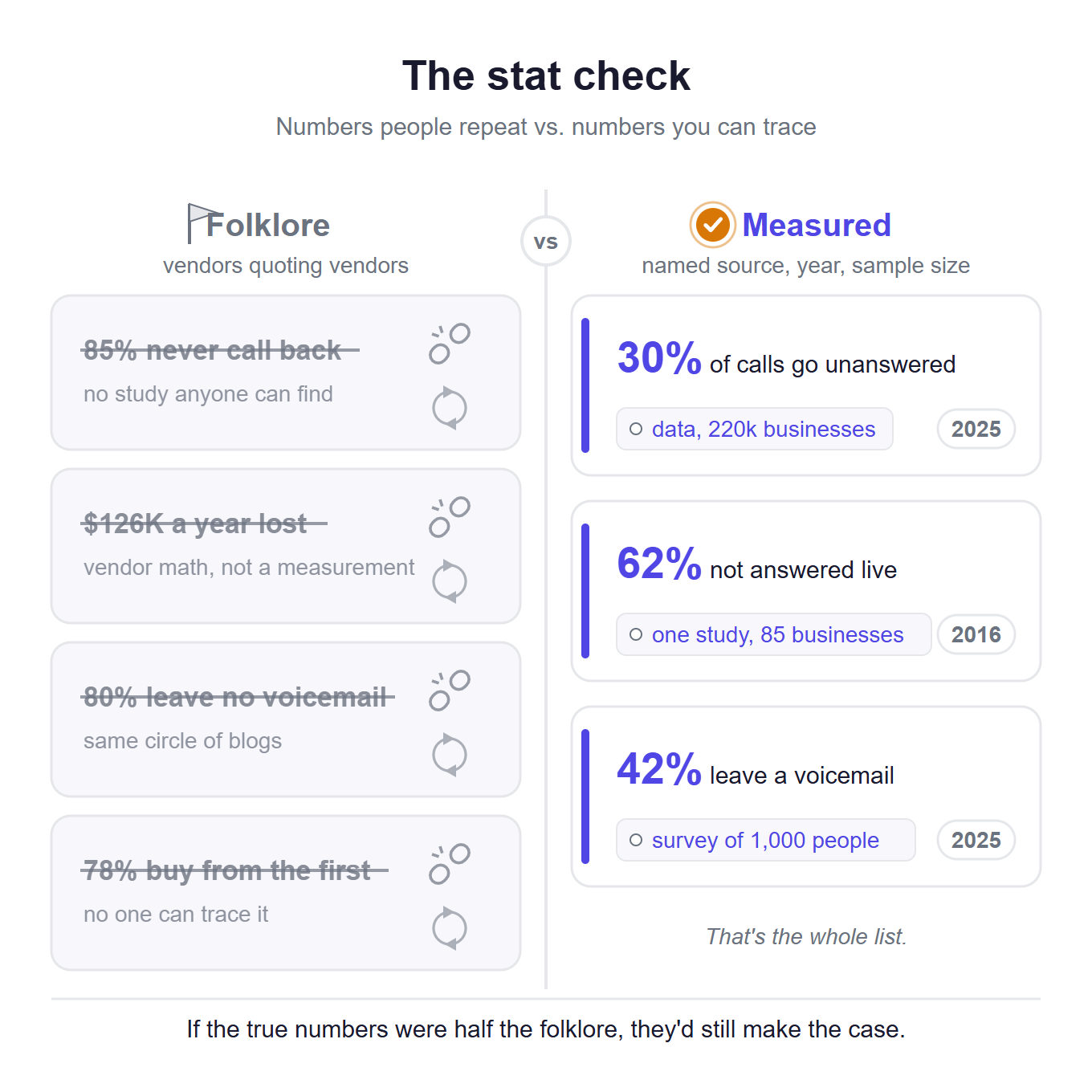
The cleanup matters for more than tidy footnotes. If the real numbers were half the folklore, missed calls would still clear the bar. A shop that loses a handful of real customer calls a month does not need an inflated statistic to justify picking up the phone. So this article will under-claim and be believed. That trade is deliberate, and it runs through everything below.
Our first position, stated flat: trust no dollar figure you didn't compute. Any page that tells you what missed calls cost your business, without asking a single question about your business, is selling something.
The cure for a bad statistic is a measured one, and yours is sitting in the call log already in your pocket. Your line has a real miss rate. Nobody has ever checked it, including you. The one-week audit a few sections down is how you read it out, and everything after it runs on what you find.
When you don't pick up, the caller doesn't wait
82% of consumers say that if a business doesn't answer the phone, they'll call a competitor. That comes from a 2025 CallRail survey of 1,000 U.S. consumers. CallRail sells call software, so it wants that number to look big. Hold the exact figure loosely. The direction is hard to argue with.
Two more findings from the same survey fill in the picture. 78% said an unanswered call has made them give up on a business for good. Not annoyed for a day. Done, before you ever knew they existed. And fewer than half say they leave a voicemail after nobody picks up.
That voicemail number is the quiet one that matters. If most missed callers leave no message, your call log undercounts the damage. A missed call from an unknown number looks like nothing. It might have been a kitchen remodel. The calls that cost the most leave the least evidence, which is how this problem survives in shops run by careful people.
The caller isn't angry at you, and they aren't loyal to the next shop either. They have a burst pipe and a search results page — whoever picks up gets the job. They just call the next name on the list. Somebody two listings down picks up on the second ring, and that's where the work goes.
You already know this, because you've been the caller. Anyone who has needed a contractor on short notice knows the drill. You call five numbers and leave two voicemails. One person calls back, maybe the next day. By then you've hired whoever answered on the second ring, and you're grateful to them. Their afternoon of calling strangers was worse than your afternoon of missing calls. Answering reliably isn't a marketing move. It's plain decency toward a person standing in an inch of water.
None of this arrived with the AI wave, either. The phone was already the front door. In a 2019 BrightLocal survey of 500 U.S. consumers, 60% said calling is their preferred way to reach a local business. Email got 16%, and walking in got 15%. The survey is aging, but the gap was never close. A person with an urgent problem wants a voice, not a contact form. People reach for the phone first. When the phone gives them nothing, they don't switch to email. They call someone else.
You miss calls because you're doing the work
You can't hold a torch and a phone. Nobody can. The tile setter is gloved up, kneeling in wet thinset. The stylist has foils in and a timer running. The roofer is forty feet up with both hands on a shingle. The landscaper is halfway through a quote with a toddler in the car seat. None of them is ignoring customers. They are doing exactly what a customer hired them to do.
The better you are at the work in your hands, the more calls you miss.
That's physics, and it doesn't respond to effort. A phone answered from the top of a ladder isn't service; it's a fall risk. A call taken mid-color rushes a, say, $220 appointment that took weeks to book. Owners who answer everything haven't solved the problem. They've decided the interruption costs less than the miss, and some days that math is wrong in both directions.
Spam raised the price of picking up. When half your unknown numbers are robocalls, every ring at dinner is a coin flip. Answer and it's a recording about your car's warranty; ignore it and it might be a $4,000 recurring contract. Screening spam means screening customers too. They call from the same unknown numbers.
So you let strangers ring through to voicemail. Some of those strangers had water on the floor.
And the expensive problems keep evening hours. The AC quits at 7:40 on a July night. The pipe lets go on a Sunday. Those calls arrive exactly when answering is least reasonable to expect of a human being. Picture it from the kitchen: phone on the counter, one ring, no voicemail, dinner still warm. The next morning a competitor's van is parked two doors down. Nobody did anything wrong. The call just landed where no one could catch it.
Widen the lens once and the phone is one slice of a two-hands problem. In a 2024 Slack-commissioned survey of 2,000 U.S. small business owners, respondents reported losing about 1.5 hours every workday to tasks that waste their time. That's most of a full workday gone each week. The hours went to every kind of busywork, not just the phone, and that's the point: the day was already spoken for before it rang. "Answer faster" asks the busiest pair of hands in the building to take on one more job.
So what would it take to answer every call without carrying the phone into the crawlspace? Hold the question until you've counted. The next step is a week of tallies, and it costs nothing but a pencil.
The Missed-Call Audit: measure your line for one week
Before you buy anything or change anything, spend one week counting. That is the whole prescription. The Missed-Call Audit is five tallies a day, pulled from the call log your phone already keeps. It ends with three numbers almost no owner has ever seen for their own line: a miss rate, an after-hours share, and a voicemail capture rate. Every decision left in this article runs on those three numbers instead of somebody's marketing statistic.
Each day, count five things:
- Calls answered live.
- Calls missed from a number you know.
- Calls missed from a number you don't.
- Voicemails actually left.
- Rings outside your posted hours.
That last column earns its keep. A ring at 6:50 on a Wednesday, ten minutes after you flipped the sign, is the kind of call this article exists for.
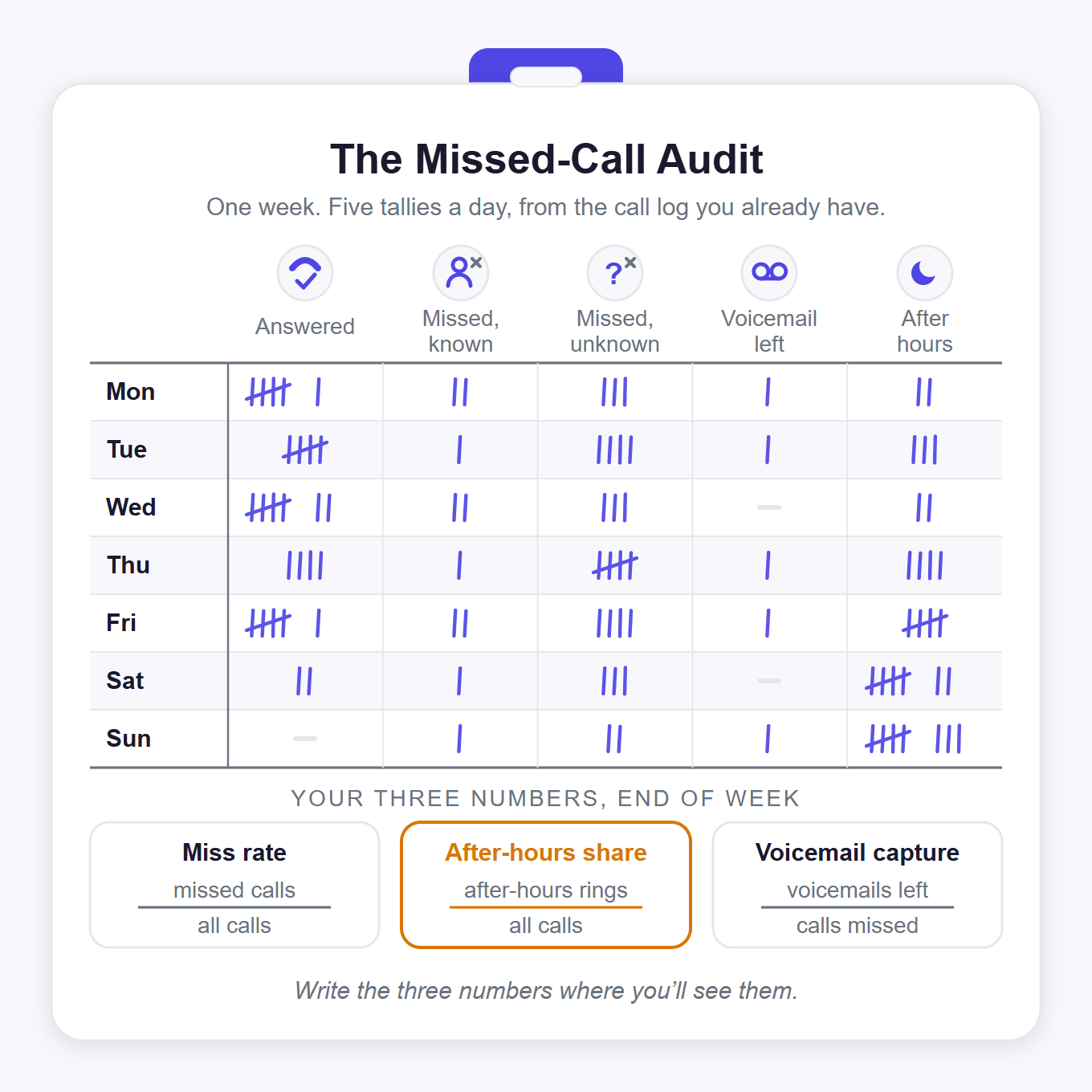
The data is already sitting there. Your phone's recent-calls screen holds most of it, and your carrier's online account keeps the full log with timestamps, usually going back months. If a nightly tally won't survive contact with your real week, skip it and pull all seven days in one sitting. Twenty minutes on a Sunday covers it. There is no app or tracking software to install, and nothing to spend.
Play it straight. Count the spam. Flag it as spam if you like, but leave it in the unknown-number column, because that column is only useful when it's complete. The calls you ignored on purpose count too; the audit doesn't grade you, it measures the line. And if two people pick up at your shop, both keep a tally, or the math comes out flattering and wrong.
When the week ends, do three small divisions.
The miss rate comes first: missed known plus missed unknown, divided by total calls. It settles whether you have a problem at all, and how big.
The after-hours share is rings outside posted hours divided by total calls. This one usually decides where coverage begins, because closed hours are when the expensive problems call and when nobody could reasonably expect you to pick up. For most shops it is the lowest-risk place to start, and the rest of this workbook treats it that way.
Voicemail capture is voicemails left divided by calls missed. If it runs low, voicemail is not a safety net on your line. It is an archive of calls that died there.
Nothing in this section says what a "typical" miss rate looks like, and not by accident. A barbershop whose regulars text has one kind of line; a plumber whose whole trade rings in from unknown numbers has another. The folklore numbers got famous partly because they let owners skip the counting. One honest week beats all of them, because the line being measured is yours.
Mon: Answered ___ / Missed-known ___ / Missed-unknown ___ / Voicemail left ___ / After-hours ring ___
Tue: Answered ___ / Missed-known ___ / Missed-unknown ___ / Voicemail left ___ / After-hours ring ___
Wed: Answered ___ / Missed-known ___ / Missed-unknown ___ / Voicemail left ___ / After-hours ring ___
Thu: Answered ___ / Missed-known ___ / Missed-unknown ___ / Voicemail left ___ / After-hours ring ___
Fri: Answered ___ / Missed-known ___ / Missed-unknown ___ / Voicemail left ___ / After-hours ring ___
Sat: Answered ___ / Missed-known ___ / Missed-unknown ___ / Voicemail left ___ / After-hours ring ___
Sun: Answered ___ / Missed-known ___ / Missed-unknown ___ / Voicemail left ___ / After-hours ring ___
Miss rate = (missed known + missed unknown) ÷ total calls
After-hours share = after-hours rings ÷ total calls
Voicemail capture = voicemails left ÷ calls missed
Write the three numbers where you'll see them. They run the rest of this article.
Copy this into your notes app, or print it and keep it on the truck's dash for the week.
Next, the tallies become dollars.
Do your own math (ignore anyone who hands you a dollar figure)
The formula is four numbers long: missed real-customer calls per week, times the share you'd have won, times your average job value, times 52. Three of those numbers are already yours. The missed-call count comes straight off your Missed-Call Audit, and the job value comes off your own invoices. Only one is a guess: the share you'd realistically have won. Be honest with that one and the result beats any statistic on the internet, because it is about your line and nobody else's.
Watch it work. A plumber's audit, say, turns up six missed unknown-number calls a week. Call four of them real customers rather than spam. Assume you'd have won half: that's two jobs a week you never got to quote. At an average of, say, $180 a service call, that's $360 a week walking out the door. Times 52, it comes to $18,720 a year.
A salon runs the same math smaller. A missed Saturday call is usually somebody trying to fill a slot that week, so assume one lost 90-minute appointment a week at, call it, $220. That's $11,440 a year. And chair time is expired inventory. When the Saturday 10am color goes unfilled, nobody restocks that hour. That slot is gone for good.
Every dollar figure in both examples sits next to a "say" or an "assume" on purpose. They show the shape of the math, not the answer. Yours will differ, which is the point.
If you want an outside number for context, keep it narrow and keep the source in view. Invoca's own home-services call data puts the unanswered share in that trade at 27%. The page never says when the data was pulled or how many calls sit behind it, and Invoca sells call software, so apply the usual discount. The dollar-loss figures on that same page are arithmetic, not measurements. That is why this section makes you run your own.
That small number carries one of this article's firm positions: voicemail is an archive, not coverage. If fewer than one caller in twenty will talk to your machine, then "they'll leave a message if it's important" is not a plan. It's a filing cabinet for calls that already died. Check the voicemail-capture rate from your own audit before you argue with that.
One last discipline before the worksheet: run it twice. Use a close rate you suspect is too low, then one you suspect is too high, and let the answer be a range. A range is harder to fool yourself with than one confident number, including your own.
1. Missed real-customer calls per week (from the audit): ___
2. Share you'd realistically have won: ___%
3. Average job or ticket value: $___
4. Weekly loss = line 1 × line 2 × line 3 = $___
5. Yearly loss = line 4 × 52 = $___
Run it twice, once pessimistic and once optimistic, and trust the range, not the point.
Scribble these five lines on the back of your audit sheet; the two belong together.
Four ways to cover a business phone (and who each one fits)
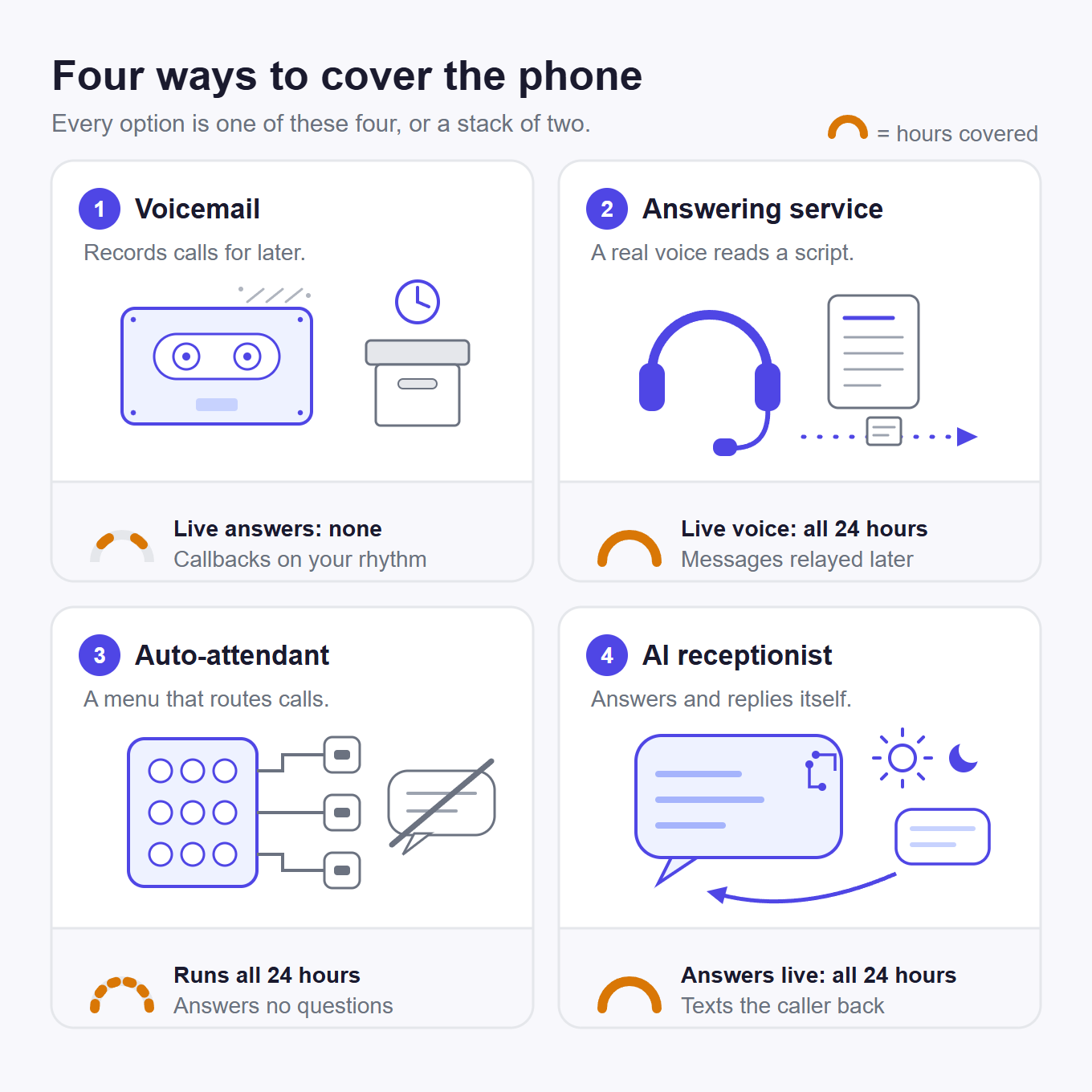
There are only four ways to cover a phone you can't pick up: voicemail, a human answering service, a phone menu, or an AI receptionist. Everything sold for this job is one of the four, or a stack of two, like a short menu sitting in front of a live answer. Once you see the map, the shopping gets shorter.
1. Voicemail, on purpose
Free, and already on your phone. It works for one kind of business: the solo operator whose regulars know the rhythm. They know you're up a ladder until noon and that you call back at lunch, so they leave a message and wait.
New customers are the weak spot. Someone who has never hired you hears a beep, and most of the time won't talk to it. You no longer have to take that on faith. Your audit week gave you a voicemail capture rate for your own line. If callers from unknown numbers rarely leave messages, your greeting is only holding the people who were going to wait for you anyway.
2. A human answering service
A real voice at any hour, which counts for a lot. The trade-offs are built in, though. You pay per call, so a busy week costs more than a quiet one. The person picking up reads a script and has never seen your calendar or the caller's history with you. And the message reaches you as a relay, minutes or hours later, flattened into whatever fit the intake form.
It fits businesses where a warm human voice is the whole point and the questions are simple enough to live on one script page.
3. A menu-only auto-attendant
"Press 1 for hours. Press 2 to leave a message." It routes and it records, but it answers nothing. A caller with an actual question pokes at the keypad, hears no way to ask it, and tries the next listing. As plumbing under a better layer, a short menu pulls its weight, and a later section shows how to build one nobody hates. As the whole answer, it is a locked door with good signage.
4. An AI receptionist
Answers live, knows your hours, takes a real message with the details you need, and can text the caller back on the spot. It covers 2 a.m. the same as 2 p.m., which matters once your audit shows how much of your ringing happens after close.
The honest risks are the ones owners actually name: it sounds robotic, or it says something wrong in your business's name. Those fears are fair. A badly set up receptionist costs you reputation on every call it takes. That is why the next stretch of this article is design work: the greeting, the menu, the follow-up, and the calls a machine should hand straight to you. Get those right and the risk shrinks to something you can live with. Nothing in this model promises perfection, and you should walk away from anyone who does. It fits the owner whose hands are busy all day and whose audit shows misses from numbers she doesn't know.
The longer case for letting software near this job at all is in how we scored phone answering in the automation playbook.
The same map, side by side:
| Model | All hours? | Caller hears | Breaks when |
|---|---|---|---|
| Voicemail | Yes, passively | A beep | Strangers hang up |
| Answering service | If you pay | A hired stranger | Script runs out |
| Auto-attendant | Yes | A menu | Callers have questions |
| AI receptionist | Yes | A live answer | Setup is sloppy |
If this is you, keep voicemail on purpose. You work alone, your regulars know you call back at lunch, and your audit showed almost no missed calls from unknown numbers. It is a fair choice — the only thing this article asked of you was to check its price, and you have.
Draw your coverage map: who answers when
Coverage is a schedule, not a product. Before you pick any of the four models, decide who answers the phone in each block of your week. Write it down. Whatever you set up afterward just fills the blocks you left blank.
A small-business week has three kinds of hours.
Open hours are the easy block. You or your counter person pick up, same as today. Nothing changes here yet.
Edge hours are the bands around your posted day, roughly 7 to 8 in the morning and 5 to 8 at night. The calls in those windows are real. The customer ringing at 7:15am wants a plumber today, not whenever the shop officially opens. But your hands are on the truck keys or the first pot of coffee, and nobody is at the counter. Most owners have never actually decided what happens to these calls. Letting them ring out is a decision too. It is just one you never made on purpose.
Closed hours are nights, weekends, holidays, and the week you finally take off. Nobody answers now, and everyone knows it, including the caller with the flooded kitchen.
For open hours, add one rule: the overflow rule. Let the call ring twice at your pocket first. Then the layer picks up. Two rings is about ten seconds. If your hands are free, you answer your own phone the way you always have. If they are inside a wall, the call gets caught instead of dying. You stay first in line. The layer only stops the drop. If your objection to this whole article is "I still want to answer my own phone," good. This rule is how you keep doing exactly that.
Now the position: start coverage after hours only. Closed hours are where the after-hours share from your Missed-Call Audit lives. The 9pm caller expects nobody, so any real answer beats silence, and a rough first night costs you almost nothing. Daytime stays exactly as it is until you have read enough transcripts to trust the layer with it. The first-week plan near the end of this article runs in that order for that reason.
Put the schedule on paper before you touch a single setting.
Open hours (___ to ___, days ___): answered by ___.
Edge hours (___ to ___): answered by ___ after ___ rings.
Closed hours: answered by ___.
Holidays and vacations: answered by ___.
Overflow rule: after ___ rings at my phone, the layer picks up.
If a block says nobody, that block is where your after-hours share is bleeding.
Keep this in the same doc as your audit tallies and fill it in once. It becomes the spec for whatever you set up next.
Write a greeting that sounds like your shop
A good answer does four things in the first ten seconds. It says your business's name and offers to help. It sounds like your shop, not a call center. And it never claims to be a person. The first three you can get from any template. The fourth is a position.
An answering layer that pretends to be human is spending your reputation on a lie with a short shelf life. Some caller will ask. When they do, the layer should say what it is and keep helping. Trust survives "I'm the after-hours assistant." It does not survive getting caught.
Before any wording, decide what the message has to carry. Every greeting collects four fields: the caller's name, a number to call back, what's going on, and the address or job site if your trade needs one. A message missing any of those is a callback you can't make. "Some guy about a water heater" isn't a customer. It's a note about one who's already calling the next name on the list.
The three scripts below are written to be spoken, contractions and all. Read each one out loud before you use it. If it sounds like a brochure, rewrite it until it sounds like the person behind your counter.
First, daytime overflow. This one picks up after your two rings, so the caller has already heard about ten seconds of ringing. It should feel like the shop answered, just with its hands full.
"Thanks for calling [shop name]. Everyone's out on a job right now, but I can take the details and get you a call back. Can I grab your name, the best number to reach you, what's going on, and the address for the job? You'll hear from us inside 20 minutes."
Swap in your shop's name and read it out loud once before it goes anywhere near a caller.
That 20-minute window is yours to set. Pick a number you can hit from under a sink, then treat it like a quote.
After hours, the job changes. The caller expects nobody, which makes this the easiest expectation you'll ever beat. Say when you open and when the callback lands.
"You've reached [shop name]. We're closed for the night; we open at 8. Leave your name, your number, what's going on, and the job address if there is one, and you'll get a call first thing after 8. If it can't wait, say so and I'll flag it urgent."
Paste this one into your own doc as-is; the 8am promise only works if you keep it.
The last piece is for trades with real emergencies. It isn't a script so much as a fork: one question, two paths.
"Before I take the details: is there water, gas, or no heat right now?"
If yes: "I'm flagging this to [owner] right now. Stay by your phone."
If no: back to the standard intake, all four fields.
Add this branch only if you truly want the 2am call. In a trade where pipes burst, you do.
None of these scripts mention how much you care. There's no "your call is important to us" and no apology on a loop. The caller with water on the floor doesn't need a brochure. They need your shop's name in their ear and one promise the shop will keep.
If you need a menu, keep it to three buttons
Three options, ten seconds, always an exit. That's the whole rulebook for a small-business phone menu. Every menu that has ever made you jab zero and curse at the speakerphone breaks at least one of those rules. Most break several, because somebody kept adding branches and nobody ever called their own number to listen.
Skip the menu entirely if your line gets fewer than about 10 calls a week. At that volume, a straight answer and a message taken beats any tree you could design. Menus exist to route volume, and you don't have that volume yet. Nothing wrong with that.
For everyone else, the small-shop tree has exactly three branches. Button 1 is emergency or urgent. Button 2 is booking, whether that's a new appointment or moving one. Button 3 catches everything else, and it must end in a real intake, never a recording that shrugs and hangs up.
Emergency is always button 1.
The caller with water spreading across the kitchen floor should never sit through your booking options first. Button 1 drops straight into the emergency question you wrote in the last section, and it pings you the moment the caller says yes.
Four rules keep the tree from turning on you. Never add a second layer; a menu inside a menu is where callers hang up. Never loop back to the top; a caller who presses wrong gets helped where they landed. Let callers talk over it; someone who ignores the buttons and just says what they need should be understood, not restarted. And no branch ever ends with goodbye; every path closes with help on the line, or a message taken and a callback window attached.
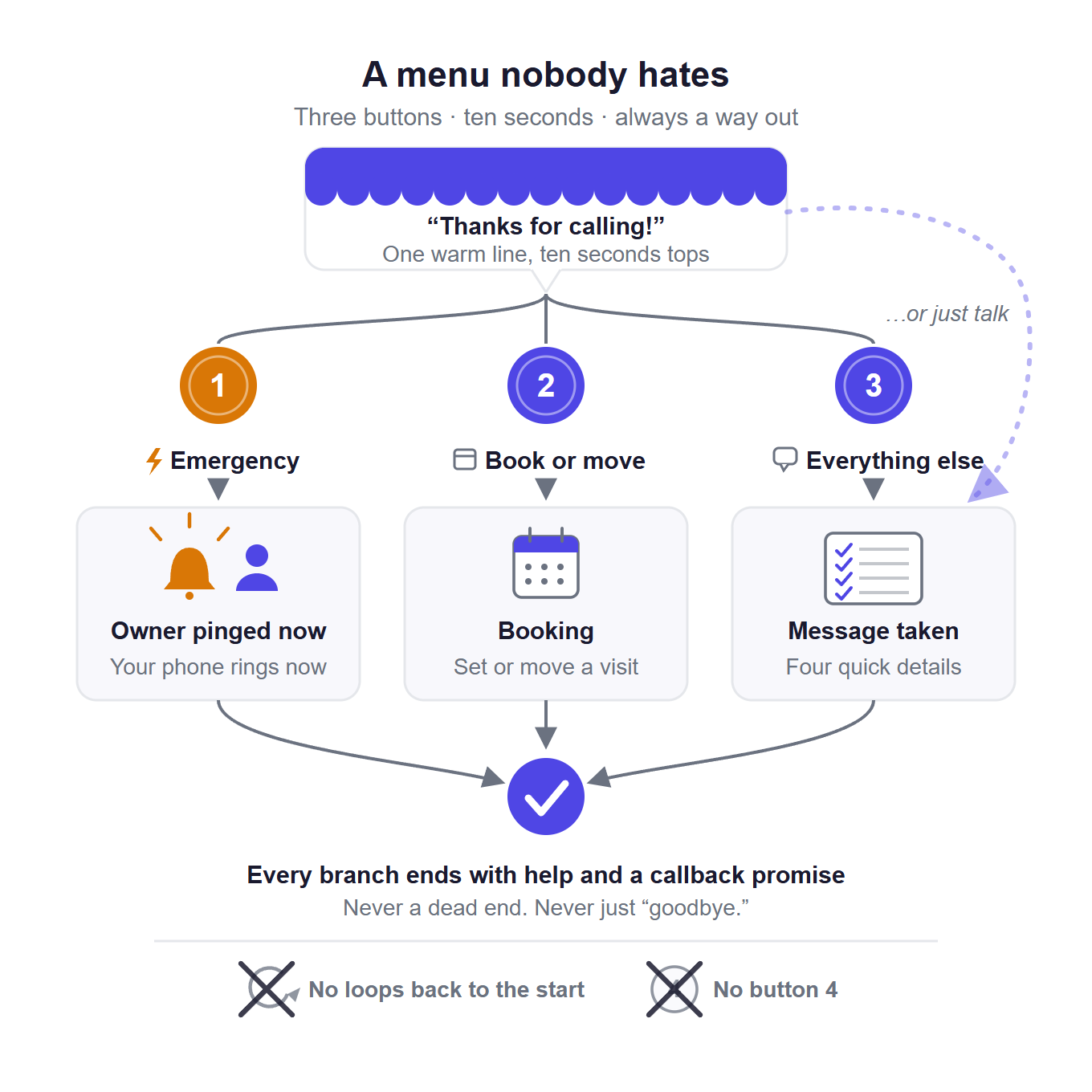
One thing has changed since menus got their bad name. With a live AI answering the line, the whole tree becomes optional, because callers can simply talk the way they would to a person. Keep the keypad branches anyway. Plenty of callers, including some of your best regulars, would rather press a button than explain themselves. Buttons and plain speech should both work on the same line, on the same call.
"Thanks for calling [shop name]. If this is an emergency, press 1. To book or move an appointment, press 2. For anything else, press 3, or just tell me what you need."
Button 1 asks the emergency question ("Is there water, gas, or no heat right now?") and pings the owner right away on a yes. Button 2 runs the booking intake. Button 3 takes the full message: name, callback number, what's going on, and the address if the job needs one, then states the callback window.
Paste this into whatever answers your line, and if you're ever tempted to add a fourth button, cut something instead.
Before you build any of it, pull one number from your Missed-Call Audit: the unknown-number column. Ten unknown callers a week is real routing demand; build the tree. Two a week means you don't need a menu so much as a callback list. The audit already told you which shop you are.
What happens in the five minutes after the ring stops
Whatever answered the call, four things should happen before five minutes pass. The caller gets a text. The message lands somewhere you will actually see it. You get pinged wherever you are, up a ladder or halfway under a sink. And the callback goes on a list with a time attached, not onto a mental note that dies by lunch.
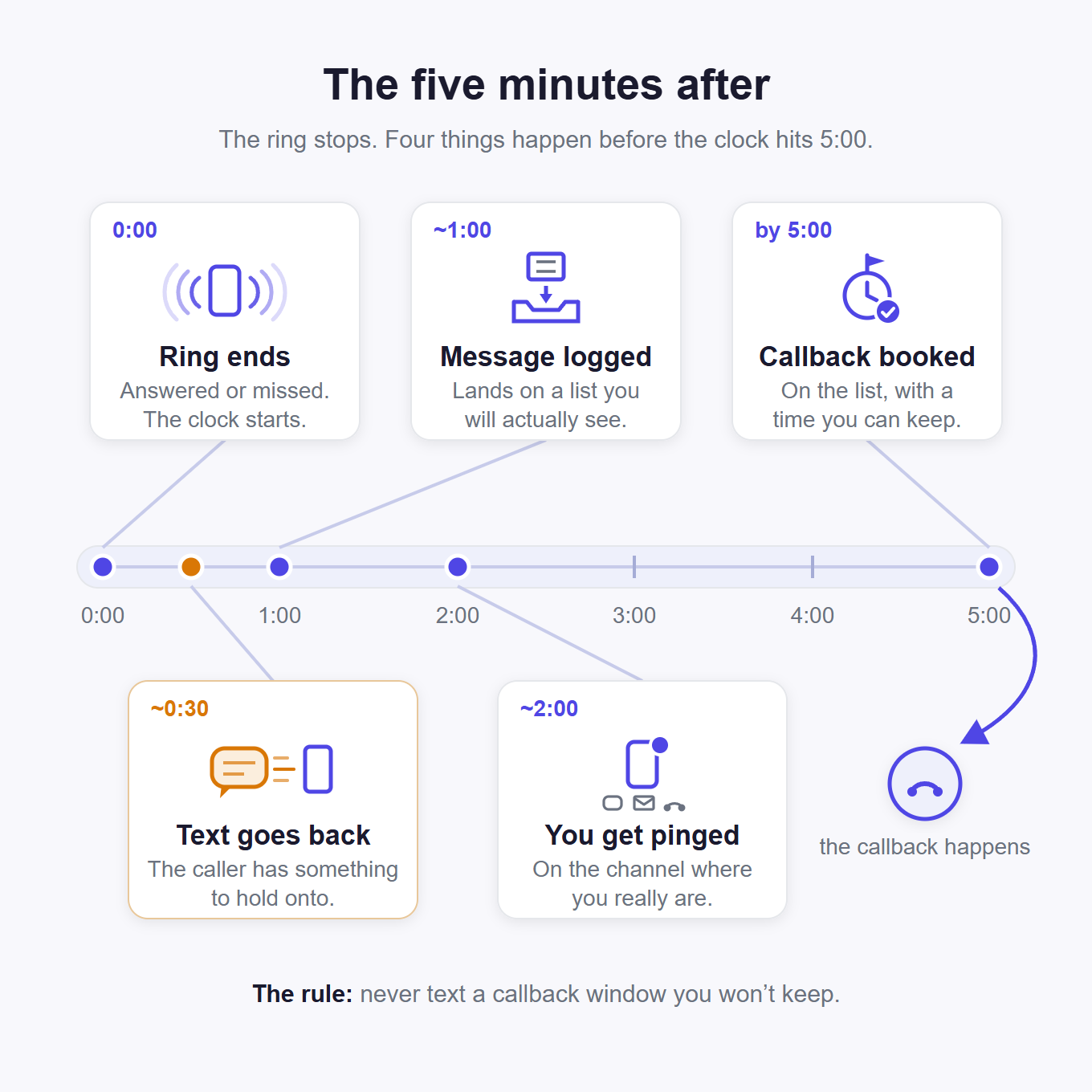
Run that loop and a missed ring turns into a kept promise. The caller mopping up the kitchen knows your shop heard them. Skip it and they keep dialing down the list.
The text goes first because it does two jobs at once. It creates a record where a silent missed call leaves nothing. And it gives the caller something to hold while they wait.
Texts are not the cheap cousin of a real call. A 2013 Cochrane review of seven randomized trials covered more than 5,800 patients. It found text reminders got people to show up for healthcare appointments as reliably as phone-call reminders did. Attendance ran 78.6%, against 67.8% with no reminder at all. Those were clinic trials, not service shops, so take the modest conclusion and leave the rest. A text is a channel people actually act on.
Two texts cover almost every case. The first goes to any real number that rang and got nothing.
[Shop name] here. Sorry we missed your call. What do you need? If it's urgent, reply URGENT and we'll jump on it. Otherwise you'll hear from us by [time].
Copy it into your own doc, then trim until it fits one bubble. Two bubbles reads like a robot.
The second goes out after a message is taken, and it repeats the promise back. "You're on the list for tomorrow morning" is the same discipline that collects invoices: say the commitment out loud and both sides now hold it.
Got your message about [issue]. [Name] will call you between [window]. Reply here anytime if anything changes.
Drop this one in the same doc and fill the brackets now, not mid-crisis. The window you text is a promise; pick one you can keep on your worst day.
The quieter half of the loop matters just as much. The message gets logged in one place you already check, a job board or a shared doc, not scattered across a voicemail box and a sticky note. The ping reaches you on a channel you actually look at, because a notification you never see is just voicemail with better branding. And the callback gets a name and a time, so "someone will get back to you" becomes "Dana calls at 8."
If the shape feels familiar, it should. This is the same message-lever-exit rhythm our invoice-chasing clock runs on: name what happens next, then do it on schedule.
One rule holds all of it together. Never text a callback window you will not keep. A broken "20 minutes" is worse than an honest "first thing tomorrow," because now you have missed the same customer twice. On your worst day the honest window might be tomorrow at 8. Text that. The customer who knows when the call lands can plan around it. The one staring at a silent phone cannot.
The calls a machine should never keep
Four kinds of calls go to a human, every time. Real emergencies first: life, property, gas, water on the floor. Angry callers second, because an upset customer wants a person, not a script. Third, anything above your dollar threshold. Pick one now; say $1,000, then swap in your own number. Fourth, any regular who asks for you by name. The woman who has booked the first Tuesday of every month for nine years is not a "caller," and she knows it.
The angry caller deserves a word more. A machine can stay polite forever, and that is the problem. Politeness is not what an upset customer called for. They want someone with the authority to fix the thing, and every calm scripted sentence between them and that person turns the temperature up. Hand those calls off early.
Write the rules down before you switch anything on. An escalation rule you invent mid-call, while somebody shouts about a warranty, is not a rule. It is a guess under pressure. The whole list fits on an index card, and the card is the point. The answering layer will follow it exactly, on the worst night of the year, the same as on a slow Tuesday.
Which calls would you honestly want interrupting dinner? That question sets your threshold faster than any formula. Water coming through a ceiling, yes. A fence quote that can wait until Monday, no. For the borderline cases, the two-question scoring grid from our automation playbook works on call types the same way it works on tasks.
One piece of honesty most vendors mumble past.
With today's answering layers, "get me a human" does not mean the call is passed to you live. Escalation means the layer takes the message and pings you at once, on the channel you actually watch. The caller gets a firm, fast callback promise instead of hold music. Design your rules around that, and the line will never make a promise you can't keep.
The difference shows at 9pm. A caller who smells gas should hear "I'm flagging this to the owner right now, stay by your phone," not "please hold while I transfer you" and then silence. The first promise can be kept in under a minute. The second one often can't be kept at all.
Seen that way, escalation rules are not a fence around the answering layer. They are the reason handing over everything else feels safe. The emergency, the shouting customer, the big job, the nine-year regular: once you trust them to reach your pocket within a minute, the machine can keep the small stuff.
The worked example: a receptionist number in Praxivara
Everything you just built is a spec. The coverage map, the greeting scripts, the three-button menu, the text-backs, the escalation rules: together they are a job description for whoever answers your phone. Turning that spec into a working line in our product takes about an afternoon. The spec does the deciding; the setup is mostly typing it in.
Step one: rent the number. Inside Praxivara you rent a real phone number, live on every account, and you can hold up to 5 of them. You see the price inside the app before you buy. The phone number setup guide walks through it screen by screen.
Step two: describe the receptionist. Agents are built in the Agent Builder by describing the job in plain language. Something like: "Answer calls for a plumbing shop. We're open 8 to 5, weekdays. Take messages with a name, a callback number, the problem, and the job address. Flag anything with water or gas to me right away." The builder turns that into a working agent with the right tools wired in. Paste your greeting scripts from earlier straight into the instructions; you wrote them to be spoken. The step-by-step phone agent build guide covers the details.
Step three: attach it to the number. One agent per number, with inbound answering switched on. From that moment, a call to that number is picked up live by that agent. Your cell stays your cell. Rent a second number later and it gets an agent of its own, with its own rules.
On the call, the agent works from your actual business, not a stranger's script. It can check your posted hours and offer the next open time. It can look up whether this caller has called before and what happened last time, so your Tuesday regular is never treated like a stranger. Messages and callback requests get taken and queued. The press-1 menu you designed runs as written, because keypad menus work on inbound calls; button-pressers and talkers land on the same line. To text callers back as well, connect a texting app such as Twilio and have the agent that runs after each call send your text-back.
Then the five-minutes-after loop runs itself. A message or a callback request lands in your Tasks and pings you on whichever channel you live on: SMS, Telegram, iMessage, or WhatsApp. After every inbound call ends, exactly one agent run fires with the transcript, the caller's number, the call length, and the recording. The agent then does what you told it to do with all that, like emailing you a summary or logging the call against the customer. If the phone rang at 9pm, you know everything by breakfast. No shorthand on a sticky note, and no wondering how the call was answered.
The honesty rules from the greeting section ship as defaults, not settings you have to hunt for. Every call opens with a recording disclosure, and a caller who objects gets a polite goodbye instead of a recorded call. If anyone asks whether they're talking to a real person, the agent says it is an AI and keeps helping.
Two boundaries, stated plainly, because you should pick coverage on what a thing won't do. It does not transfer a live call to your pocket. Instead it takes the message and pings you right away, while the caller hears exactly when the callback lands — the handoff shape the escalation rules above were written around. And while inbound calls to your rented number are unlimited, outbound calls draw on a monthly allowance that comes with your plan.
That is the whole build. On the delegation ladder, this is a full rung up from doing it all yourself. The phone gets answered in your shop's name while you finish the job in front of you.
Your first week: after hours only, then decide
The whole rollout fits in seven days. Days 1 and 2: keep the Missed-Call Audit running and write your greeting. Day 3: switch on after-hours coverage, and nothing else. Daytime runs like it always has, phone in your pocket, you picking up when you can. Days 4 through 6: read every transcript with your morning coffee. Day 7: look at what the week produced and decide whether daytime overflow comes next.
The morning reading is the point, not a chore. Five short transcripts take a few minutes. You are not being asked to trust a black box. You are being asked to read what the layer actually said, in your business's name, at 9:40 on a Tuesday night, and form your own opinion. The recordings are there too if a transcript reads oddly. Check the small stuff: your shop's name said right, the caller's number and problem captured. If a transcript embarrasses you, fix the greeting or fire the thing — the same standard you would hold any new hire to.
If this still feels like an early-adopter move, it isn't.
That number comes from U.S. Bank's 2026 small business survey, fielded this spring across owners with 2 to 99 employees. The same survey found 44% said they use AI to automate a process, and after-hours answering is exactly that kind of process. It is one bank's survey, so don't bet the shop on the decimals. But you are not the guinea pig here. You're on time.
Day 7 is a review, not a leap of faith. Count the after-hours calls that got answered live, and set that against the after-hours share your audit found. Count the messages that arrived complete, all four intake fields filled. Half a message is still a missed call. Then run the check that matters most: whether somebody kept every callback window the layer promised a caller. A line that promises "first thing after 8" and then calls at 2pm is worse than voicemail. Voicemail never made the promise.
Only then decide about daytime. If the transcripts read clean and after-hours was carrying most of your misses, you may be done for a while; some shops stop there and lose nothing. If the audit says daytime is where the leak lives, add the two-rings rule from your coverage map. You still answer first; the layer only catches what you drop. Either way, the decision rests on a week of evidence from your own line, not on anybody's statistic.
Missed-call questions owners actually ask
How much does a missed call cost a small business?
There is no honest universal number, and anyone who hands you one without knowing your call volume or your job sizes is guessing. Run the Missed-Call Audit for one week. Then do the five-line math: missed real-customer calls per week, times the share you would have won, times your average job value, times 52. Your own call log already holds all the inputs; the audit just makes you count them. Trust the range you compute and nothing else.
Is an AI receptionist better than an answering service?
It depends on the shape of your calls, and the audit will tell you which shape you have. A human answering service gives you a real voice at per-call prices, working from a script that has never seen your schedule or your customer history. An AI receptionist answers every hour of the year and knows your calendar and your callers, on a subscription instead of a per-call bill. If your after-hours share is high and your messages need detail, the AI usually fits a small shop better. If your callers need long, sensitive conversations, a human service earns its price.
Can an AI answer my business phone after hours?
Yes, and it is now ordinary for a small shop. You rent a business number and attach an answering agent, and it picks up live at 2pm or 2am in your business's name. It takes a message and books the callback, so nothing rides on whether a stranger decides to talk to your voicemail. In Praxivara, this is live today on every plan.
Will callers know they're talking to an AI?
They should. A layer that is set up right answers in your business's name and gets straight to work on the caller's problem. If the caller asks, it says plainly that it is an AI and keeps helping; getting caught costs more than the disclosure ever will. And you never have to wonder how a call went. In Praxivara, every call is recorded and transcribed, the recording stored encrypted, and you can pull up either from chat the next morning.
The short version
Distrust every dollar figure you didn't compute. That is the first rule and the cheapest one. Any page that prices your missed calls without asking about your business is guessing, and the fix costs one week of counting plus one afternoon of setup.
In order:
- Run the Missed-Call Audit. One week, five tallies a day, straight off your phone's call log. It ends with three numbers no marketing page can hand you.
- Do the five-line math. Missed real-customer calls, times the share you'd have won, times your average job, times 52. Run it pessimistic, then optimistic, and trust the range over any single point.
- Pick a coverage model with the audit in hand, not a sales page. There are only four, and one of them is free. If you're a solo shop and your numbers show almost no unknown-number misses, voicemail-on-purpose is a real choice.
- Start after hours only. That is where the expensive problems call from, and it is the block where any answer beats silence. Daytime doesn't change until the transcripts have earned your trust.
- Write greetings that sound like your shop, and never let the line pretend to be a person. If a caller asks, it says what it is and keeps helping.
- Keep every callback promise the line makes. An honest "first thing tomorrow" beats a broken "20 minutes" every time.
Some of you will run the audit and find a near-zero miss rate. Keep voicemail, on purpose this time. The audit did its job, and it cost you a week of tally marks.
For everyone else, the win is small and daily. The burst-pipe call at 9pm gets answered in your business's name and booked for 8am. The Saturday cancellation refills before you finish the color in front of you. Dinner stays dinner. Your hands stay on the work.
Build a receptionist agent for your line
Describe your shop's hours and rules in plain language. It answers in your name, and you read every transcript the next morning.