


To automate customer onboarding with AI, do not connect Closed Won directly to a welcome email. Use the win as a signal to verify onboarding eligibility, gather the approved sales evidence, reconcile promises and missing inputs, create the internal operating space, prepare customer communications for the right approval, and release a kickoff brief only when the account is genuinely ready. The goal is not a faster sequence of tasks. It is a reliable transition from what was sold to what both sides are prepared to do next.
This guide covers post-sale B2B customer and client onboarding: the work between a verified sale and a successful external kickoff. It is not an employee-onboarding guide or a consumer product-tour checklist. The examples are deliberately CRM-neutral unless a current product behavior matters, and every workflow still depends on the systems, permissions, actions, triggers, account limits, and source data actually available to your team.
The governing idea: Closed Won is not kickoff-ready. AI should preserve what the customer bought, expose contradictions before they become customer problems, and turn approved context into a prepared human conversation.
A kickoff should not begin with “That’s not what we bought”
The delivery lead opens the meeting with confidence: “We will begin across all sixteen locations next Monday.” The customer pauses. “I thought phase one was the two-store pilot.”
Nobody intended to mislead anyone. The CRM says sixteen locations because two future stores remained in a discovery field. The signed scope lists fourteen. A later email from sales proposes a two-location pilot. The discovery-call notes contain an operating constraint—no site work during morning receiving—but those notes never reached delivery. The kickoff deck was polished. The handoff underneath it was not.
That is the failure most onboarding automation misses. Sending an email, making a folder, assigning tasks, and scheduling a meeting are easy to demonstrate. Preserving the customer’s actual promises across sales, finance, delivery, support, documents, and calendars is harder. Yet that continuity is what the customer experiences. In Salesforce’s global research, 85% of respondents expected consistent interactions across departments. An onboarding workflow that makes the buyer repeat the sales process is not consistent, however fast it runs.
The first design question is therefore not “Which welcome email should AI write?” It is “What must be true before our company behaves as though this account is ready?”
Closed Won is a starting signal, not a complete brief
A deal-stage change is useful because it is timely and machine-readable. It can identify the deal, account, owner, close date, package, amount, and associated contacts. What it rarely contains is the whole truth needed for delivery. Important context may live in an executed agreement, an approved amendment, a proposal, an order form, product configuration, sales email, call summary, contact record, security questionnaire, billing system, or a decision that never made it into a structured field.
That distinction matters because “closed” can mean several things operationally. A salesperson may mark a deal won before the signed agreement is attached. Payment or purchase-order requirements may remain open. An implementation owner may not be assigned. A renewal, expansion, partner-led deal, trial conversion, or reactivated account may need a different onboarding lane. A corrected deal might leave and re-enter the won stage. None of those variations is safely handled by “stage equals Closed Won, therefore send everything.”
Current systems already illustrate the difference between the sales record and delivery work. HubSpot, for example, documents a separate project object for service delivery and a workflow that can create a project from a won deal while keeping the sales pipeline focused. That is a good structural pattern: the win initiates a handoff into an operational record. It should not turn the sales pipeline into the project plan or make the initial event payload the permanent source of truth.
Use an eligibility contract between Closed Won and onboarding. It is a short, explicit definition of which deal shapes may proceed and what must be re-verified. A typical contract might require:
- the deal is presently in an approved won stage;
- the agreement or order is executed, if that is part of your commercial policy;
- the onboarding lane and accountable internal owner can be determined;
- a primary customer contact exists;
- the purchased package, scope, and promised date have approved sources; and
- the same deal and onboarding version have not already created the downstream records.
The trigger starts an evaluation. The evaluation decides whether the account proceeds, waits, or becomes an exception. That one separation prevents a surprising amount of customer-facing damage.
Define a successful kickoff as a state
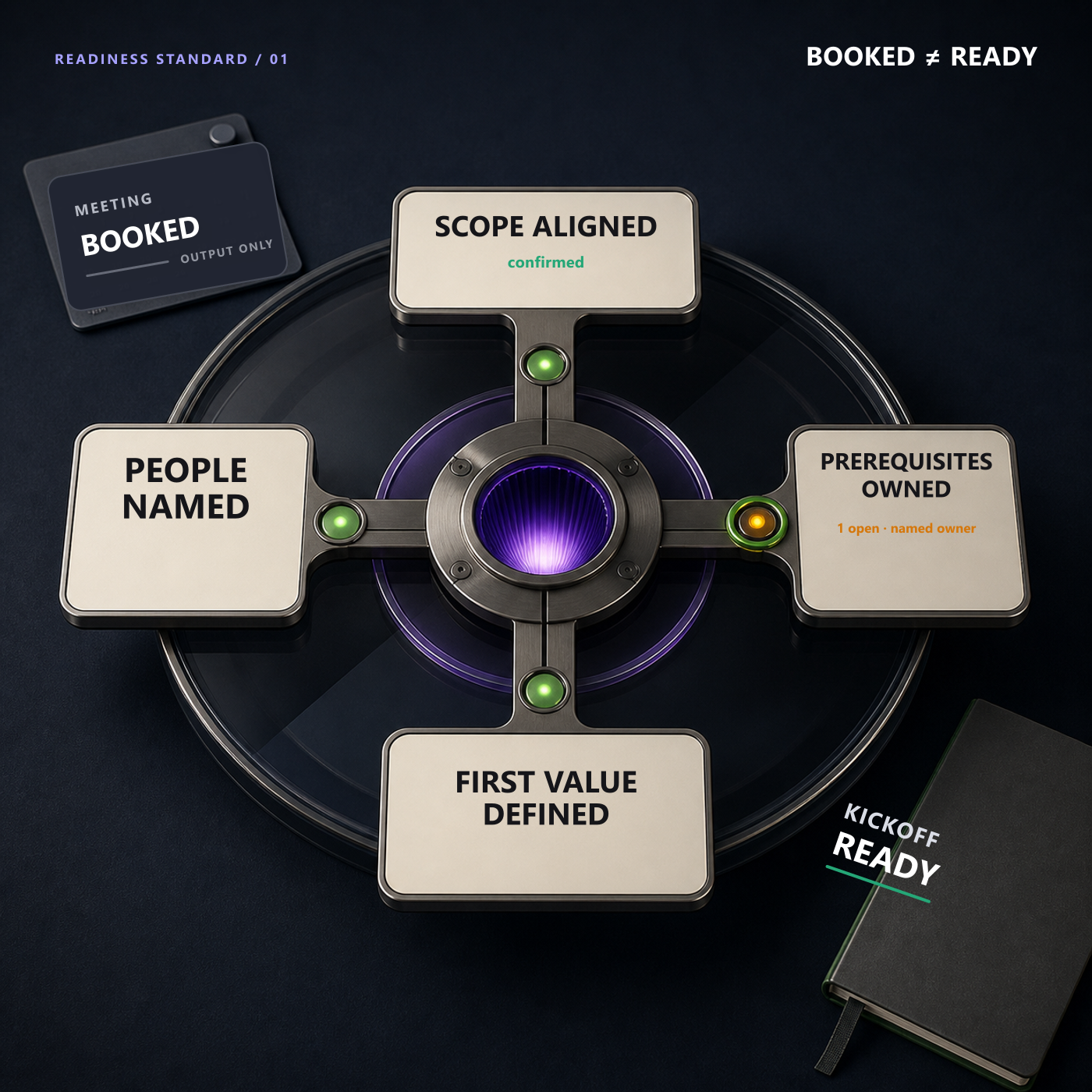
A calendar invitation proves that time was reserved. It does not prove that the right people are attending, that the team understands the purchase, or that anyone can name the first meaningful result. A successful kickoff is better defined as a prepared operating state with four conditions.
- Shared scope and outcome. The internal team can state what the customer bought, what is outside the current scope, why the customer bought it, and which approved sequence will be discussed.
- Named people. Both sides know the sponsor, decision-maker, day-to-day contact, delivery lead, and owners of any specialist or commercial decisions.
- Visible prerequisites. Access, data, documents, approvals, environments, and dependencies are complete, assigned to an owner, or deliberately placed on the agenda with a decision path.
- A first-value event. The team can name the earliest customer-specific outcome that will demonstrate progress, who owns it, and what evidence will show it happened.
This standard does not require pretending that every open item is complete. A missing site roster can remain open if the customer coordinator owns it, the due date is visible, the work that depends on it is clear, and the kickoff agenda includes the necessary confirmation. Readiness means no material unknown is both hidden and ownerless.
That definition is consistent with the purpose of a client-facing kickoff. Asana’s current guide describes kickoff as a collaborative session for aligning on goals, scope, roles, and next steps before the work begins. Automation should prepare that alignment. It should not replace it with a scripted presentation.
Build a Customer Promise Ledger before you build the workflow
The Customer Promise Ledger is the smallest operational record that can carry a sale into service. It is not a transcript dump, a generic account summary, or a second CRM. It is a structured set of the promises, conditions, decisions, dependencies, and success outcomes that delivery must honor.
Every material entry should answer six questions:
- What is the statement? Fourteen locations are contracted. The rollout begins with two pilot sites. Morning receiving hours are unavailable. The first review will use a defined operating metric.
- Where did it come from? Record the source and a stable reference: executed scope, approved amendment, CRM field, sales email, call note, or customer response.
- What is its state? Use a bounded vocabulary such as confirmed, missing, conflicting, superseded, decision required, customer confirmation required, or out of scope.
- Who owns it? Name the internal owner and, when applicable, the customer owner. “The team” is not an owner.
- What does it depend on? Connect the statement to required access, information, dates, decisions, or predecessor work.
- What proves readiness? Define the observable condition that must exist before kickoff or the reason the item may remain openly unresolved.
The memorable rule is simple: every promise must be sourced, owned, and provable before it becomes onboarding work.
The source policy deserves as much attention as the fields. Do not let the model decide that the newest sentence is automatically true or that a confident CRM note outranks an agreement. Define precedence for your business. An executed agreement may normally outrank an earlier proposal; an approved amendment may supersede that agreement; a later customer email might change the preferred sequence without changing contractual scope. If two material sources conflict and no approved rule resolves them, the correct AI behavior is to cite both, explain the consequence, and route one precise decision to the accountable person.
| Promise or condition | Evidence | State | Owner | Kickoff proof |
|---|---|---|---|---|
| Fourteen contracted locations | Executed scope | Confirmed | Delivery lead | Fourteen locations in the project record |
| Begin with a two-location pilot | Sales email; absent from scope | Decision required | Account executive | Approved pilot sequence |
| Avoid morning receiving hours | Discovery-call note | Confirm with customer | Project lead | Constraint acknowledged |
| Site-contact roster | No approved source | Missing | Customer coordinator | Named contact for every pilot site |
The ledger should remain compact. Include information that can change an obligation, sequence, owner, experience, or definition of success. Do not copy every conversational detail into it. The objective is operational memory with provenance, not maximum volume.

Reconstruct one deal from six pieces of evidence
Consider Copper Peak Energy, a fictional composite company that has won a multi-site efficiency assessment for Willow Market Group. The example is a teaching simulation, not a performance claim.
The CRM record is a locator, not the verdict
The won opportunity identifies Willow Market Group, the sales owner, the primary contact, the package, and sixteen locations. The AI uses the deal ID to gather the related evidence. It does not immediately create sixteen site tasks or write “sixteen” into the welcome message. The eligibility check first re-reads the current deal because trigger payloads can be delayed, incomplete, duplicated, or followed by another edit.
The executed scope changes the footprint
The signed document lists fourteen operating locations. Two planned stores discussed during discovery were never added to the commercial scope. The ledger records fourteen as the confirmed contracted footprint and preserves the CRM discrepancy as an exception to correct. It does not erase the original evidence or silently choose an average.
A later sales email changes the sequence, not the contract
An approved email proposes starting with two representative sites before expanding to the remaining twelve. That can be a sensible implementation sequence without changing the contracted total. The AI creates a “decision required” entry: confirm fourteen contracted locations and approve two for the initial pilot. The question goes to the account executive with both source references and the downstream consequence.
The discovery note protects the customer’s operation
A call summary says Willow Market cannot host assessment work during morning receiving. This detail is not a line item, yet losing it would make the first operational interaction feel careless. The ledger marks it for customer confirmation because the note is relevant but not yet an approved implementation constraint. The welcome draft can acknowledge that the team has captured the preferred window and will confirm it at kickoff.
The primary contact is not the site-contact roster
The CRM has the sponsor’s name and email. It does not have a coordinator for each pilot site. Those are different facts. The workflow requests only the missing roster rather than sending a broad intake form that asks Willow Market to repeat company, goal, scope, and contact information already available from approved sources.
The first-value event turns activity into progress
The contract’s outcome is lower avoidable energy use, but that is too broad to manage as an immediate onboarding milestone. The delivery lead defines the first-value event as an approved baseline and opportunity review for the two pilot locations. The ledger records the owner, required data, target decision, and proof of completion. The kickoff can now connect every prerequisite to a meaningful result.
The account executive confirms the interpretation: fourteen contracted sites, two in the initial pilot. The AI can then prepare the downstream records against the approved footprint, draft a welcome that demonstrates memory, track the site roster as a customer-owned prerequisite, and assemble the kickoff brief. The repaired kickoff begins with the decisions that matter. The customer does not spend the first twenty minutes correcting the company.
Work the handoff before you automate it: Download the Customer Promise Ledger & Kickoff Readiness Workbook. Its five editable sheets cover the Promise Ledger, eligibility contract, kickoff-readiness check, exception register, and onboarding metrics, with a fictional account you can replace during planning.
Use exact rules for state, AI for meaning, and people for commitments
Strong onboarding automation does not ask one model to improvise the entire process. It divides the work according to the kind of judgment required.
| Use | Best for | Examples in onboarding |
|---|---|---|
| Deterministic rules | Exact state and repeatable controls | Detecting the approved stage transition, checking required fields, computing due dates, using a stable deduplication key, creating a known record shape, and enforcing allowed states |
| AI | Meaning across messy evidence | Extracting outcomes and constraints, comparing documents, identifying contradictions, classifying replies, drafting a personalized welcome, and assembling a concise kickoff brief with source references |
| People | Authority, accountability, and relationship | Changing scope, resolving contractual ambiguity, approving customer-facing commitments, negotiating dates, handling sensitive access, and leading the kickoff conversation |
The boundaries are more important than the labels. AI can spot that the signed scope and CRM disagree. It should not silently rewrite the contract. A rule can require a signed-status field. It cannot decide whether a side letter is commercially sufficient. A person can approve a non-standard promise. They should not have to copy the same approved value into five systems afterward.
This division also improves accountability. When a result is wrong, the team can ask whether the state rule was incorrect, the source policy was incomplete, the model misread evidence, or a person made a business decision. “The automation did it” is not a useful root cause.
Turn approved truth into a customer-ready account
Once the eligibility contract and Promise Ledger are defined, the operating sequence becomes much easier to design. Think of it as a Closed-Won Relay with a normal lane and an exception lane—not as one long chain that must pretend every account is standard.
Qualify the start
Receive the supported deal-won or record-update event, then load the authoritative record again. Check the current stage, contract status, deal type, package, owner, primary contact, and onboarding lane. Use a stable onboarding key such as the deal ID plus an onboarding version before creating anything. That is workflow design, not a promise of exactly-once execution across every connected system.
The engineering reason is practical. Salesforce’s own record-triggered flow guide explains why a Closed Won automation should run only when the record first meets its conditions; otherwise an unrelated edit can create another downstream record. Stripe’s webhook documentation adds a broader systems lesson: events can arrive more than once and are not guaranteed to arrive in order. Your onboarding design therefore needs deduplication, current-state validation, and safe recovery—not faith that the trigger will be pristine.
Gather and reconcile the evidence
Fetch only the sources approved for that deal shape. Extract material commitments into the Promise Ledger, attach provenance, apply the source policy, and compare the entries. Routine matches proceed. Missing facts get owners. Material conflicts stop the affected branch and produce a focused decision request. The rest of the account does not need to disappear into a generic “failed” state while one question is being answered.
Create one operating space
After the material truth is approved, create or update the project record, task structure, customer folder, internal channel, and onboarding document set supported by your connected systems. Carry stable identifiers forward and, where supported, write the project, folder, and meeting references back to the CRM. The delivery lead should be able to move from the account to the work without searching through a private sales thread.
Keep ownership explicit. A system can assign the standard delivery lead by region, package, or capacity. A person should approve ambiguous routing, strategic-account staffing, or exceptions to capacity. Do not let “assigned by automation” become “owned by nobody.”
Open the customer conversation with memory
The welcome message should name the outcome the customer purchased, introduce the accountable people, state the next useful action, and request only genuinely missing information. It should not expose internal uncertainty or quote raw call notes. In an initial deployment, customer-facing sends and calendar invitations should wait at a configured approval gate so the owner can review recipients, commitments, dates, and tone.
Personalization is not adding the contact’s first name to a template. It is demonstrating that the company remembers the customer’s goal, approved sequence, constraints, and next decision without inventing intimacy or making new promises.
Prepare the kickoff, then let humans lead it
The kickoff brief should make the meeting better, not longer. A useful brief contains the purchased outcome, scope and exclusions, approved sequence, stakeholder map, open prerequisites, decisions already made, material risks, proposed agenda, first-value milestone, and links to the authoritative records. A short customer-facing version may omit internal risk notes and source disputes; the internal version can preserve them.
During the meeting, people listen for priorities, tension, language, and changing context. AI can take structured notes if that is permitted, but the relationship owner remains responsible for the conversation and any new commitment.
Write the meeting back into the operation
The relay is not complete when the call ends. Capture approved decisions, corrected scope, owners, dates, communication rules, prerequisite changes, and the precise first-value milestone. Update the project and CRM where supported. Create the next work from the agreed state. If the kickoff changes a contractual or commercial commitment, route it through the company’s approval process instead of treating meeting notes as automatic authority.
This last movement is what keeps the Promise Ledger alive. Otherwise the kickoff becomes another context-rich event whose truth is lost before delivery begins.
Teach the onboarding system how to stop
The strongest automation is often the one that refuses to do the wrong next thing. Define stop conditions before the happy path goes live.
- Duplicate or replayed event: return the existing onboarding record instead of creating another project, folder, or welcome.
- Deal reverted or materially changed: pause affected customer-facing work, reload current state, and route the change to the owner.
- Missing or unsigned commercial source: keep the account in an eligibility exception; do not infer scope from a summary.
- Conflicting promise: cite the competing sources, show the consequence, and ask one bounded question.
- No valid primary contact: do not guess a recipient or send to everyone associated with the account.
- Bounced message or declined invitation: keep the prerequisite visible and route recovery rather than repeatedly sending the same message.
- Sensitive credential request: direct the customer to the approved secure intake path; do not solicit secrets in ordinary email or chat.
- Unsupported or permission-denied action: surface the failed step and preserve the remaining handoff rather than claiming completion.
- Customer reply changes the plan: extract the requested change, but require the appropriate owner to accept any new scope, price, date, or risk.
A stop should produce useful state: what was attempted, what is safe and complete, what is blocked, which source or permission is involved, who owns the decision, and what can resume afterward. “Automation failed” merely gives the work back to a human without context.
Make onboarding a role Praxivara manages—not a workflow your team chases
You do not need to manually build every API call, timer, state check, and workflow described in this guide. Praxivara lets you describe the onboarding job in plain language, connect the supported systems, review the proposed Agent Blueprint and approval rules, and coordinate the work from one operating layer.
When a deal becomes Closed Won in our supported CRM, compile a sourced Customer Promise Ledger from the current deal record, approved sales material, and connected documents. Stop when material sources conflict. Once a person resolves the conflict, create the supported onboarding records, prepare the customer welcome for approval, monitor prerequisites, and deliver a kickoff brief when the readiness conditions are met.
That description is a starting specification, not magic process discovery. The builder can ask clarifying questions and show the proposed role as a visual Blueprint: what the Agent watches, how it reasons, which supported actions it can use, what it delivers, and where approval belongs. The owner should inspect the source policy, eligibility checks, tool scope, and stop conditions before enabling a live start.
A supported HubSpot or Pipedrive closed-won event can start the role. Salesforce can use a supported record-update event followed by an independent stage check. Trigger coverage varies by CRM, so verify the exact start and downstream action set in the Praxivara integrations catalog. After the event, the Agent should re-read the authoritative deal, contact, company, owner, and contract state rather than trusting routing filters alone.
From there, the same role can use supported connected actions to create or update project work, prepare file structures and documents, draft the welcome, coordinate a kickoff event, and return a completed handoff or exception. The exact sequence depends on provider permissions, available actions and triggers, source quality, approval configuration, credits, and account limits.
Use a whole-run checkpoint or selected gates for consequential steps. In this role, the customer-facing welcome, invitation, non-standard CRM write, deletion, financial action, or changed promise deserves deliberate review according to your policy. Approval is configurable; it is not a claim that every sensitive consequence is automatically recognized or blocked without setup. The principles in Praxivara’s security overview are a useful companion when defining access and approvals.
The operating surfaces matter after launch. Agent Task keeps the job, standing instructions, run mode, capabilities, and delivery status visible. Deliveries can hold the kickoff brief, completed handoff, or exception summary the Agent explicitly returns. Activity shows recent runs and tool steps. Errors groups failed steps, failed runs, repeated error signatures, and runs that appear stuck, then shows a plain-language likely cause and suggested fix. Treat that guidance as diagnostic help, not guaranteed root-cause analysis. Version history can restore an earlier Agent configuration, while behavior-changing edits pause a live role for review.
Restoring configuration cannot retract a sent email, undo every CRM write, unshare a file, or reverse all downstream effects. That is why narrow permissions, current-state checks, deduplication, approval before difficult-to-reverse actions, and visible receipts belong inside the role from the beginning. If your team wants a deeper framework for placing approval without creating constant interruptions, see how to cut AI babysitting while keeping control.
Praxivara’s advantage here is operational continuity: one managed role can carry a supported CRM signal through evidence gathering, bounded cross-system work, approval, exception handling, and a usable kickoff Delivery—while a named person remains accountable for the customer and every consequential commitment.
Test contradictions, retries, and recovery before a real customer sees them
Do not test only the perfect demo deal. Build a small historical case library, remove or mask sensitive data, and run the role against the variations your team actually creates.
| Test case | Expected behavior | Evidence to inspect |
|---|---|---|
| Standard eligible deal | One onboarding record, correct owners, approved draft, complete kickoff brief | Identifiers, source references, recipients, field mapping, Delivery |
| Duplicate event | Existing onboarding returned; no duplicate external effects | Stable key, prior record lookup, Activity |
| Won stage later reverted | Affected work pauses and current state is surfaced | Stage re-read, queued actions, owner notice |
| CRM and agreement conflict | Material branch stops with both sources and one decision request | Ledger state, citations, approval context |
| Missing primary contact | No customer message; exception assigned internally | Recipient validation, unsent draft, owner |
| Permission denied downstream | Completed work remains visible; failed step and recovery path are explicit | Tool result, partial outcome, Errors |
| Customer requests new scope | Request is summarized, not accepted; commercial owner decides | Reply classification, proposed change, approval boundary |
Review quality at the field and consequence level. Was the right evidence used? Did the welcome reflect approved truth? Was an already-completed action repeated? Could the owner understand a decision request without opening five tabs? Did the final brief distinguish resolved facts from open prerequisites? A green “completed” status is not enough.
Start with one repeatable deal shape: one package, one region, one CRM pipeline, one project pattern, and one clear first-value event. This is a better pilot boundary than a calendar-based rollout plan. Expand when the exception set is understood and the role’s records are useful to the people who inherit them.
Measure readiness and recovery—not email volume
Count the moments that determine whether onboarding preserves momentum:
closed_won_at → handoff_started_at → useful_contact_at → kickoff_ready_at → kickoff_booked_at → kickoff_held_at → first_value_at
Keep kickoff-ready and kickoff-booked separate. A meeting can be on the calendar before prerequisites have owners; an account can also become ready before the final time is selected. Keeping both timestamps reveals whether the delay is preparation, scheduling, or something else.
| Metric | Definition | What it reveals |
|---|---|---|
| Closed-Won-to-useful-contact | Time until the first approved message that names the customer’s outcome and next action | Whether post-sale momentum is preserved |
| Customer repetition rate | Accounts asked for information already present in an approved source divided by accounts onboarded | Whether sales context survives the handoff |
| Kickoff readiness pass rate | Kickoffs meeting all four readiness conditions divided by kickoffs held | Whether meetings begin prepared |
| Surprise-at-kickoff rate | Kickoffs where material scope, stakeholder, or dependency information first appears in the meeting | Whether evidence reconciliation works |
| Prerequisite age | Median and upper-range time that prerequisites remain without completion or an accepted plan | Where accounts stall and who needs help |
| Avoidable rescue rate | Accounts requiring unscheduled reconstruction because context or automation failed | How much work the system gives back |
| Time to first value | Time from verified close to the account-specific first-value event | Whether onboarding creates progress rather than activity |
Time to first value should be customer-specific and outcome-based. Gainsight’s current onboarding guidance treats time to first value, completion, adoption, effort, and early support demand as related measures rather than one universal score. Use that same discipline here: establish baselines by package, segment, or onboarding lane instead of inventing one target for every customer.
Separate planned human judgment from manual rescue. An account executive resolving a genuine scope conflict is not an automation failure. A delivery manager hunting for an agreement because the role queried the wrong location is. Fewer human touches are not automatically better; fewer unnecessary touches and faster consequential decisions are.
Also review false confidence. Compare “completed” runs with downstream reality: did the project exist, did the folder have the intended access, did the invitation contain the approved attendees, and did the CRM receive the useful writeback? Use sampled verification until those actions are stable. If a provider changes a field, scope, or permission, the exception rate should reveal it before customer experience does.
The onboarding finish line is not the kickoff
The kickoff is the end of the handoff and the beginning of delivery. A well-designed role keeps watching the first-value milestone, the prerequisites that survived the meeting, and the decisions that need to reach the operating systems. It should not send generic reminders merely because time passed. It should know which outcome is late, what it depends on, who owns the next move, and when a person should intervene.
This is where onboarding connects to the rest of the business. The same approved customer state may drive an invoice, provisioning request, project forecast, support context, or executive report. If those downstream jobs are still manually stitched together, the broader guide to automating finance, operations, admin, and reporting shows how to extend the operating model without turning one onboarding role into an unlimited super-agent.
The boundary matters. One role should own the customer handoff and kickoff readiness. Separate roles can own billing follow-through, ongoing adoption signals, or support triage, with explicit inputs and outputs between them. Clear ownership is safer and easier to improve than one sprawling automation that claims to run the entire customer lifecycle.
Make the next kickoff feel remembered
AI customer onboarding is valuable when it protects the promise between sale and service. Start with one eligible deal shape. Define kickoff readiness. Build the Customer Promise Ledger. Give rules the exact state, AI the messy evidence, and people the commitments. Then test the exceptions more aggressively than the welcome email.
Turn your next closed-won deal into a kickoff-ready customer. Describe the onboarding role in Praxivara and review its Blueprint before it touches a live account.